


Baishakhi Style
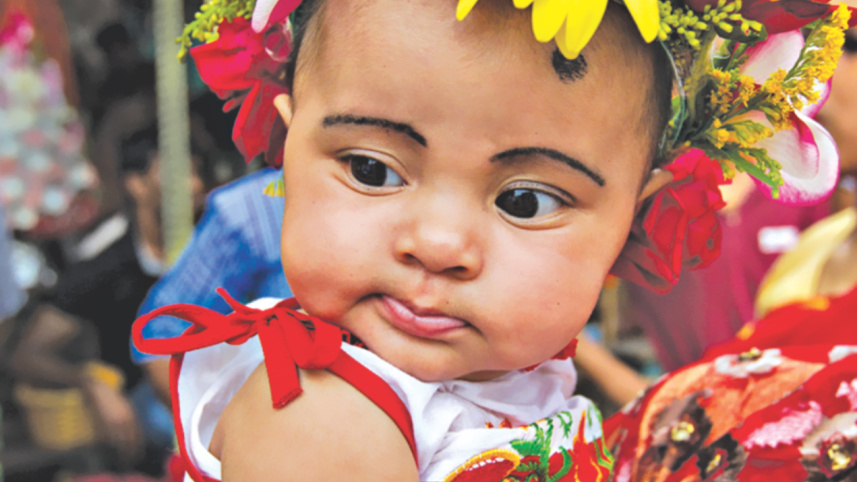
Like other years, I was at Shahbag early morning on Pahela Baishakh with my camera. The festive spirit and colourful attires are simply irresistible to me. I wandered through the crowd and photographed people of all ages and walks of life. Most of the revellers had invested considerable effort into dressing up in a carefree yet elegant style for the occasion.
A chubby baby, about a year old, was being carried by her mother. If there ever was a Baishakhi Princess she was the one. She wore an elegant red-and-white short-sleeved top. Her eyebrows had been lined. The crown of flowers on her head, highlighted by a large yellow sunflower half the size of her face, was striking. But the real reason she was a princess was because of her expression. She maintained a distinctly regal pout while surveying the world imperiously.
 For all latest news, follow The Daily Star's Google News channel.
 Nearby, an older girl, perhaps seven or eight, was wrapped in a rainbow-coloured sari tied tightly around her waist. A set of bangles hung around her wrist. Her cheeks said "shubho noboborsho" and "1222" in crimson paint. Her hands were decorated with henna and her forehead had a red dot.
Even among all the colours, the little boy stood out as he walked hand-in-hand with his father. That's because he wore a crisp white dhoti with a patterned red border. Near the lake, a short-haired girl walked with her mother; each was engrossed in the other's company. The girl's red and white blouse sported a "Barbie" patch. Compared to other women, her mother was dressed simply in a multi-coloured salwar-kameez, but that did not detract from her enjoying these precious minutes with the child.
The face painters were out in full force. Holding paint palette in one hand and brush in the other, they deftly painted the cheeks of women and children with words and pictures. A vendor peddled yellow and red gamchas, dangling some from his hands while stacking the remainder of his stock atop his head. A group of customers surrounded the bangle-seller who was doing brisk business. Meanwhile, a tokai girl, who was busily filling her bag with discarded bottles, had stopped dead in her tracks. She had found a kaleidoscope while poking through some discarded items. Looking into it, she entered another world for several minutes, oblivious to the merriment around her. The tokais too had put on their nicest clothes for the occasion.
Two sisters, about five and seven, wore intricate red and white headcovering (hijab). The older shied away from my camera, but the younger one posed gracefully.
Women of all ages had dressed up, some very elaborately. But that did not mean adornments could not be added! Many stopped at the row of flower shops across the museum. There were flower crowns for the head, jasmine garlands to spiral around braided hair, bangles for the wrists and flowers to wear behind their ears. After the purchase, their friends or spouses helped them wear it, right then and there.
A new style of punjabi with embroidered design around the collar and chest was popular among men. Some men wore gamchas around their head. Other fashion props included masks, hats, coloured umbrellas and sunglasses.
Once again, the first day of Baishakh had brought out the stylish in each of us.
www.facebook.com/tangents.ikabir.
Comments