


The quiet burden of love: Silence, separation, and the lives unfulfilled in Tagore
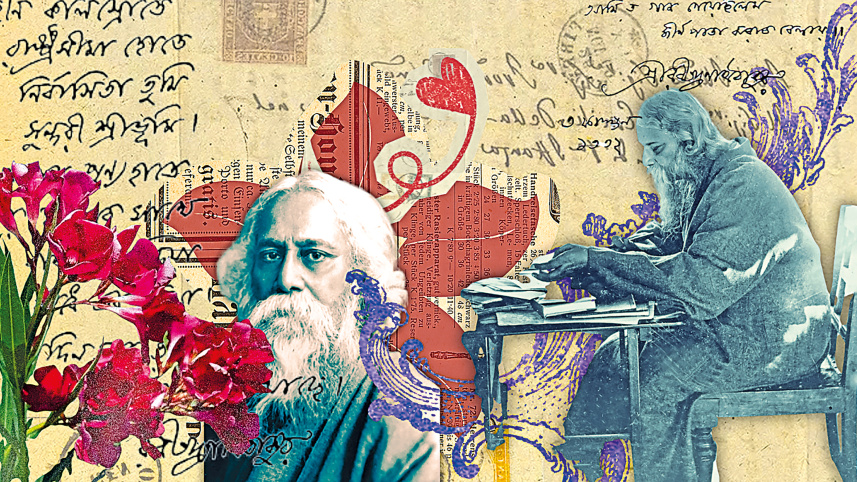
To read Tagore on love is to understand that romance in his world is rarely free. It is always brushing up against something—a family’s expectation, a society’s silence, a lover’s indifference. He does not write love stories so much as he writes what happens to love when the world gets in the way. And yet there is something luminous in these short stories. In them, he achieves something rare: the ability to hold the entirety of human life within a few pages. Yet in these short slices of life, romance arrives in two forms. There is the love for nature—vast, spiritual, almost silently sacred. And then there is the love between people—more fragile, more earthly, and far more painful.
It is this second kind that lingers. There is pining and yearning. There is hesitation in each turning. There are feelings that never find the right moment to be said, and silences that end up saying everything. Subha’s eyes say everything her tongue never could. Charulata’s heart wakes slowly to its own loneliness. Haimanti’s love grows smaller and smaller inside a house that never wanted her. Even Anupam—a man who could not hold on to love when he had it, not because he did not feel it, but because he did not know how to fight for it. Shurbala in “Ekratri” (1892) meets a love that comes only once and leaves just as quietly. That particular ache runs through Tagore’s short stories like a quiet current. He tried to investigate love and romance both inside and out of the institution of marriage, and the vantage point of society and its written and unwritten norms.


In “Subha” (1893), Tagore places love at the edge of language, where it must find other ways to exist. Subha, being mute, grows up outside the usual exchanges through which people recognise and return affection. What she cannot claim among humans settles elsewhere. The river, the shifting light before a storm, the cattle she tends, the small animals that gather around her—these become part of a world where she is neither questioned nor set aside. It is not that she turns to nature out of choice. It is that, here, she is not made to feel incomplete.
There is a kind of intimacy that forms when one is left out of ordinary belonging. Those who are not heard often learn to read what does not speak back. Subha’s attachments deepen in this way. Her only human companionship comes in brief, almost incidental moments with Pratap, during fishing. It is a space where silence is not a lack but a necessity, and in that shared stillness she finds, perhaps for the first time, a sense of being included, and ever so, expected. Yet even here, the feeling does not carry the same weight for him. What forms in her remains unrecognised on the other side. When she is taken away to Kolkata for marriage, something unsettled begins to take hold within her, a feeling she cannot quite name. It carries the weight of yearning, and also something that, in Bangla, we would simply call obhimaan: a tender, unspoken hurt that comes from feeling deeply and finding no answer in return. She does not simply resist leaving. What troubles her more is that what she feels has no echo. Subha, who has always spoken through her eyes, must now carry this unreturned emotion within her, where it remains, shaping a silence that now holds both love and loss.
What remains after “Subha” is a question that lingers. What happens to love when it is never spoken, never returned, or never even fully understood? In some lives, it exists as a bittersweet memory—a mild crush to share with grandkids, or a passionate memoir of a heartbreak. But sometimes, it does not disappear. It returns, at a time when one has already moved too far ahead to hold it, which was portrayed in “Ekratri”.
In “Ekratri”, the narrator and Shurbala begin as childhood companions, sharing a closeness that had no name at the time. The narrator moves on, drawn into what time demands of him, into questions of identity and purpose, leaving behind something he does not yet know he will one day need.
Years later, when life begins to feel uncertain again, when the sense of self no longer sits firmly in place, memory brings him back to what he had left unresolved. On a storm-filled monsoon night, he meets Shurbala again. The world outside is restless, and that unrest seems to mirror what has remained within them. She now belongs to another life, one that cannot be reversed or reached. Yet in that brief meeting, something long left behind comes into full view.
Tagore does not turn this into fulfillment. Instead, love and romance remain as understanding. The narrator sees, at last, what his life had been moving past all along. What stands before him is not possibility, but a form of realisation shaped by timing itself. By morning, they part, unchanged in circumstance. What remains is the knowledge that this feeling had always been there, waiting, and that he comes to recognise it only at the moment when time no longer allows it to belong to his life. Some would call this a closure, others would simply choose to name this as a wistful memory.

This idea of delayed recognition and misplaced affection continues, but in a more entangled form, in “Protibeshini” (1900). The two closest friends fall for the same widowed neighbour girl, albeit unknowingly. Both of them have their distinct philosophy and approach to love. One of them, the protagonist, yearns for her internally and prefers to preserve his reverence like worship, while the other is more straightforward in his approach. The protagonist has some acumen in poetry, so the poems the other friend writes for her often carry his influence in words and letters, unbeknownst to him about where they are eventually directed.
In a tragic irony of fate, the protagonist finds the identity of his friend’s muse to be the same as his own enchantress, but it is rather too late to reveal that. He does not know who to blame, his inertia, his friend, or the god of love.
Apart from the common love triangle trope that we are so accustomed to and maybe experience in our own circles, this story also talks about widow remarriage and presents theoretical conversations and arguments swiftly inside the narrative, with a yearning that is confused between the right course of action. In this space, love is not a simple attraction; it becomes something that struggles against social permission, especially in the case of a widow who still carries the possibility of life, memory, and desire, even when society has already marked her past as closed.
Here, Tagore portrays love and romance as something deeply entangled with hesitation, ethics, and timing. Across Rabindranath Tagore’s short stories, love itself seems to shift alongside the changing social realities of his time, where questions of marriage, widowhood, and personal freedom and agency were slowly entering public thought. Yet across these stories, we also notice how often women love within enclosure and boundaries. Their longing runs as deep as men’s, yet their choices are rarely as free; they endure, hesitate, and sacrifice far more often than they act. Perhaps this reflects the social world Tagore was rendering, though some have asked whether even his sympathy remains touched by a male way of seeing. Or wonder whether it reflects, in part, his own vision of womanhood, where women’s suffering and resignation sometimes seem almost expected. Even so, he makes that suffering impossible to ignore. Their silences wound us so deeply that they begin to feel less like submission, and more like a cry for another world.
In Rabindranath Tagore’s short stories, the purpose of love is not possession, nor fulfilment, but the act of loving itself, a state that moves beyond desire, beyond the hunger to hold. Love, in his world, does not ask to be completed. It asks only to be experienced, to be lived in its own unfolding.
Though his characters breathe through very human emotions, yearning, hesitation, separation, regret, Tagore lifts love gently away from the limits of the human hand. It becomes something inwardly vast, where feeling matters more than outcome, and presence matters more than possession. This is why his lovers often come close, yet never arrive. Life holds them only up to a certain edge, and beyond that, something invisible pulls them apart again. It remains as it is, unfinished, unspoken, carried intimately like something sacred that does not need form to exist. In this way, Tagore’s idea of love finds its final shape, not as completion, but as something preserved beyond reach, almost touched by the divine.
Mahmuda Emdad is a sub-editor at Star Books and Literature.
Abdullah Jubayer is a literature and philosophy enthusiast burdened with worldly affairs.
 For all latest news, follow The Daily Star's Google News channel.
Comments