


Anxiety, unmarriedness, and ‘An Eye and a Leg’
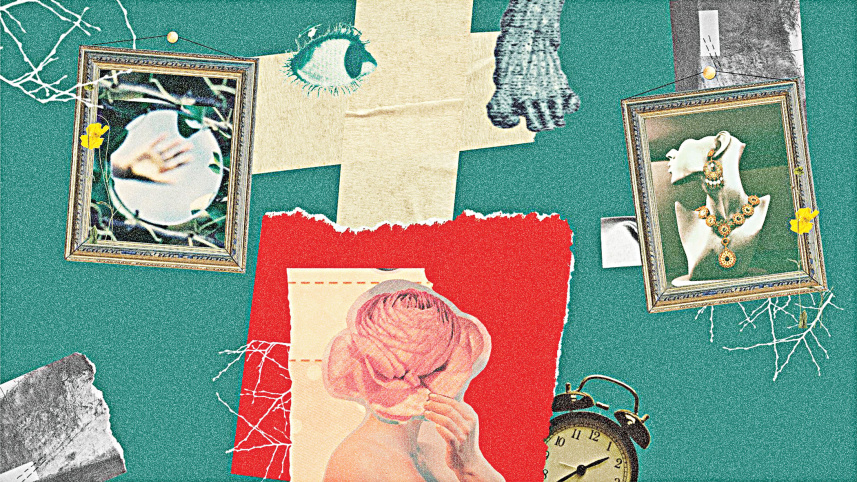
Anxiety as an emotion is revelatory of not only individual fears, but structural ones. Faria Basher’s “An Eye and a Leg” (Granta, 2025) touches upon a severe anxiety in Bangladeshi consciousness—that of the unmarried woman.
The unmarried woman in the current Bangladeshi landscape is an identity that fits uneasily into the preexisting slots, if at all. Discourse online and offline are rife with comparisons of women with inanimate objects that rot if left unconsumed. That the figure of the women is likened to these is not revelatory of the state of the women, but the ecosystem that marks her as such.

The rush to get women attached to a man, and subsequently the man’s family and lifestyle, is clothed in statements that show concern, urgency, and for some, threats of perpetual loneliness and societal abandonment. But it may well be this very socially enforced anxiety, often bordering into paranoia, that is maybe the very thing being joked about here.
I feel compelled here to say that of course happy marriages exist. Yet, it is necessary to also admit that marriage, at least in the form it continues to exist today, is not only a purposefully intense display of dominant heteropatriarchal norms, but a regulation mechanism that relies on women’s continued commodification.
For one, the protagonist seems to be in a family without financial anxieties. She also has her own income from her music lessons, even if there is no indication that there is no connection to an institution. This freedom from financial constraint is of great importance if we consider that economic burdens loom large in the life of many people today when marriage comes into consideration. So, Basher’s choice to have a narrator simply wake up sans one eyeball and eventually a leg that begins rotting, becomes the impetus behind her family frantically searching for a groom.
In contrast to the often arbitrary (but presented as catastrophic) reasons to get married, the surreal circumstances of the narrator’s sudden disability becomes a genuine corporeal crisis, one that would actually lead to her death.
Thus, in the creation of this strange disorder that results from a lack of marriage, Basher gives a corporeal realism to the anxiety expressed at the state of women simply disengaging from marriage. In doing so, Basher situates the anxiety in a comparative lens which exposes the unfounded baseless nature of the anxiety directed toward young women who have nothing to lose from staying unmarried, unless of course the society disallows this through explicit and implicit tactics.
The narrator’s condition comes in like a cosmic punishment. There appears to be no human source of her predicament. Yet, it is her unmarried state which is proffered as the reason for her illness, both by relatives who blame her parents, and medical professionals. The reactions to her grim prognosis mirrors the reactions women receive in real life, even when imminent untimely death is not an issue. And much like the fate of many Bangladeshi women, the once semi-independent narrator with a content life becomes forced to rely on a man to continue staying alive. In both the fictional and the real life case, the result is this: the woman’s status in the current sociopolitical matrix is preserved and reproduced as she falls within the control of her husband.
Anxiety as an emotion has a high epistemological cachet. It is revelatory of where we believe lie the weaknesses of the structures we have come to be comfortable with. Any deviation from perceived norms causes not just the realisation that there is an arbitrariness to the rules we follow, but that they may be dismantled by human efforts. It also reveals, much to the discomfort of many, that their commonplace socially sanctioned anxiousness may not have a firm rational basis.
I feel compelled here to say that of course happy marriages exist. Yet, it is necessary to also admit that marriage, at least in the form it continues to exist today, is not only a purposefully intense display of dominant heteropatriarchal norms, but a regulation mechanism that relies on women’s continued commodification. Basher’s text, in being a story that simultaneously utilises corporeal horror and absurdity, reveals the psychological hold a custom such as marriage continues to have in contemporary Bangladesh, despite the many unpleasant angles it comes with.
In one of the most on-the-nose moments of the text, Basher’s narrator is taken to the “marriage market”, a place in a mall where women of varying ages and conditions are placed as products with a price tag on them. The narrator is priced at a discount, and sold to the third interested man.
This pricing of women has parallels in the material woman. The search for a serious partner often leads to a calculation of the self. Questions ranging from salary, status, education, age, physical attributes, and the like become variables that determine not only how much of a high valued partner one can get, but also the “furniture” a family can ask for.
In the text, the narrator’s life with her husband, though not one of blind bliss, is one she can adjust to and feel a degree of contentment in, at least at the initial stages. It devolves, however, as many marriages do, with the husband being irritated at the minutest inconveniences, including even parts of the narrator that he had admired before. Her harmonium playing, which was one of the primary reasons for his interest in her, becomes one of the irritants, and the narrator eventually loses out on a source of income as she begins to revile the idea of having students over when her husband is so impatient.
The unhappiness at such a marriage causes the narrator to announce to her mother that she will leave, even if it means she will no longer be alive. That decision, however, never needs to be made as the husband (now former) brings in a new wife and asks her to leave. The story ends with the narrator leaving, her last words being “The next morning, and for the rest of my life, I stood on two legs, and looked at the world through fresh eyes.”
The metaphorical and literal meanings are obvious, but the implications require analysis, for the text ends by including how the experience has very likely altered how she sees the world post-marriage and post-separation. It is these “fresh eyes” which are so lacking in society, for the psychic hold of marriage as an institution continues to distort thinking and disallow new ways of living. Should an outsider observe the urgency with which we enforce marriage by listening into our most vulnerable and intimate discussions, one would think there is a belief that marriage holds some sort of magical quality to it. History provides one answer for how it has come to be this way; mass anxiety’s sociocultural permeation offers another. It thus makes sense why Basher’s story of an absurd, near surreal circumstance makes way for an easier critique of an institution that continues to demand more of women who already shave off parts of themselves before they exit singlehood. The story can thus be seen as a commentary on anxiety as a mechanism for control.
Anxieties, much like the parties in a marriage, have rankings. Some are given the status of being absurd, while some are elevated to the rank of such importance that deviation from a path elicits fear so immense that it produces actions some individuals would not otherwise partake in. In the case of marriage, the anxiety ranks alongside events such as birth and death. This isn’t surprising if we consider that much like some other cultures, we believe that of the things that can never be avoided, marriage is one of them. This unfortunately common belief leads to marriage being treated, even if it is not admitted, as some kind of magic. If we think with honesty for an instant, we will be able to conjure up the many times marriage is proffered as a solution for problems that require systemic support and funding, for the things marriage can supposedly cure include depression and anxiety to a person’s drug addiction problem and violent behaviour. Maturity and betterment, they say, will come after. Marriage, however, must take place, even if body parts don’t disappear in the middle of the night.
Aliza Rahman is a writer and lecturer based in Dhaka.
 For all latest news, follow The Daily Star's Google News channel.
Comments