


Witnessing Alzheimer’s through Ernaux’s unflinching prose
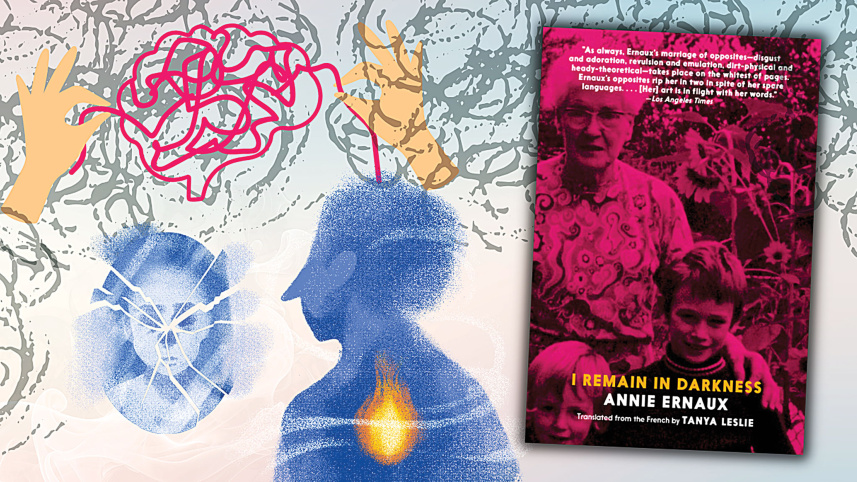
Memory is the bedrock of human existence. But what happens when that bedrock begins to crumble and a loved one starts to fade away? In I Remain in Darkness (originally Je ne suis pas sortie de ma nuit, translated by Tanya Leslie), Annie Ernaux offers a raw, unflinching, and deeply poetic exploration of this existential crisis. This work is a stark, intimate diary documenting her mother’s final years as she succumbs to Alzheimer’s disease. It is a profound meditation on how we navigate the inevitable dissolution of those who once defined our world.
Annie Ernaux, the 2022 Nobel Laureate in Literature for this work, stands as a formidable pillar of contemporary French letters. Her mastery of autofiction—a genre that deftly fuses autobiography with sociological inquiry—has redefined the parameters of personal narrative. Her prose is characterised by an aesthetic of l’écriture plate (flat writing), a disciplined, minimalist style that eschews sentimental artifice. By stripping away emotional hyperbole, Ernaux achieves an objective clarity that compels the reader to confront the unvarnished brutality of reality.

The narrative centers on the intimate and heartbreaking dynamic between the author and her mother. Before the onset of dementia, her mother is depicted as a woman of immense strength, vitality, and intellectual independence—a bedrock in Annie’s own life. The narrative follows the chronological erosion of this identity. We witness the mother’s transition from a sharp-witted matriarch to someone trapped in the fractured reality of cognitive decline. Ernaux documents the transition with profound honesty, recording mundane hospital visits, the confusion in her mother’s eyes, and the surreal conversations that signify the slow erasure of a shared history. The title itself serves as a haunting refrain, encapsulating the claustrophobic darkness of the patient’s psychological abyss and the lingering, spectral grief of the daughter who is left to bear witness to the irreversible eclipse of a loved one’s personality.
To engage with this work is to commit to an act of profound emotional endurance. Ernaux operates with a surgical precision, meticulously peeling back the layers of grief and social taboo that typically cloak the decline of the elderly. From a pedagogical standpoint, this narrative offers several vital lessons. It explores the ethics of observation, teaching us that witnessing a loved one’s suffering requires a unique kind of courage—the courage to look directly at the pain without seeking refuge in denial or cliché. It also confronts the fragility of identity, forcing the reader to realise that our personalities are tethered to our memory, and that our duty to the elderly is a fundamental extension of our own humanity.
In my view, the sheer brilliance of this narrative lies in its refusal to offer solace. It does not promise a redemptive arc or poetic closure, which makes it feel dangerously real. Reading it was an exercise in radical empathy. It forced me to interrogate my own fears regarding mortality and the permanence of human connection. The prose is sparse yet evocative, demanding a high degree of intellectual and emotional maturity. It is a work that does not just impart knowledge; it alters the reader’s perspective on the transient nature of existence.
I Remain in Darkness is not merely a memoir; it is an archeology of loss. It stands as a testament to the inescapable decay of the mind and the stoic courage required to observe it. Through her stark, incisive narrative, Ernaux does not merely recount a death; she illuminates the complex interplay between love, oblivion, and the persistence of memory. Ultimately, as we close this haunting testament to the fragility of the human soul, we are left to ponder an unsettling question: when the final light of memory is extinguished, who are we if not the stories others choose to remember for us?
Rawan Mahzabin Sami Kamal is a contributor.
 For all latest news, follow The Daily Star's Google News channel.
Comments