


A beginner’s guide to ‘Khwabnama’
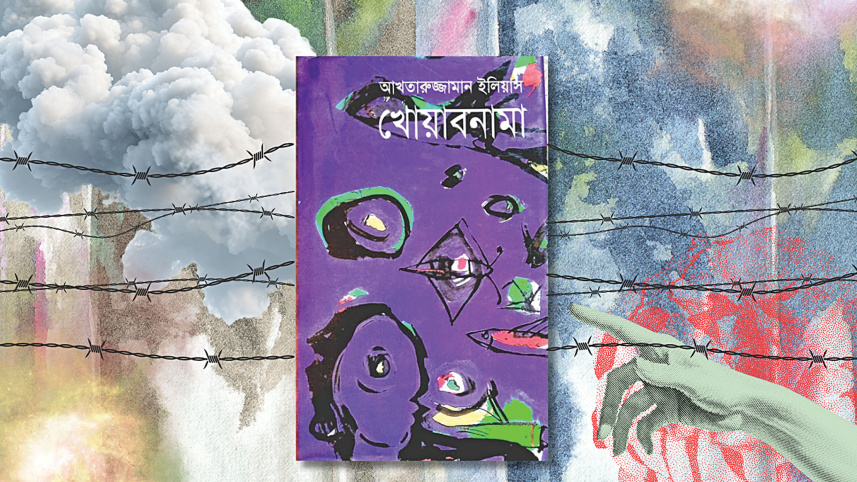
In the year 1996, just a year before his untimely death, Aktaruzzaman Elias had published his magnum opus, Khwabnama. When I picked up the magnificent book, I hardly found any accompanying materials or book reviews on the internet that would help me navigate this complex dream narrative. While the book, written in a postmodern style, is filled with surrealistic dream sequences, it has a complex narration, intertwined with partition politics, national history, revolutionary ideals, and the representations of rural Bangladesh. The absence of supplementary reading materials makes the difficult task of reading Khwabnama even tougher, and this essay precisely aims to work as an introduction to that absenteeism.
Ahmed Sofa had declared Elias’s landmark novel as an “epic, an epic of defeat, but most definitely an epic.” Later, scholars like Hasan Al Zayed had argued (2021) to reframe Khwabnama as “the Bangladeshi Epic”. Amid such scholarly engagements to situate the novel in the stage of world literature, the only English translation of the book by Arunava Sinha (2021) has already been out of print, and the Bangla original is still lurking in only one badly printed edition by the Mowla Brothers. A version with an extremely small font and spacing, spanning almost 40 lines per page. While the available Bangla edition is 352 pages, the work would easily surpass 550 pages in a standard printed edition.

The novel presents a unique selection of characters ranging from feudal zamindars, historical leaders, to the rural landless peasants. The story is complemented by a group of eccentric locals and poets, such as Boikunthu, Keramot Ali, and others, who evoke occasional relief in the complex historical narration.
In structure and style, Khwabnama follows the features of postmodern storytelling; the spirit of the novel is historically grounded in the colonial resistance movements of Bangladesh. The narration is not exactly linear; it is rather complex, and it unfolds in a collage of fiction, poetry, dream sequences, and historical accounts. The timeline roughly follows from pre-Partition to post-Partition Bangladesh (then East Pakistan), with occasional flashbacks from the revolutionary colonial past. Rather than presenting any characters at the centre, the narration of Elias presents a complex web of interconnected stories, interrupted by a series of dream sequences, magic, fantastical elements, and historical facts in the background. Written in an epic prose style, the novel captures the language and cultural cosmology of rural Bangladesh in its glorious past.
The setting of Khwabnama presents a rural community of pre-partition Bangladesh, and at the center of the dream epic lies an enormous, untamable marsh known as Katlahar. Two communities live encircling the marsh: Girirdanga, the village of the farmers, and Nijgirirdanga, another of fishermen. A mysterious fig tree stands on the north edge of the marsh. The old tree is the home to a fiery deity, Munshi: a historical figure of Bengali colonial resistance, who has become a local legend. It is said that the fish of Katlahar marsh are commanded by Munshi, and in his command, the fish of the lake turn into sheep and come out of the lake to graze in the open fields. While the fiery deity Munshi is mostly unseen by the local people, sometimes people see him resting on the top branch of the fig tree. Such an eccentric character is Tamizer Baap, an elderly fisherman and the son of Baghair Majhi, a local legend of Nijgirir Danga. Baghair Majhi was said to have caught Munshi’s largest Devil Catfish from Katlahar Lake, and from the onset of the novel, we find Tamizer Baap becoming obsessed with the deity Munshi and searching for him and his white fig tree, even in his mysterious sleepwalks.
Tamizer Baap, Tamiz, and Kulsum are a local fishing family who become an intricate part of the magical realist narrative. The family of Tamiz lives in a thatched hut in Nij-girir Danga village. Although they are poor, the family is rich in cultural and spiritual vibrancy, having a rich tradition. Kulsum is the granddaughter of the mystical Baul, Cherag Ali, who, through his songs, recounts the lost history of Munshi. In his torn-out pouch, Cherag Ali carries an old, archaic book known as the Khwabnama, a book that carries the interpretation of dreams. Swayed by Cherag Ali’s mystical songs, Tamiz er Baap becomes his dedicated yet eccentric disciple. He ends up marrying Ali’s granddaughter, Kulsum, and comes to possess the archaic book. He is one of the few people who can somewhat communicate with the deity Munshi and also possesses the ability to interpret dreams at times.
Young Tamiz has rather an unsettling relationship with his father and stepmother, Kulsum. Although born in the fishermen’s community, Tamiz has a creative brilliance in harvesting. He is fervently connected to the land. While he does not possess any land, he shares his crops as he works on a lease for the local “jotdar”, Sharafat Mondol, and Tamiz dreams of acquiring his own land, one day.
Awed by the series of picturesque chapters, I found the novel describing in detail the passionate harvesting of Tamiz against the soft earth that finally sprouts up to be the golden and lofty paddies. Beginning from ploughing the land to sowing the seeds to the festival of gathering the new rice grains in the granary, the book illustrates the rural farming life of Bengal. The hardworking Tamiz, pursued by a small dream, is manipulated in the intertwined web of partition politics and becomes attached to the independent movement of Pakistan, and ultimately finds himself in police custody.
The novel presents a unique selection of characters ranging from feudal zamindars, historical leaders, to the rural landless peasants. The story is complemented by a group of eccentric locals and poets, such as Boikunthu, Keramot Ali, and others, who evoke occasional relief in the complex historical narration. The local landless farmers and fishermen are heavily influenced and manipulated by the idea of liberation by political opportunists such as Abdul Kader, Ismael, and Kalam Majhi, who preside over their own economic agendas. In the name of nationalism, they influence the Hindu-Muslim divide, and an array of chapters document the visual, bloody, and horrendous riots around the entire community.
Two movements must be considerably kept in mind while reading Khwabnama. First, the India-Pakistan partition, which was followed by the split of the Congress and the Muslim League. Secondly, the Tebhaga movement, a revolution advocating for the sharecroppers that was led by local communist leaders, a movement our author, Elias, himself admired. Tebhaga aimed for the workers’ benefit, which propagated that the farmers should own two-thirds of the share of their crops. The nationalist partition, manipulated by personal and religious agendas, had overshadowed the Tebhaga, and the local political leaders had betrayed the rural peasants, the farmers, and the fishermen. Recounting the 1943 Famine, the fake political promises, and the religious riots followed by the partition, Khwabnama, in sheer pessimism, shows us how, in the false promise of workers’ independence, the Tebhaga movement lost its path to practice. It shows the paramount vanity of nationalism and the idea of an unsettling Pakistan.
I believe Elias’s vision was to connect the broken bridge of Bangladeshi culture to the revolutionary and glorified past of the nation. In magnificent language and style, the novel is intended to distinguish Bangladeshi from Bengali. It reimagines the anti-colonial resistance of lost Bengali heroes like the saint Bhobani Pathok and his army. Presenting a wide range of historical documentation, expressed with the fantasy of magical realism, the novel helps to situate the story of our ancestors and how we came to be. At the end, one can say Elias’s Khwabnama is a postmodern amalgamation of fractured Bangladeshi cosmology that has been constantly intervened by the arrival of colonial, partition, and post-partition politics.
After four months of active reading, annotating, and jotting down historical backgrounds on my notepad, I had finished reading this enormous work. As I folded the last page of Khwabnama, with a revelation of relief, a quiet sign of despair had also overcome my emotions. The epiphany trailed from relinking my ancestral Bengali identity to my fractured Bangladeshi present that had been realised through the labour of reading this magical world of dreams, but also, in quiet grief, I realised that never again will I experience the hauntingly beautiful task of reading the Bangladeshi dream epic for the first time.
K.M. Arefin is a writer, poet, and a translator. He works as a faculty member at the Bangladesh University of Professionals and is a researcher of Postcolonial Literature and Translation Studies. Reach him at khanmohammadarefin@gmail.com.
 For all latest news, follow The Daily Star's Google News channel.
Comments