


A humanist in the age of AI

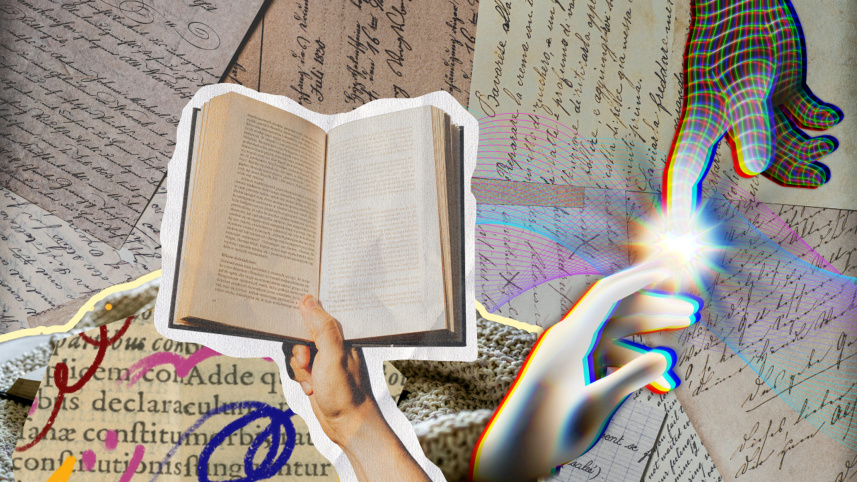
For centuries, literature asked us to believe that language is more than information, that it’s a rich repository of history, memory, grief, longing, humour, silence, and entire ways of seeing and making sense of the world. Literary translation asks us to believe something even more difficult, that these things can survive the crossing into another language. I’ve spent years studying and teaching literature, translating Bengali works into English, and believing that every translation demands not merely linguistic prowess, but intercultural sensitivity, an intimacy with two worlds, ethical responsibility, and of course, creative intuition and translatorial intervention.
Yet I find myself working in a capitalist landscape where the arts and humanities must justify their existence and where creative labour is evaluated based on whether it can be done more cheaply, more quickly, or more efficiently by AI. Not for a moment do I believe artificial intelligence can replicate the human experience that gives birth to literature or the profoundly human act of literary translation. What I fear instead is that many institutions, publishers, producers, and clients no longer care enough about the distinction between human creativity and machine-generated output. The overall winner of the 2026 Commonwealth Short Story Prize was allegedly an AI-generated piece. Nobel Prize winner Olga Tokarczuk admitted using AI to develop ideas. A member of my cohort in the University of Iowa’s MFA in Literary Translation program was commissioned to produce a short sample translation of a Finnish novel, only to see the completed English translation be generated by AI. Filmmakers no longer require professional subtitlers. Across industries, efficiency is rewarded while craftsmanship is treated as unnecessary extravagance.

How many literary giants would have remained strangers to us without the invisible labour of translators? Would the world have embraced Gabriel Garcia Marquez as it did without Gregory Rabassa’s extraordinary English translations? In a more local context, would Rabindranath Tagore have become the first non-European Nobel laureate in Literature had he not translated Gitanjali into English himself? Translation has always ensured literature’s afterlife; it has always been one of the conditions of literature’s survival across time and borders — both geographical and linguistic. This should allow readers to remember not only the author whose name appears on the cover, but also the translator who made that literary encounter possible.
As an emerging literary translator, the countless hours spent wrestling with a single sentence or a single word, the labour of listening to the soundscape of two languages, the perseverance required to negotiate syntax, cadence, cultural nuance, and even silence, and the conviction that every translation is an act of cultural stewardship rather than mere linguistic substitution—all of it begins to feel invisible in an economy that prizes production over artistry.
Let me provide examples of the kind of processes a literary translator must go through and let the reader ponder over whether AI would be able to do the same.
In Jibanananda Das’s poem “Beral”, the first couple of lines read:
“Sharadin ekta beraler shongge ghure phire keboli amar dekha hoy:
Gachher chhayay, rod er bhitore, badami patar bhire;”
I translated “badami” multiple times before settling on “peanuty”. Badami is the colour of the reddish-brown flaky skin covering the peanut kernel. In the context of Bangladesh, peanuts are never had raw or boiled; they are roasted, turning the kernel’s skin to a rich reddish-brown. “Auburn” matches the shade but evokes a contemporary hair colour; “burnt umber” or “burnt sienna” feels long and painterly; “chestnut” implies the wrong tree. None capture the playfulness of “badami.” I chose the literal “peanuty,” which preserves both colour and interpretive openness.
The same poem’s final image is quite striking:
“Tarpor ondhokarke chhoto chhoto ball er moto thaba diye lufe anlo shey
Shomosto prithibir bhitor chhoriye dilo.”
In my translation:
then, she scoops up little balls of darkness
and scatters them across the breadth of the world.
Das uses a simile in the penultimate line. A meaningful, grammatically correct structure would be: “then, with her paws, she catches darkness as if they were little balls.” However, I felt that this would read better if turned into a metaphor: “then, she scoops up little balls of darkness” (Note: I avoided the repetition of “with her paws” as it was already used in the previous line). I made the last line more dramatic, so instead of something like “and spread them across the world”, I translated it as: “and scatters them across the breadth of the world.” The verb “scatters” seems more fitting, compared to “spread”. The accurate “spread” implies a smooth, even distribution and that kind of perfection sounds more divine, as if the hand of God is involved. However, with a cat as the subject, a more random, dispersed distribution makes more sense.
Because Bengali lacks gendered pronouns, the cat’s sex remains unknown. Assigning femininity was my own interpretive choice. I avoided “it,” which felt objectifying and ill-suited for a creature who is portrayed not as a pet but as a possibly spectral, self-willed being who plays cosmologically with light and darkness, and appears and disappears with uncanny ease.
I could provide a dozen other examples of the mental processes involved in translating the entire poem, but I hope the aforementioned three will suffice. Would AI arrive at these same negotiations and interventions? Perhaps. Perhaps not. I neither know, nor do I particularly care to find out. My translation is uniquely mine, shaped by my literary sensibilities, cultural experiences, theoretical commitments, and countless acts of hesitation and revision. I have no desire to measure it against ChatGPT’s output. Perhaps my stubbornness is borne of heartbreak—a grief carried by humanists whose creative labour is undervalued in the age of AI.
Still, I write. Still, I translate. To borrow from Maya Angelou, “Still, I rise”.
Noora Shamsi Bahar is a writer, translator, and MFA candidate in Literary Translation at the University of Iowa.
 For all latest news, follow The Daily Star's Google News channel.
Comments