Nayak at 60: Satyajit Ray understood constantly being watched before the age of self-curation

Fame comes with a peculiar cruelty that Satyajit Ray understood better than most who have filmed it -- that the more a man is looked at, the less he is actually seen.
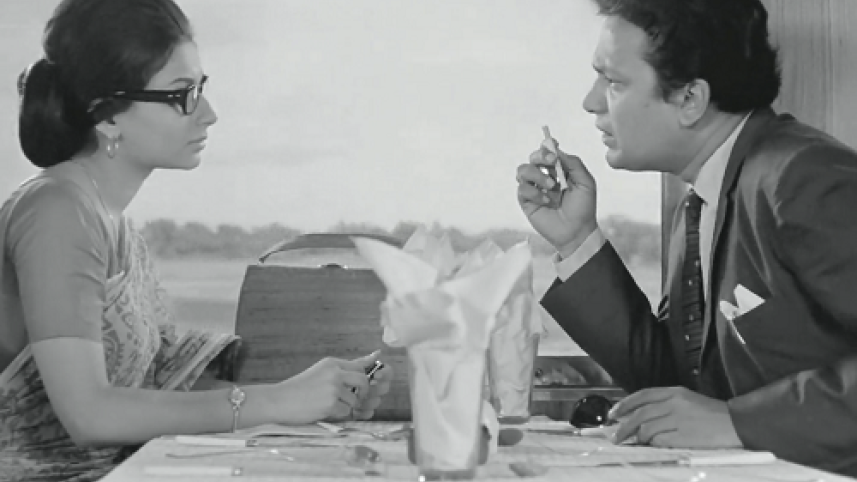
Nayak (1966), featuring matinee idol Uttam Kumar, takes this incongruity and rides it, quite literally, from Calcutta to Delhi, compressing an entire interior collapse into the rattling intimacy of a first-class railway compartment.

On its surface, the premise is almost slight -- Arindam Mukherjee, Bengal's reigning screen god, boards a train to receive a national award, and finds himself, through circumstance rather than design, opposite Aditi Sengupta, a magazine editor too principled to fawn and too curious to look away.
What unfolds over the following hours is not plot in any conventional sense but excavation. Layer by layer, Satyajit Ray strips the “nayak” -- the hero -- of the armature that makes him legible to the public, until what remains is a man who has forgotten how to be anything other than watched.

Satyajit Ray's choice of the train is not incidental either.
A train permits no exit, no retreat to the sanctuaries -- the vanity, the entourage, the adoring crowd -- that ordinarily insulate a star from scrutiny.
Confined to a compartment, Arindam cannot summon his usual repertoire of practised charm indefinitely; the journey simply lasts too long, and Aditi asks too few of the questions he is rehearsed to answer.
Satyajit Ray understood that intimacy is not built through proximity alone but through duration, and duration -- on a moving train -- is inescapable.
The film's dream sequences -- that startling passage where Arindam, sinking in a swamp of currency notes, reaches for his mentor's hand only to be pulled under by the very telephone that summons him to stardom -- are Satyajit Ray at his most unguardedly expressionist.
Bengali cinema had rarely permitted itself such candid Freudian exposure, and Satyajit Ray deploys it not for shock but with precision, mapping the guilt, ambition, and betrayals of friendship and craft that fame has quietly exacted as its price.
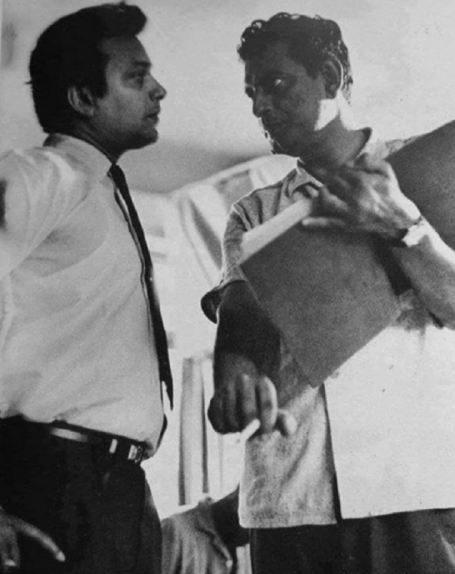
Casting Uttam Kumar -- Bengali cinema’s reigning matinee idol, the Mahanayak himself -- as a screen star in crisis was an act of directorial audacity bordering on provocation.
Satyajit Ray was not merely making a film about stardom; he was asking his era’s most beloved star to expose the unease beneath the image, allowing audiences to glimpse the vulnerability behind the polish they adored him for.
Uttam Kumar's performance, in response, is a masterclass in strategic vulnerability. He plays vanity and self-loathing not as opposites but as intimates, whispering the same doubts at three in the morning.
He registers the accusation -- half-joking, half-wounding -- that he might be nothing without the camera. There is no melodrama in his face, only the slow reckoning of a man counting the cost of becoming who he is and finding that the balance does not quite add up.
Sharmila Tagore’s Aditi is often, and unfairly, read as little more than the vessel for Arindam’s confession -- the sympathetic ear, the moral compass. Such a reading considerably undersells Satyajit Ray’s design.
Aditi is compelling precisely because she wants nothing from Arindam -- not an autograph, not access, not proximity to glamour for its own sake. Her indifference to his celebrity is what draws out his honesty: perhaps for the first time in years, he encounters someone before whom performance has little use.
Satyajit Ray gives her restraint rather than righteousness, and it is this restraint -- her refusal to either idolise or condemn, that makes the confession possible at all.
The compartment and dining car are populated with a Chaucerian cross-section of then-Bengali society -- the sycophantic advertising executive, the cynical old journalist, the young couple starstruck and oblivious to the irony that the object of their adoration is disintegrating three feet away.
Satyajit Ray uses these passengers not as filler but as chorus, each embodying a different transaction society makes with fame: worship, exploitation, indifference, envy. Arindam is, in effect, on trial before a jury he did not choose and cannot dismiss.
 For all latest news, follow The Daily Star's Google News channel.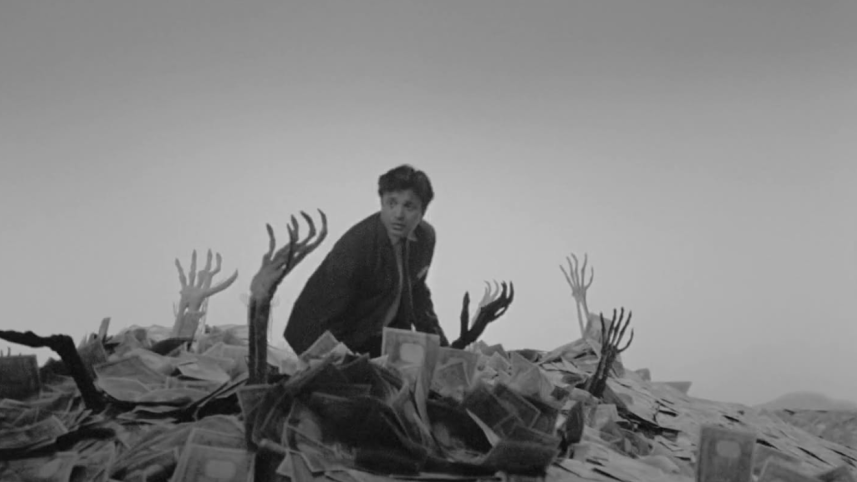
What elevates Nayak above a merely clever premise is Satyajit Ray's directorial temperance. He resists, throughout, the easy cynicism that might have turned this into a simple parable of fame's hollowness.
Arindam is neither a martyr nor a villain; his rise involved genuine talent, real betrayals both suffered and committed, and choices that were human rather than monstrous.
Satyajit Ray’s camera -- patient, unhurried, willing to linger in silences a lesser director might have filled with music -- regards its subject with the clinical compassion of a good physician: unsparing in its scrutiny, but never contemptuous.
Nayak declines the catharsis of transformation.
Arindam disembarks at Delhi still a star, still bound for the award ceremony, still performing, because that, the director suggests, is the tragic condition of the “Nayak”.
Aditi, for her part, chooses not to publish his confession, understanding instinctively that some truths are owed to trust rather than to readership. It is one of Indian cinema's quietest and most devastating endings -- nothing resolved, everything understood.
Six decades on, in an age of manufactured celebrity and relentless self-curation, Nayak reads less like a period piece.
Satyajit Ray anticipated, with uncanny foresight, the particular loneliness of being perpetually observed and rarely known -- a condition our own century has only industrialised further.
Nayak remains what few films about fame ever manage to be: honest about it, without being cruel.
15 years later, Tareque Masud’s last journey still echoes

‘Jaya Aar Sharmin’ among three Bangladeshi films selected for World Film Festival Kolkata

Shakib Khan and Idhika Paul to pair up again for ‘Nissho’?

Mark Ruffalo, Javier Bardem lead artists calling for Gaza ceasefire

Shilpakala Academy to launch regular ticketed film screenings
15 years without Tareque Masud: The filmmaker who lived for cinema

Pop Culture / Samurai Jack and the future we became

‘The Office’ star Lucy Davis diagnosed with stage 4 breast cancer
‘Mastul’ draws overflowing crowd at Shilpakala film festival