


Money talks: Now the machines are listening



For years, City Bank ran on the same rhythm every month: pull the transaction records for more than 30 lakh accounts and cardholders, clean them up, review them, then decide who gets offered what.
By the time an offer landed, the moment behind it had often already passed.

Someone’s large deposit was probably already spent. A change in spending habits came and went without anyone noticing. A fixed deposit (DPS) pitch would show up weeks after it would have actually been useful.
Now that wait is hours, not weeks.
The bank’s new Citytouch platform swaps the monthly cycle for an automated end-of-day pipeline. It refreshes customer profiles overnight and matches new activity to products, such as secured loans, deposits, insurance, and credit cards, with no manual step in between.
“If today’s transactions indicate a financial need, the customer can receive the right recommendation the very next day,” said Syed Ibrahim Saajid, head of digital banking at City Bank.
That is artificial intelligence (AI) at work, and it puts City Bank among the early movers on AI-driven personalisation in Bangladeshi retail banking.
It is not just City Bank either; the whole financial sector is shifting the same way. Small experiments are now turning into everyday infrastructure for banks and other financial institutions.
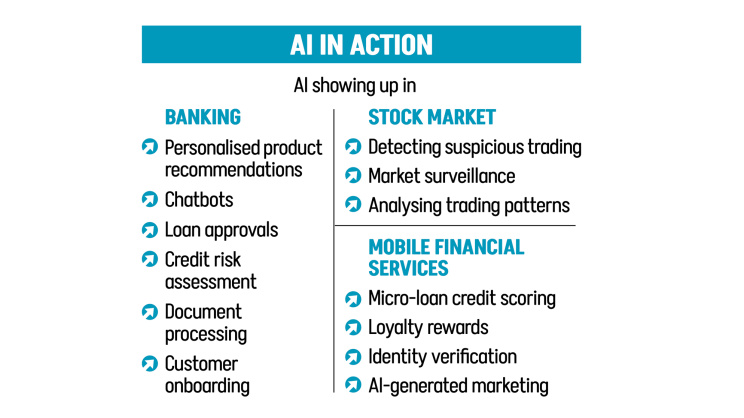
Today, machine learning is assessing credit risk, predicting defaults and recommending products. Large language models (LLMs) summarise reports and draft compliance paperwork. Natural language processing (NLP) tools comb through customer feedback.
AI also monitors transactions in real time for fraud and money-laundering risks, speeds up credit scoring, and enables chatbots to answer customer queries just as effectively at 3 am as at 3 pm.
STOPPING FRAUD
More Bangladeshis banking online means more surface area for fraud, and banks are leaning on AI to catch it before it does damage. While fixed-rule systems cannot keep up, AI can scan millions of transactions looking for patterns that do not fit.
Hassan O Rashid, managing director of Eastern Bank (EBL), said the bank already uses AI to verify faces during digital onboarding -- a way of faster and more secure account opening.
He said AI can streamline back-office operations, support predictive analytics for customer behaviour and business planning, automate document processing using OCR and strengthen fraud detection.
“It also enables banks to monitor anti-money laundering through real-time transaction analysis, and improve cybersecurity by detecting threats, phishing attempts, and abnormal user behaviour,” added Hassan.
Like EBL, Mercantile Bank is doing something similar.
Mati Ul Hasan, managing director of Mercantile Bank, said the lender is folding AI into its digital ecosystem with customer security kept front and centre.
“Our key focus areas include the nano loan platform, where AI is being introduced to enable faster, data-driven credit assessments, and AI-powered fraud detection systems that enhance the speed and accuracy of identifying suspicious transactions,” said the MD.
NCC Bank is taking a similar approach.
M Shamsul Arefin, managing director and CEO of NCC Bank, said AI runs through the bank’s digital roadmap now.
 For all latest news, follow The Daily Star's Google News channel.
 It includes AI-powered ATM surveillance for real-time monitoring, faster incident response, AI-driven e-KYC, deepfake detection, liveness checks and behavioural analytics across its “NCC Always” and “NCC ICON” apps.
Next up, Shamsul said, is trade finance, fraud detection and risk analytics through automated compliance, conversational AI and real-time anomaly detection.
SMARTER LENDING
In the past, deciding who qualified for a loan relied on financial statements, collateral and manual credit checks.
Today, machine learning models analyse transaction histories, repayment behaviour, income patterns and other digital signals to make faster and more accurate lending decisions.
While lending, banks are now getting a wider picture, and they are getting it fast.
Mercantile Bank is putting AI to work in its Nano Loan platform. The bank’s Managing Director Mati said they see AI playing a vital role in improving customer service, risk management, operational efficiency, and financial inclusion.
“Our goal is to leverage AI to deliver smarter, safer, and more inclusive banking services for our customers,” he added.
Eastern Bank also sees AI reshaping the lending process.
EBL MD Hassan said AI can automate credit scoring and loan processing, adding that it also supports predictive analytics for customer behaviour and business planning.
“Banks are using the same predictive models to flag borrowers heading for trouble early, so they can step in before things get worse.”
AI in bank lending is not the whole story, though.
Machine intelligence is quietly automating routine work everywhere -- such as compliance, internal documentation and knowledge management. LLMs summarise reports and draft paperwork so people do not have to.
At EBL, that is spread well past customer-facing work. The bank’s MD Hassan said AI screens CVs during their recruitment, and AI-assisted coding tools help engineers ship faster.
He said the commercial lender sees AI touching nearly every corner of banking -- back-office operations, OCR document processing, fraud detection, AML monitoring and cybersecurity.
At Mercantile Bank, the AI rollout is following phases, with data security and Bangladesh Bank compliance as the priority.
United Commercial Bank (UCB) is taking an even broader approach.
UCB’s Chief Communication Officer Zeeshan Kingshuk Huq said the bank, first in South Asia to run Oracle’s microservices-based, open API core banking platform, now has AI in nearly 25 banking processes, from onboarding through to loan disbursement.
“This cuts manual work and eliminates human errors. The point is not automation for its own sake; it frees our people to build relationships. Banking is a service, and AI lets us focus on customer delight,” he commented.
HELPING CUSTOMERS
For most customers, the most noticeable change is not how loans are approved or fraud is detected, but how quickly they receive support.
City Bank’s call centre fields around 6,000 interactions a day. Its chatbot now handles roughly half of them, about 3,000 queries, with no phone queue.
City Bank’s chatbot runs on an LLM that reads both Bangla and English, understands plain questions instead of fixed commands, and either answers from the bank’s knowledge base or routes the customer to the right place.
“AI offers a multitude of new opportunities in terms of achieving greater efficiency and delivering better customer experience,” said Syed Ibrahim Saajid, head of Digital Banking of City Bank PLC.
“However, it is critical for financial institutions to understand the different risk factors associated with using AI and managing those effectively before opening Pandora’s box,” said Ibrahim.
Mutual Trust Bank is on a similar path with MTB Neo -- an AI chatbot and automated call centre support already live, voice banking coming later, according to its Managing Director Syed Mahbubur Rahman.
Eastern Bank has an internal chatbot for staff now, with customer-facing rollout planned.
“It can power 24/7 customer support through chatbots and virtual assistants, automate credit scoring and loan processing, and enhance contact centres with voice assistants, call summarisation, and sentiment analysis,” said EMB MD Hassan.
Behind the scenes, natural language processing tools are chewing through customer feedback and complaints, surfacing recurring problems and giving staff faster access to answers.
WATCHING THE MARKET
Apart from banks, AI is reaching the capital market too.
The Dhaka Stock Exchange (DSE) is preparing an AI-powered surveillance system to flag suspicious trading, and regulators are pushing it along.
Masud Khan, chairman of the Bangladesh Securities and Exchange Commission (BSEC), has told the DSE to bring one in to help curb manipulation.
But tech alone would not fix it.
DSE Managing Director Nuzhat Anwar said the exchange is upgrading its surveillance platform first. “The main challenge with our current system is that it is not integrated with KYC [know your customers] information,” she said.
“Without KYC integration, we will not achieve the best outcomes even if we deploy AI. That is why our priority is to first build the right infrastructure and enhance the human capacity required to use AI effectively.”
Nuzhat said the goal is AI supporting analysts, not replacing them.
BEYOND BANKS
Mobile financial services are moving just as fast. At bKash, predictive models track customer behaviour to improve retention, and chatbots handle common questions instantly.
“Our recommendation engine analyses user preferences and behaviour to suggest relevant services, improving customer usage and satisfaction,” said chief product and technology officer Azmal Huda.
“Additionally, our AI-based credit scoring models facilitate micro-loan services by accurately assessing creditworthiness, ensuring that customers receive timely access to credit,” he added.
bKash also runs an AI loyalty engine for reward points, and uses machine learning to verify ID documents and faces during onboarding.
Nagad is using AI differently, mostly for content.
Muhammad Zahidul Islam, head of media and communications at Nagad, said the company has cut marketing costs significantly by swapping traditional production for AI-generated content.
He said nearly all its recent campaigns were made this way, with engagement holding steady.
Comments