


Earning trust with every bite

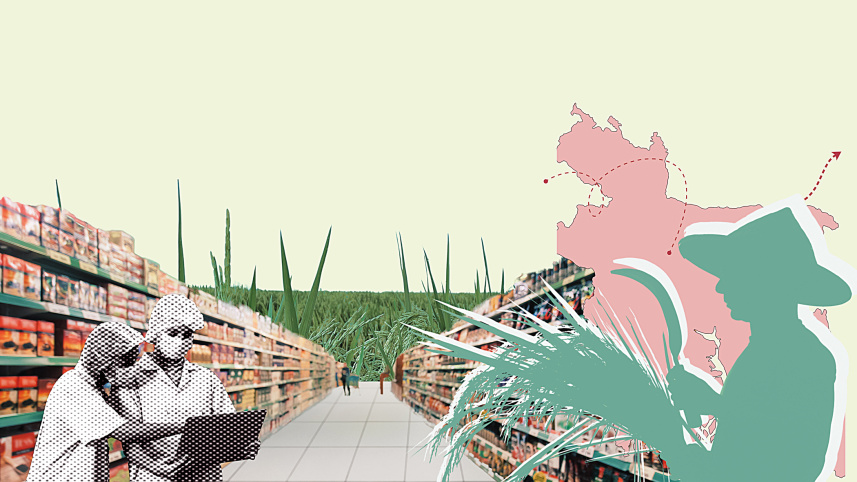
Every packet of frozen paratha, every bottle of cooking oil, and every biscuit on a Bangladeshi shelf carries an invisible history of farms, factories, laboratories, and freezer trucks before it reaches a kitchen. Consumers rarely see this journey, but it decides whether their food is safe, and increasingly, whether they can afford to eat well at all.
Trust Matters More Now

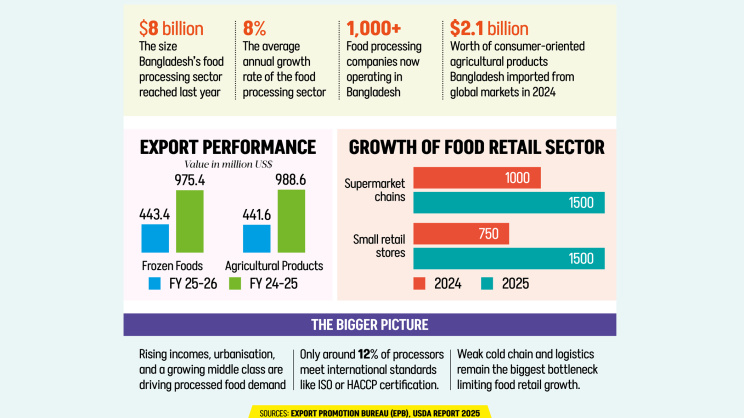
Bangladesh’s food industry has grown at breakneck speed, feeding a fast urbanising population that increasingly buys packaged and frozen food instead of cooking from scratch. Supermarket chain outlets more than doubled to over 1,500 in 2025 from 750 a year earlier, and the sector’s turnover jumped to an estimated 800 million dollars, per the US Department of Agriculture’s latest Exporter Guide. But growth without trust is fragile; one contamination scandal can undo years of brand building. As Tahmina Mostafa, Director of Meghna Group of Industries (MGI), puts it, “scale multiplies responsibility.” Consumers choosing the same products daily are extending trust to the producer, she says, and that trust “has to be earned continuously, never assumed.”
Millions Still Go Hungry
That trust matters even more against a troubling backdrop. A UN report released this month found that 26.2 percent of Bangladesh’s population, or 4.54 crore people, faced moderate or severe food insecurity between 2023 and 2025, while 6.78 crore people could not afford a healthy diet in 2025. The cost of a nutritious diet has climbed from around Tk 108 a day in 2017 to nearly Tk 160 today, and poor nutrition still hits women and children hardest. An editorial in this newspaper has urged the government to stabilise food prices, expand social protection such as the Family Card scheme, and treat food security as more than the absence of hunger. For an industry built on daily consumer choices, that affordability gap is as much a trust issue as contamination risk.
Government Tightens Food Safety
The government is responding on the regulatory front too. Under new Food Safety (Registration and Licensing) Regulations gazetted in July, every business in the food chain, from street vendors to large processors, must now register or obtain a licence from the Bangladesh Food Safety Authority (BFSA). Separately, the BFSA has begun mapping 10.13 lakh food businesses nationwide with the Infrastructure Investment Facilitation Company (IIC), building the country’s first comprehensive database of owners, licences, and business types to improve monitoring and safety training.
Industry leaders have welcomed the intent while flagging execution risks. Kamruzzaman Kamal of PRAN-RFL Group told to the Daily Star that food businesses already answer to 17 different departments, calling the new rules a crowded system rather than a coordinated one. Mostafa Kamal of MGI urged the government to cut regulatory overlap instead of adding to it, since bureaucracy sits at odds with its own promise of a single window system.
AHM Shafiquzzaman of the Consumers Association of Bangladesh said such initiatives, if implemented properly, could finally bring long standing oversight problems under control.
Safety Built Into Production
For established producers, this scrutiny simply formalises what many already practise. At MGI, raw materials from approved suppliers are logged with unique codes that stay linked to the finished product through every stage, Mostafa explains. Kazi Foods Industries traces every product “back to the specific shed the chicken came from,” says CEO Tanvir Haider Chaudhury, whose hens or farm animals are grain fed and raised without harmful antibiotic residue. Both firms run on HACCP, ISO, Halal, and Good Manufacturing Practice standards, with metal detectors, retention samples, and blast freezing protecting products through a cold chain.
The Road Ahead
None of this sits in isolation. Bangladesh now counts more than 1,000 food processing companies in an 8 billion dollar sector growing roughly 8 percent a year, and every part of it, from roadside vendors to exporters, is being pulled toward the same demands at once: tighter registration, cold chain investment, digital traceability, and a hungrier, more price sensitive consumer base watching every taka. For the shopper, none of this machinery is visible. What is visible is a Halal logo, a BSTI mark, a BFSA registration number, or a “best before” date, small signals of an industry under pressure to keep Bangladesh’s food both safe and within reach.
 For all latest news, follow The Daily Star's Google News channel.
Comments