


Meet the girls breaking barriers through skateboarding
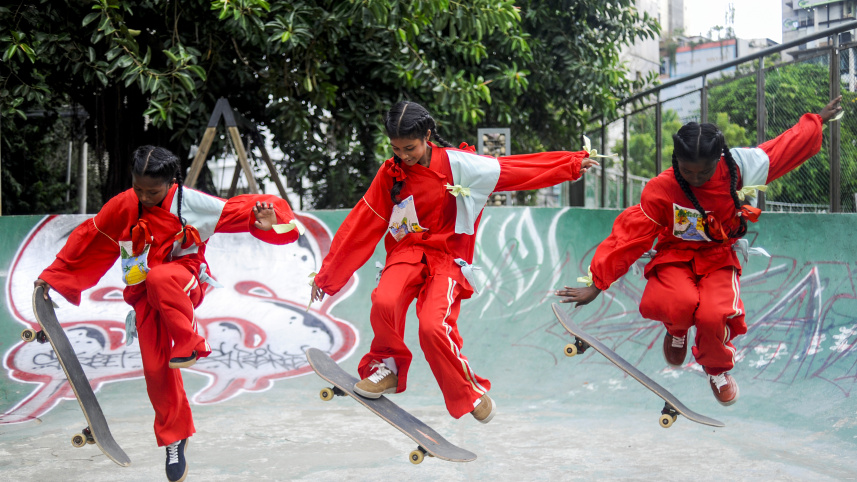
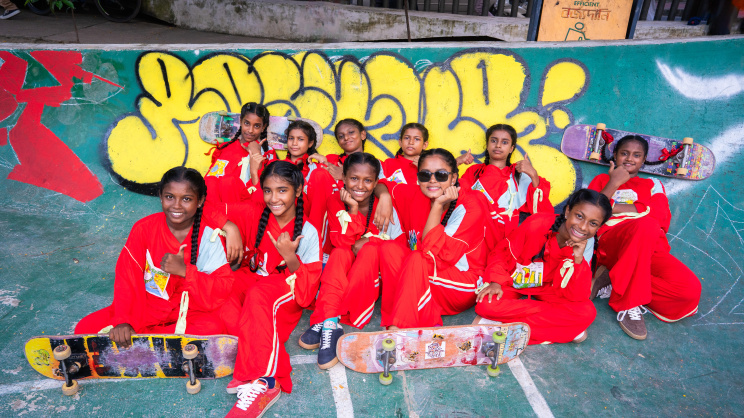
For a group of young girls in Dhaka, skateboarding is about far more than tricks and ramps. It is a way to claim space, build confidence and imagine futures beyond the limits placed around them. At Bangladesh Street Kids Aid, the board becomes a starting point for education, friendship, mentorship and dreams of reaching the pinnacle of success.
The first thing Mim Akter learned about skateboarding was not how to land a trick. It was how to stand on the board without losing her balance. Two years later, the 14-year-old talks less about staying upright and more about how far that board might carry her.

“I have many dreams in skateboarding,” she said.
Mim found skateboarding almost accidentally. A friend, Amena, kept disappearing somewhere after school. Curious, Mim asked where she went every day. Amena told her she went to “play with a board” and invited her along. Mim said yes. That small exchange between two schoolgirls became the beginning of something much bigger.
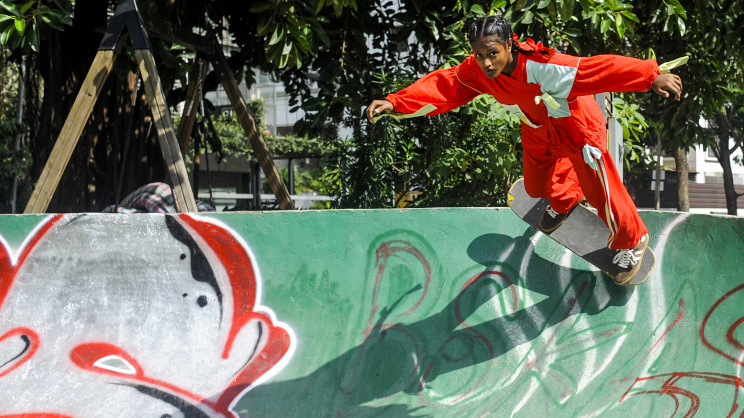
Today, when asked about the old assumption that boys can do things girls cannot, Mim’s answer is uncomplicated: “It’s not just that boys can do everything. We are proving that girls can do everything as well.”
Around her, boards hit concrete, wheels scrape against ramps, someone falls, gets back up, and tries again. In this corner of Dhaka, skateboarding is doing something more interesting than producing skaters. It is giving a group of children a place to belong, an education, friendships, meals and, perhaps most importantly, the audacity to imagine futures larger than those circumstances might have prescribed for them.
At its centre is Bangladesh Street Kids Aid (BSKA), founded by Susie Halsell. But calling BSKA simply a skateboarding programme misses much of the story. Because the skateboard is, in many ways, only the invitation.
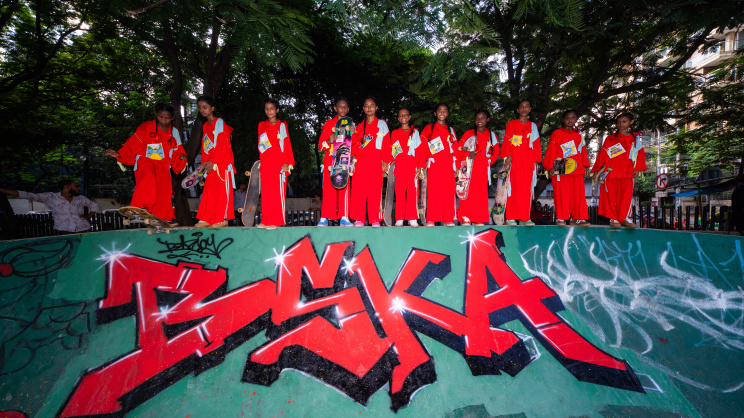
The board is the beginning
Halsell sees something in skateboarding that conventional outreach can struggle to reproduce: equality without formality. On a skateboard, everybody is vulnerable to the same concrete and the same possibility of falling.
For Susie Halsell, that is precisely its power.
She describes skateboarding as a combination of physical activity, creative expression and community. Unlike many competitive sports, there is not necessarily a coach shouting from the sidelines. Skaters develop their own style while encouraging one another through individual progress. A difficult trick is broken down into tiny victories, and those victories add up to confidence.
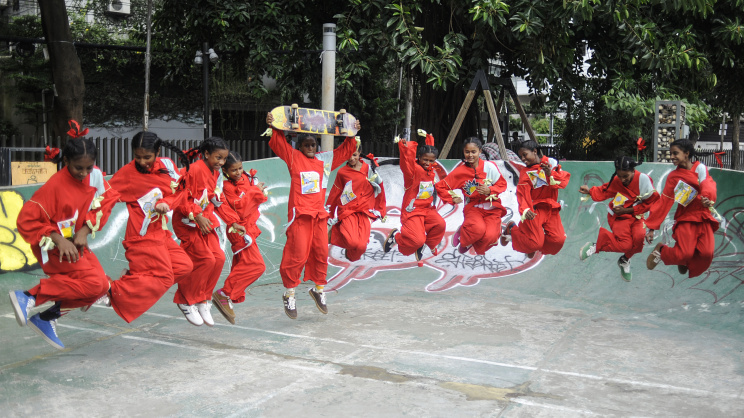
It also works remarkably well as outreach. A skateboard attracts curiosity in a way that an adult approaching a child with a clipboard and questions about their circumstances may not. Halsell says children living and working on the streets have followed her around to watch her skate since she began running skate programmes in Bangladesh in 2007.
“You skate and have fun together, everyone becomes an equal,” she explains.
That sense of equality is visible in the way the children describe the programme themselves. They rarely talk about being “beneficiaries”. They talk about their friends, their apus and bhaiyas, the tricks they are learning and where they want to go next.
Eleven-year-old Sonia perhaps captures it best. “We all play together, draw together, go to school together, and come back from school together. I like that a lot,” she chimes.
It sounds almost ordinary. That may be exactly why it matters.
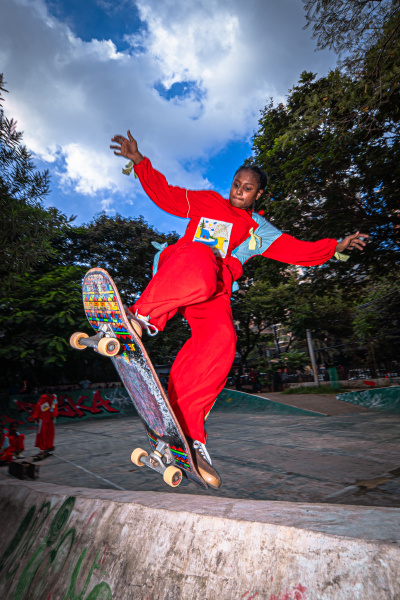
When a girl gets on a skateboard
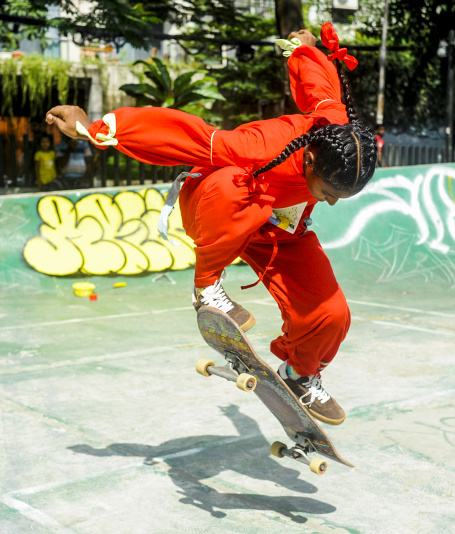
There is something quietly disruptive about watching a teenage girl command a skateboard in a public space.
 For all latest news, follow The Daily Star's Google News channel.
 Not because a girl skating should be extraordinary, but because public space has historically not belonged equally to girls. Boys grow up occupying fields, streets and playgrounds with an ease girls are not always afforded. Girls are more frequently taught to be careful, stay close, sit properly, come home early.
A skateboard asks for the opposite. Take up space. Move. Fall. Be seen trying again.
Fourteen-year-old Jannatul Akter has been skating for three years. “When I play with the skateboard, I feel like I am moving independently,” she elaborates. Jannatul, who lives in Korail Adarsh Nagar, wants to reach the Olympics and, in her words, “build a good life” for herself through skateboarding. Mariam, also 14, has a similar ambition. She wants to become a great skater and travel internationally.
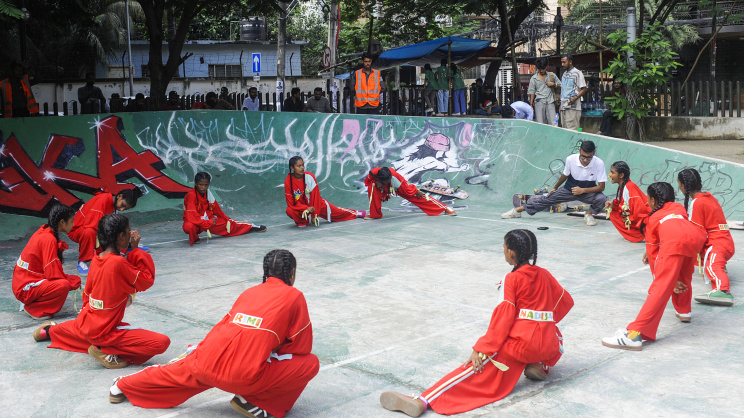
Rimi Akter has heard people question girls skating, but her response is equally resolute. She asserts, “Whatever boys can do, girls can do as well. If girls try, they can do everything!”
Their dreams recur with striking frequency: Olympics, international competitions, teaching younger skaters, going very far.
It would be easy to dismiss these as childhood declarations. But perhaps adulthood is too quick to ask whether a dream is realistic instead of asking what a child needs to have a fair chance at pursuing it.
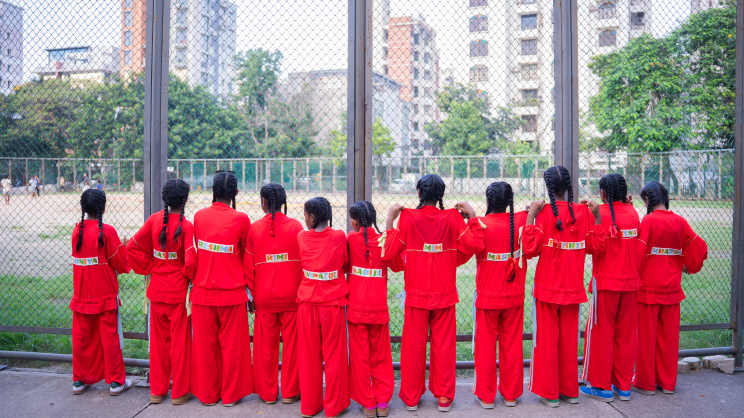
A programme that follows the child home
BSKA’s work does not stop when the skateboard is put away.
Program Coordinator Jesmin Akter, who joined the organisation as a teacher in 2019, says many of the girls come from Korail, while the programme also works with boys living in street situations. Education is a major component of its work. For some children, BSKA helps with schooling, tuition and examination fees. Street-connected children can receive educational classes and meals.
Volunteer Sharafat Karim explains that support increases as children remain consistently involved. Around 20 children receive educational support, while a smaller group of advanced skaters also receives assistance for their families, including essentials such as rice and oil. Outings are organised too, giving the children opportunities simply to experience something different.
The programme also asks children to think about the community around them.
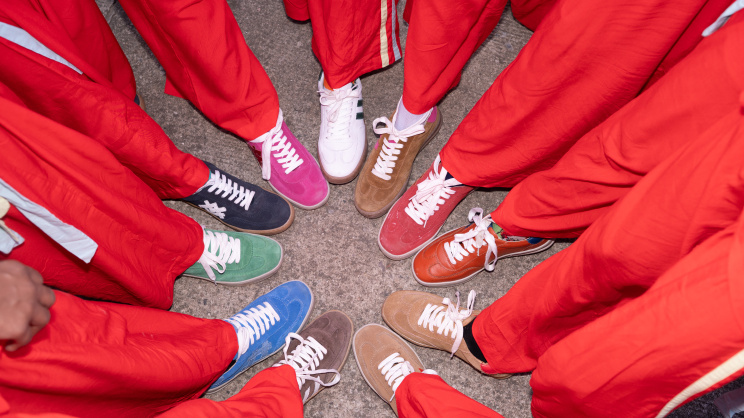
Reshma Akter, a 16-year-old skater who has already become a coach, says groups of roughly 25 to 30 children participate in clean-up activities around 55 Kodomtola. They collect rubbish, plant trees and sometimes paint public areas, often on Fridays and Saturdays.
Reshma's progression from child skater to teenage coach is particularly telling. She has been skating since she was six and has spent the past few years teaching others. Halsell, too, points to Reshma's long journey as one of the transformations that has stayed with her.
It is a model in which receiving support can eventually turn into providing it.
But where do they skate?
Here the uplifting narrative collides with a very practical problem: space.
According to Jesmin, there is no readily accessible alternative skate park for the children when their regular space becomes unavailable. She says fairs and stalls are periodically set up in the park, interrupting practice. Travelling to another skate facility in Gazipur is expensive. Her wish is straightforward: a dedicated place with appropriate ramps where the children can practise consistently.
Then there is an even more basic issue: the washroom.
Jesmin says access, particularly for the young girls, has repeatedly been difficult because washrooms are sometimes kept locked.
Md. Mynul Hossain Sajeeb, Deputy Security In-charge of Banani Society, offers the management perspective. He says the washrooms have at times been locked because of concerns about misuse by other park users, but that the Society's president has permitted them to remain accessible when the skating children are present. He also says security personnel are deployed at the field and remain in communication with senior security officials.
The differing accounts expose an important gap between policy and lived experience. Permission on paper matters, but for a 10- or 13-year-old girl who needs a washroom during hours of practice, reliable access matters more.
It is a mundane detail until you consider what it says about inclusion. We often celebrate children for overcoming extraordinary obstacles while failing to remove extremely ordinary ones.
A functioning washroom should not be one of the hurdles on the road to becoming an athlete.
The children the city learns not to see
BSKA's work becomes more complicated when it comes to children living on the streets.
Sharafat describes volunteers approaching children who may be dealing with substance use and inviting them to observe the programme. Some stay, skate, eat a meal and make art. For those hours, he says, they are occupied by something constructive and surrounded by people encouraging them to return.
This matters because outreach is rarely as neat as the success stories we prefer to publish. A child does not become easier to help simply because help has arrived. Children facing unstable housing, substance use, poverty or disrupted education may require more patience, specialised services and sustained intervention, not less.
And this is where the philosophy Halsell describes becomes especially relevant. Skateboarding can begin a relationship without demanding that a child first explain their life.
What happens if the dream gets bigger?
BSKA now faces the question that eventually confronts many grassroots initiatives: what happens when the children's ambitions begin to outgrow the programme's resources?
Jesmin says funding must stretch across schooling, tuition, examination fees, clothing, shoes and other everyday needs. International competition brings another level of expense altogether, and she says the organisation has yet to receive the kind of support required to take young skaters abroad at scale.
For children repeatedly naming the Olympics as their destination, that gap matters.
Facilities, coaching, equipment and most importantly, nutrition matter. And for girls, reliable sanitation and a safe environment in which they can train without being made to feel that they are intruding matter enormously.
Talent can emerge almost anywhere. Opportunity cannot.
Keep rolling
Late in the day, perhaps the park looks much as it did before the children arrived. The ramps remain concrete. Traffic continues outside. Dhaka returns to its familiar impatience.
But for the children, something has shifted.
A skateboard has become a reason to come back tomorrow. A friend has become a coach. A park has become a classroom. A girl from Korail can stand on four small wheels and picture herself underneath an Olympic flag.
And somewhere in that possibility lies the real story of BSKA.
Comments