


The Tagores and their Influence on Bengali Fashion
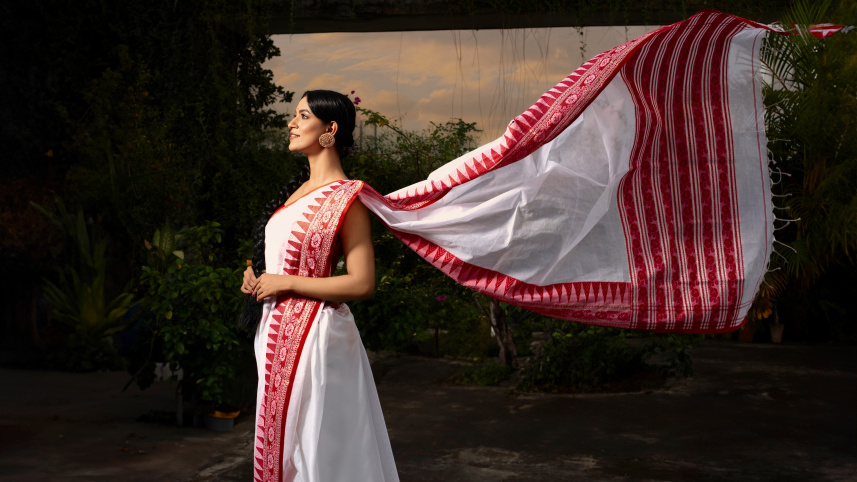
Rabindranath Tagore is remembered as Asia's first Nobel laureate, but his sartorial legacy is equally revolutionary. The Tagore family of Jorasanko did not merely write the Bengali Renaissance; they tailored it. By fusing European utility, Mughal elegance, and indigenous craft, Tagore and his circle created a distinctly Bengali modernity in dress that remains the backbone of contemporary style. As Tagore himself observed in Shesher Kobita, “Fashion is a mask, and style is the visage behind”— a philosophy that turned clothing from costume into cultural identity.
Building a “Bengali Style”
 For all latest news, follow The Daily Star's Google News channel.
 Before the Tagores, Bengali women's attire was largely unstitched and domestic. The six-yard saree was draped without a blouse or petticoat, confining women to the “andarmahal”. The shift began with Jnanadanandini Devi, Rabindranath Tagore's sister-in-law.
After living in Bombay, she adapted the Parsi/Gujarati drape and paired it with chemise-style blouses and petticoats — a style popularised through Bamabodhini Patrika as the “Brahmika saree”, later the “Bombay Dastur”, and finally the “Thakurbarir saree”.
This was not vanity; it was politics. Noted researcher Sangeeta Datta notes, “Jnanadanandini introduced the modern way of wearing a saree along with fashionable shirt blouses. This was the time when women were stepping out from the inner quarters to the public sphere".
The new drape enabled mobility, dignity, and participation in Brahmo Samaj reform. The Tagores thus stitched social liberation into every seam, allowing homemakers "to find a place in the world outside, while maintaining their dignity and grace”.
For men, Tagore himself became the silhouette. His ankle-length jubba or kaftan, long beard, and soft chappals created a visual grammar of the Bengali intellectual, distinct from both the British suit and the orthodox dhoti. He was "a man so advanced, he created his own emoji," instantly recognisable. This look distilled simplicity, spirituality, and defiance into one garment.
Selective modernity, not mimicry
The Tagores were cosmopolitan but not colonial. Living in Jorasanko during the 1858 Crown Raj, they absorbed “Western ideas” alongside “decided Persian influence". The result was a curated fusion.
European elements adopted by Tagore's circle included the chemise, petticoat, jacket-blouse, shoes, and brooches.
Suniti Devi, Keshab Sen's daughter, even wore a Spanish mantilla-like headcloth. Yet, these imports were re-engineered for the Bengali climate and modesty. The blouse was never low-cut; the petticoat was never a crinoline. The Tagore household’s women were "blending diverse cultural influences”; they carried “a distinctive and enduring identity”.
Tagore's own wardrobe choices for stage productions prove his curatorial eye. Descriptions in his novels and dance-dramas show “meticulous attention" to costume. Designers today still study his plays to understand how British fashion fused with contemporary Bengali styles during his lifetime.
Weaving nationalism into cloth
Tagore's second revolution was at Santiniketan. After visiting Java and Bali in 1927, he introduced Javanese batik, “wax-resist dyeing”, to Kala Bhavana. Taught at Visva-Bharati, batik became a cottage industry employing thousands and was "fully integrated with local customs and traditions”.
This was Tagore's answer to Gandhi's khadi. While both championed the handloom, Tagore's nationalism was aesthetic, not ascetic. Students were inspired to wear handloom and also learn to spin and weave. This went hand in hand with rural industry development and crafts like leatherwork, specialised batik and kantha. He promoted indigenous weaves but rejected sartorial uniformity, contrasting his “view of nationalism vis-a-vis Gandhian notion of nationalism”. The result: garad, tant, baluchari, and batik became markers of educated Bengali taste.
How Bengali fashion became timeless
Tagore's influence endures because it was rooted in principle, not trend. Three elements made it timeless —
Adaptability: The Brahmika drape of the 1870s evolved into today's designer sarees with belts and jackets, yet “preserving the essence of Bengali identity".
Artistic legitimacy: By placing textiles in literature, theatre, and painting, Tagore gave cloth intellectual weight. Exhibitions like Thakur Barir Saaj Poshak chronicle how “Tagore's large family made wardrobe choices that got distilled to the modern day".
Cultural confidence: T-shirts, mugs, posters with his lines prove his aesthetic “democratises Tagore" and “reaches out much more easily among ordinary people”. His work is “genuinely timeless”. A century later, designers from Kolkata to Dhaka city have him as muse.
Nine leading Bangladeshi designers staged a show where “designs demonstrated the influence of British fashion in Tagore's life with a fusion of contemporary styles”. The Tagore silhouette — flowing, hand-loomed, thoughtful — still walks on runways.
The visage behind the mask
Tagore never wrote a fashion manifesto. He wrote poems like "Where the mind is without fear” and let his life be the illustration. By giving Bengal a wardrobe that could enter salons, universities, and protest marches without apology, he proved that style is not frivolity but freedom. As the poet wore his philosophy, Bengal learned to wear its own. In the words he penned for Geetanjali: “Clothe me, O Father, with thy strength, That I may walk in beauty and in truth."
Tagore clothed Bengal first, with a style that still fits.
The writer is an Assistant Professor at Department of Fashion Design and Technology, Shanto-Mariam University of Creative Technology.
Comments