


Ageing with dignity: Why Bangladesh must invest in long-term care

Bangladesh is ageing rapidly. By 2050, nearly one in every five citizens will be 60 years or older. Yet today, most elderly persons in Bangladesh receive care from unpaid family members, most of whom are women, with little or no public support. While caregiving remains a deeply rooted social norm, the growing burden of elder care in a changing society is fast outpacing traditional systems. It is time for Bangladesh to reimagine care for its ageing population, not as charity or family obligation, but as a pillar of public policy and human dignity.
Elder care in Bangladesh is not only a demographic or health issue but rather a gender justice issue. Women and girls account for more than 80 per cent of informal caregivers. Many sacrifice income, education, or health to care for ageing parents or in-laws. At the same time, older women - who live longer, earn less, and often live alone - face heightened vulnerability. Without a system to support care work, the country is entrenching gender inequality and leaving both caregivers and recipients unsupported.

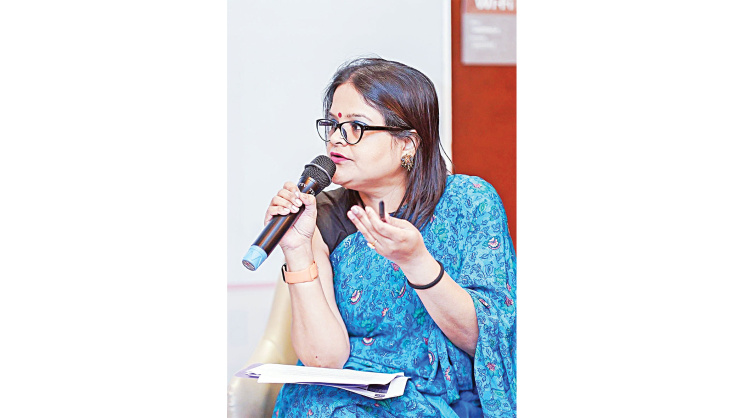
In 2025, the Asian Development Bank (ADB), in collaboration with Ayat Education and in partnership with the Department of Social Services (DSS), completed the first national diagnostic study on long-term care (LTC) in Bangladesh. The study included over 1,200 interviews with older persons, caregivers, community health workers, and local officials.
The findings were sobering. Formal institutional care reaches fewer than one percent of the elderly population, and where services do exist, they remain fragmented, poorly resourced, and largely unregulated. Older persons without family support such as widows, people with disabilities, or men living alone are often left entirely outside the care system. Existing social protection schemes also fall short, offering limited financial support but rarely addressing the daily care needs of older adults or the unpaid caregivers who support them.
Some argue that institutional care models are “Western” and incompatible with Bangladeshi values. Indeed, the tradition of family-based care especially by women remains strong. But this tradition is under strain. Smaller families, labour migration, urbanisation, and the rise of women’s employment mean that many households are struggling to care for ageing members. In the ADB-DSS study, nearly 29 per cent of surveyed older persons had no one to regularly assist them with daily tasks. Rather than replacing family care, a public LTC system can complement it—offering options like trained home-care aides, day-care centres, or community volunteers. These services can help reduce caregiver burnout, prevent elder neglect, and offer dignity to all.
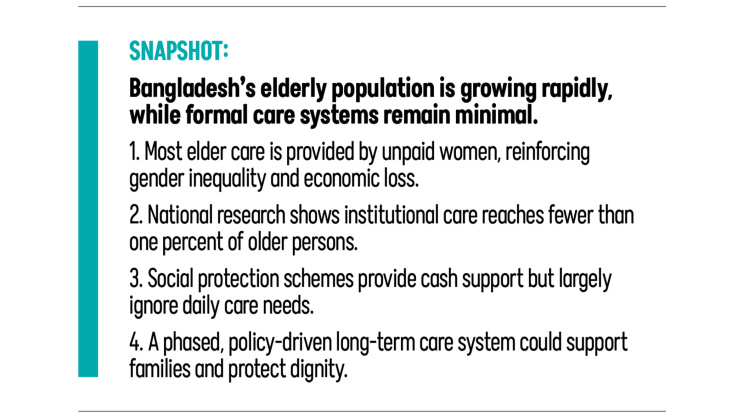
Based on the ADB-DSS roadmap and international experience, a five-pillar framework can be proposed to help Bangladesh build a gender-responsive, financially viable, and sustainable LTC system over the next decade. First, Develop a National LTC Policy and Legal Framework and create a comprehensive policy that defines LTC, sets service standards, ensures quality, and integrates it into the national development agenda and 9th Five-Year Plan. Second, Invest in the Care Workforce and establish structured training, certification, and employment pathways for caregivers through existing platforms like the Skills for Employment Investment Program (SEIP) and TVET institutions. Third, scale Community-Based and Home-Based Care Models Pilot and expand services delivered at the union and municipal levels through local NGOs, community clinics, and DSS centres. Prioritise models that allow aging in place while creating jobs for women and youth. Fourth, ensure Sustainable Financing and introduce a blended model of public financing, co-payments for those who can afford it, and social insurance mechanisms. Link with existing allowances (e.g., Old Age Allowance, Widow’s Allowance) to bundle cash with care services. Fifth, harness Data and Technology and create registries of caregivers and older persons, use mobile applications for monitoring and reporting, and build a robust data system to inform planning and accountability.
A common concern is affordability. Can Bangladesh finance such a system? The ADB-supported study estimates that even a modest LTC system, phased in over 10–15 years, would require strategic reallocation within existing social protection budgets, new budget lines, and co-financing options. Pilot programs can be launched at manageable cost, particularly if they tap into existing health and local government infrastructure. Over time, scale-up can follow based on results, capacity, and fiscal space.
One of the biggest challenges will be institutional. Currently, responsibility for elder care is spread across DSS, the Ministry of Health, local governments, and NGOs, with limited coordination. A national LTC strategy must clarify mandates, establish governance arrangements, and build technical and management capacity at all levels. Without this, even well-designed programs will falter.
Ultimately, long-term care is not just a service, it’s a reflection of national values. Do we, as a society, believe that older persons deserve to age with dignity, regardless of income or family status? Do we believe that care work, often invisible and unpaid, is worth public investment? Answering “yes” means building a system that reflects both tradition and transformation. One that respects families while easing their burden. One that uplifts caregivers rather than exploits them. One that sees care not as a cost, but as a contribution.
Bangladesh stands at a demographic crossroads. If we act now, we can build a care system that supports women, protects older persons, and strengthens families. If we wait, the burden will fall silently and disproportionately on those least able to bear it.
 For all latest news, follow The Daily Star's Google News channel.
Comments