


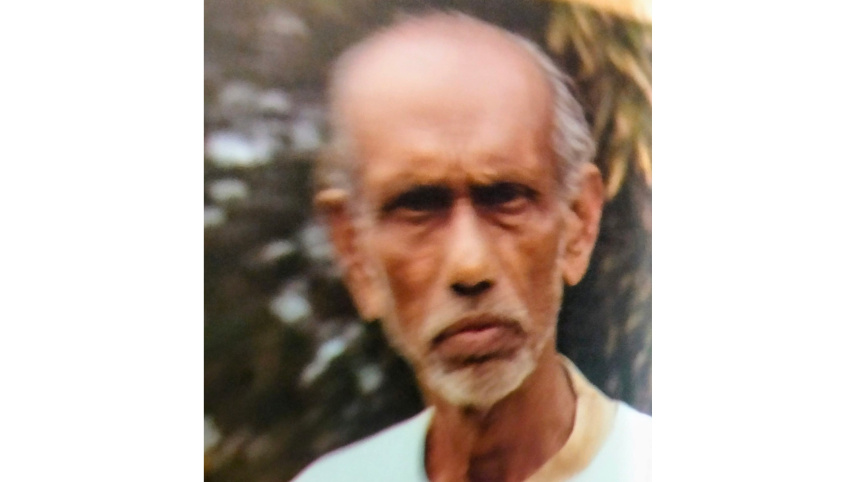
Ranjit Baowali no more but struggle for Bhobodoh remains

The waters are still there.
In Bhobodoh, a vast low-lying region spanning Jashore and Khulna, homes remain surrounded by stagnant water, bamboo walkways link verandas to the few roads above flood level, and families endure a hardship that has become somewhat of an inheritance.

For many, four decades of waterlogging have transformed an environmental crisis into a way of life.
Ranjit Baowali spent most of those four decades trying to change that.
The veteran grassroots leader and convener of the Bhobodoh Water Drainage Movement Committee died on Wednesday at his home in Dumurtala village of Jashore’s Abhaynagar upazila after suffering a brain haemorrhage.
His funeral at Nawapara crematorium drew political activists, cultural workers and ordinary villagers, many of whom regarded him not simply as a movement leader but as the voice of a forgotten region.
For the people of Bhobodoh, his death is more than the loss of an organiser. It is the departure of a man who chose to dedicate his life to thousands of impoverished families while asking almost nothing for himself.
More than 30 lakh people living across parts of Abhaynagar, Monirampur and Keshabpur upazilas in Jashore, and Dumuria and Phultala in Khulna, continue to suffer from chronic waterlogging.
Rivers such as the Mukteshwari, Teka, Shree, and Hari have gradually lost their navigability because of siltation, leaving rainwater trapped across villages and croplands.
The result is an endless landscape of standing water.
Fields that once produced crops remain submerged for months. Fish enclosures are damaged, livestock fall sick, and families struggle to protect even the smallest pieces of dry land around their homes.
Children grow up crossing bamboo bridges to attend school, while elderly residents spend years living in damp houses vulnerable to disease.
Seventy-year-old Atul Sarkar of Hatgacha village knows no other reality.
“Our people and our cattle are suffering equally,” he said. “Skin diseases have become common because we have lived in water for so many years. We don’t know whether this suffering will ever end.”
Ranjit Baowali made it his lifelong mission to end the suffering of his locality.
Although he himself lived with financial hardship, those who worked alongside him say he devoted little attention to improving his own circumstances.
Instead, he travelled from village to village organising residents, leading demonstrations, meeting officials and demanding a permanent solution to Bhobodoh’s drainage crisis.
He believed the people themselves had to remain united if they were ever to reclaim their land.
Writer and researcher Gauranga Nandy first met Ranjit Baowali while reporting from Bhobodoh. He remembers him as a man whose greatest wealth was his commitment to others.
“His family lived in poverty,” Nandy recalled. “Yet instead of spending his life trying to improve his own condition, he dedicated himself to improving the lives of others. He wrote songs, composed music and performed them to inspire people to join the movement. His life revolved around the people of Bhobodoh.”
That commitment came at a heavy personal cost.
During demonstrations demanding government action over the prolonged waterlogging, Baowali was brutally assaulted. According to his colleagues, he suffered severe head injuries during one protest after security forces cracked down on demonstrators. Those injuries eventually damaged his eyesight, and in his final years he became completely blind.
 For all latest news, follow The Daily Star's Google News channel.
 Blindness, however, did not silence him.
Unable to see the flooded villages he had spent decades defending, Ranjit continued attending meetings whenever his health allowed.
Friends say he encouraged residents to remain united and repeatedly reminded them that only collective action could force lasting change.
His own life, meanwhile, was marked by repeated tragedy.
He had already endured the loss of his son. Just two months before his death, he also lost his wife, a blow that deeply affected him emotionally.
On July 1, he suffered a brain haemorrhage and was admitted first to Abhaynagar Upazila Health Complex before being transferred to Jashore General Hospital. After receiving further treatment at a private clinic, he returned home on July 14, where he spent his final weeks surrounded by family.
For members of the movement committee, his greatest sorrow was not his illness but the unfinished struggle.
“He fought for the people until his last breath,” said Chaitanya Pal, member secretary of the Bhobodoh Water Drainage Movement Committee. “He always hoped he would witness a permanent solution. That dream remained unfulfilled.”
Ranjit Baowali’s activism dated back much earlier than the waterlogging movement. Influenced by leftist politics from his youth, he joined the Liberation War in 1971. When waterlogging first emerged in Bhobodoh during the 1980s, he began mobilising local communities. After severe flooding returned in 2005, he became convener of the movement committee and remained at its helm until his death.
He was also a respected folk poet, lyricist and composer whose songs reflected the struggles of ordinary rural people. His literary works earned recognition from Bangla Academy, Shilpakala Academy and several cultural organisations, but those who knew him say awards never mattered as much to him as the movement itself.
Ranjit Baowali is no longer in this world, yet in Bhobodoh, many believe his greatest legacy lies not in speeches or slogans, but in the unwavering conviction that even the poorest and most neglected people deserve dignity, and that their struggle is worth a lifetime of sacrifice.
Comments