


179 dead in South Korea plane crash
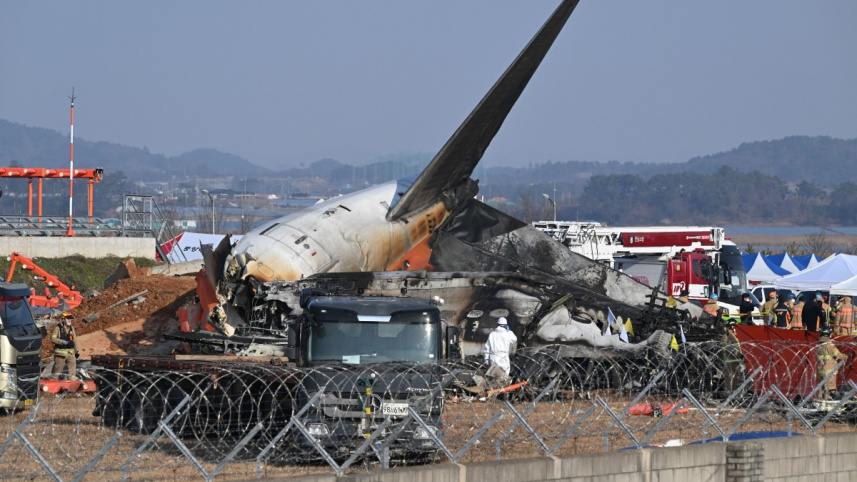
- Jeju Air flight skidded without gear down before exploding
- Investigators recover both black boxes
- S Korea declares 7-day national mourning
The deadliest air accident ever in South Korea killed 179 people yesterday, when an airliner belly-landed and skidded off the end of the runway, erupting in a fireball as it slammed into a wall at Muan International Airport.
Jeju Air flight 7C2216, arriving from the Thai capital Bangkok with 175 passengers and six crew on board, was attempting to land shortly after 9:00 am (0000 GMT) at the airport in the south of the country, South Korea's transport ministry said.
 For all latest news, follow The Daily Star's Google News channel.
 Two crew members survived and were being treated for injuries. South Korea's acting President Choi Sang-mok declared a national mourning period until January 4.
The deadliest air accident on South Korean soil was also the worst involving a South Korean airline in nearly three decades, according to the transport ministry.
The twin-engine Boeing 737-800 was seen in local media video skidding down the runway with no visible landing gear before crashing into navigation equipment and a wall in an explosion of flames and debris.
The two crew members, a man and a woman, were rescued from the tail section of the burning plane, Muan fire chief Lee Jung-hyun told a briefing. Authorities combed nearby areas for bodies possibly thrown from the plane.
Investigators are examining bird strikes and weather conditions as possible factors, Lee said. Yonhap news agency cited airport authorities as saying a bird strike may have caused the landing gear to malfunction. Both black boxes of the plane have been recovered from the wreckage.
The control tower issued a bird strike warning and shortly afterward the pilots declared mayday, a transport ministry official said, without specifying whether the flight said it struck any birds.
Soon after the mayday call the aircraft made its ill-fated attempt to land, the official said.
Experts said the bird strike report and the way the aircraft attempted to land raised more questions than answers.
"A bird strike is not unusual, problems with an undercarriage are not unusual," said Airline News editor Geoffrey Thomas. "Bird strikes happen far more often, but typically they don't cause the loss of an airplane by themselves."
Hours after the crash, family members gathered in the airport's arrival area, some crying and hugging as Red Cross volunteers handed out blankets.
Families screamed and wept loudly as a medic announced the names of 22 victims identified by their fingerprints. Papers were circulated for families to write down their contact details.
Mortuary vehicles lined up outside to take bodies away, and authorities said a temporary morgue had been established.
Before the crash, a passenger texted a relative to say a bird was stuck in the wing, the News1 agency reported. The person's final message was, "Should I say my last words?"
The passengers included two Thai nationals and the rest are believed to be South Koreans, according to the transportation ministry.
The crash is the worst by any South Korean airline since a 1997 Korean Air crash in Guam that killed more than 200 people, according to transportation ministry data. The worst on South Korean soil was an Air China crash that killed 129.
Comments