


Trump says US and China are aligned on Iran, Tehran must make a deal soon
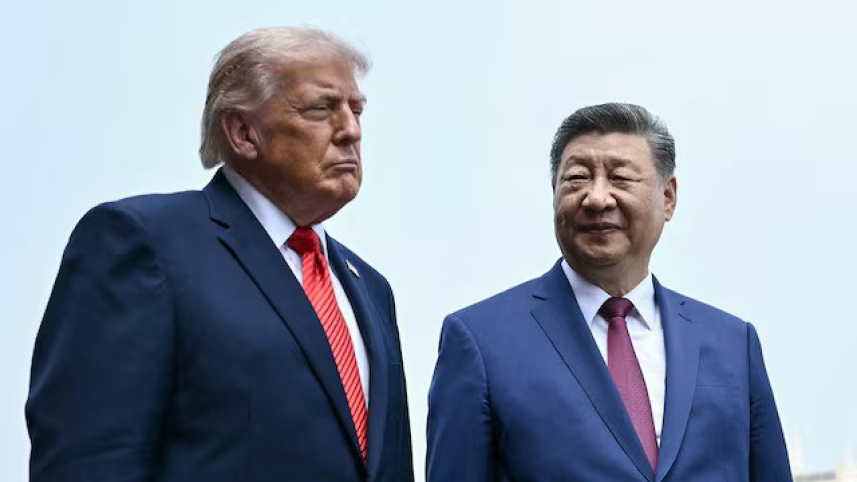
US President Donald Trump said his patience with Iran was running out and that Chinese President Xi Jinping had agreed during their talks in Beijing that Tehran must reopen the Strait of Hormuz.
Trump said later he was considering whether to lift sanctions on Chinese oil companies buying Iranian oil imposed by Washington ahead of his trip to Beijing. China is the biggest buyer of Iranian oil.

However, his comments gave little indication of whether Beijing might use its influence with Tehran to end a conflict it said should never have started.
"I'm not asking for any favors because, when you ask for favors, you have to do favors in return," Trump said, when asked by a reporter on his plane home whether Xi had made any firm commitment to put pressure on the Iranians to reopen the strait.
"We've wiped out their (Iran's) armed forces, essentially. We may have to do a little cleanup work."
Xi did not comment on his discussions with Trump about Iran, although China's foreign ministry issued a blunt statement outlining Beijing's frustration with the Iran war.
"This conflict, which should never have happened, has no reason to continue," the ministry said.
Iran effectively shut the Strait to most shipping traffic in response to US-Israeli attacks, which began on February 28, causing an unprecedented disruption to global energy supplies.
'WE WANT THE STRAITS OPEN'
The US paused its attacks on Iran last month but began a blockade of the country's ports. Tehran said it would not unblock the strait until the US ended its blockade. Trump has threatened to attack Iran again if it does not agree to a deal.
"We don't want them to have a nuclear weapon, we want the straits open," Trump said in Beijing, sitting alongside Xi.
Iranian Foreign Minister Abbas Aragchi said Tehran had received messages from the US indicating Washington was willing to continue talks.
"We hope that, with the advancement of negotiations, we will reach a good conclusion so that the Strait of Hormuz can be completely secured and we can expedite the normalisation of traffic through the strait," he told reporters in New Delhi.
Iran, which denies it intends to build a nuclear weapon, has refused to end its nuclear program or relinquish its hidden stockpile of enriched uranium, to Trump's frustration.
"I am not going to be much more patient. They should make a deal," Trump said in an interview aired on Thursday night on Fox News' "Hannity" program, suggesting the enriched uranium only needed to be secured by the US for public relations purposes.
Oil prices rose around 3% to near $109 a barrel on concerns over a lack of progress in resolving the conflict.
After talks between Trump and Xi yesterday, the White House said Xi had made clear China's opposition to any Iranian effort to charge a toll for use of the strait.
Trump said Xi also promised not to send Iran military equipment. "That’s a big statement," Trump said on "Hannity".
Asked about US sanctions on Chinese oil refineries buying Iranian oil, he told reporters on his plane: "We talked about that, and I'm going to make a decision over the next few days."
IRAN SAYS IT DOES NOT TRUST THE AMERICANS
 For all latest news, follow The Daily Star's Google News channel.
 The war has become a liability for Trump ahead of key US midterm elections in November.
China has dismissed reports it had plans to supply weapons to Iran as "groundless smears", but analysts doubt Xi will want to push Iran hard or end support for its military, given its value as a strategic counterweight to the US.
Talks on ending the war, mediated by Pakistan, have been on hold since last week when Iran and the US each rejected the other's most recent proposals.
Iran would welcome any Chinese input, Foreign Minister Aragchi said today, adding that Tehran was trying to give diplomacy a chance but did not trust the US
Iran is prepared for a resumption of fighting as well as for diplomatic solutions, Aragchi said, reiterating that vessels not linked to states attacking his country could traverse the Strait of Hormuz.
Before the war, about a fifth of global oil and liquefied natural gas as well as fertilizer and other vital supplies, passed through the waterway. Attacks on shipping have prevented almost all traffic, although a huge Chinese tanker and another linked to Japan crossed the strait on Wednesday.
The UAE said it would speed up building a new pipeline to its Fujairah port just outside the strait, after a vessel heading to it was sunk this week and another was boarded and redirected to Iran.
LEBANON TALKS AIM TO EXTEND CEASEFIRE
Thousands of Iranians were killed during the US and Israeli air strikes, and thousands have been killed in renewed fighting in Lebanon between Israel and the Iran-backed group Hezbollah.
With a fragile ceasefire in Lebanon due to expire on Sunday, discussions between Lebanese and Israeli officials were set to resume on Friday. Hezbollah opposes the talks, in which Israel is insisting on the group's disarmament.
Trump says his aims in starting the war are to destroy Iran's nuclear program, end its ability to attack neighbors, and make it easier for Iranians to overthrow their government.
Iran is seeking the lifting of sanctions, reparations for war damage, and acknowledgment of its control over the strait.
Comments