


Don’t let the artificial fertiliser crisis persist
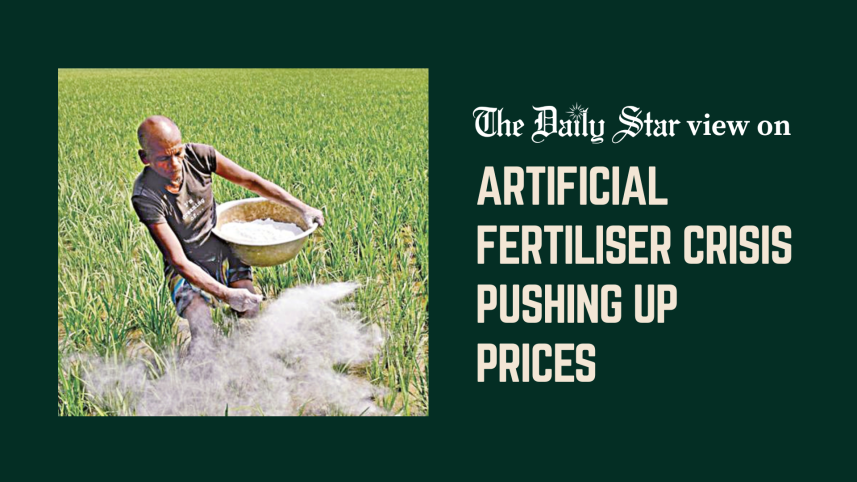
The apparent scarcity of fertiliser during the peak planting season—which has driven up prices by nearly 25 percent—is deeply worrying. This disruption is baffling given the agriculture ministry’s own data as cited by a report by this daily. It shows that national reserves comfortably exceed current demand: against a requirement of 13.21 lakh tonnes for the July-September period, existing stocks stand at 13.65 lakh tonnes. What's causing the crisis then? Agriculture Minister Aminur Rashid has alleged that the breakdown in distribution, despite sufficient stocks, is part of a “planned conspiracy,” although he stopped short of identifying who is behind it or what their motives might be.

Reports from across the country indicate that government-appointed dealers are largely responsible for the artificial crisis. Many of them are either withholding their stocks received through official allocations from farmers, or appointing retail agents who overcharge them. Their motive appears to be to maximise profits by controlling the release of their stocks and pocketing illicit commissions from sub-dealers or retail agents. Reports also suggest that the government’s latest amendment to the national fertiliser policy, alongside its move to review existing dealership licences and issue new ones, has unnerved certain licensees facing allegations of malpractice, rule-breaking, and attempts to monopolise regional markets. It has long been an open secret that some dealers obtained multiple licences under different company names or through relatives to manipulate supply and prices in their respective territories.
To break such cartels, the interim government had revised the fertiliser policy last year and decided to scrutinise all existing licences, but could not complete the process. The current government has resolved to continue the review and appoint new dealers. Through an amendment to the policy, it has also allowed the appointment of retail agents, which the interim government had restricted. While it may be too early to gauge the impact of these policy shifts, the government must take every measure to restore supply normalcy and prevent further disruptions.
The ministry has reportedly already initiated punitive action against some dealers, suspending five licences and fining around 25 others in connection with the ongoing crisis. While such crackdowns are a welcome step, the authorities must also move quickly to establish alternative distribution channels. It’s worth noting here that a greater risk looms as the US war on Iran drags on, threatening Middle Eastern supplies of gas and fertiliser ahead of the coming crop season. With most domestic plants forced to shut down due to gas shortages, the government must urgently explore alternative global suppliers and secure adequate stocks for timely distribution, ensuring that our food production is not compromised.
 For all latest news, follow The Daily Star's Google News channel.
Comments