


Draft laws on NHRC and enforced disappearances fall short
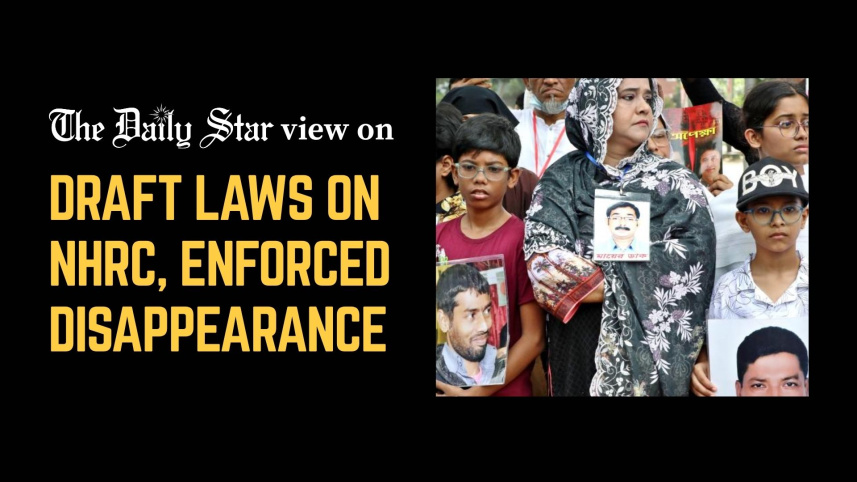
The BNP government’s failure to draft better laws on enforced disappearances and the National Human Rights Commission (NHRC) is indeed disappointing. The draft laws, unveiled on Sunday, seem to weaken the NHRC’s institutional strength and independent oversight while placing the police in charge of investigating disappearances. Considering the law enforcement connection with most of the enforced disappearance cases during the Awami League regime, putting the probe responsibility on the police raises eyebrows. This provision appears almost like making the wolf the shepherd.
It is a well-known fact that most of the enforced disappearances were committed by security and intelligence forces during Sheikh Hasina’s time. At one point, the Detective Branch of police became notorious for picking up businessmen, torturing them, and then demanding ransom from their families for their release. How can a sub-inspector be expected to probe into such crimes impartially and without fear of retribution from their seniors? But that is what the new draft law on enforced disappearance proposes, diverging from the interim-time ordinances, which tasked the NHRC with investigating disappearances and barred members of a force from investigating their own members.

In fact, the BNP government’s proposed law on the NHRC strips it of its power to investigate rights violations by disciplined forces, which was given in the ordinances passed by the interim government. Per the new draft, the NHRC must seek a report from the agency chief or the government when such violations occur, and can only issue recommendations and demand response from the government if it is not satisfied with the report. In other words, the NHRC’s role will be limited to paper shuffling when it comes to rights violations by law enforcers, just as it was during the Hasina government.
What’s more, the selection process of NHRC members, per the draft, creates room for increased government influence in the institution. Unlike the NHRC-related 2024 and 2025 ordinances, the member selection committee will be chaired by the speaker of the House and not by an Appellate Division judge chosen by the chief justice. Besides, the inclusion of the law and home ministers on the selection committee gives the executive significant influence over NHRC appointments. Given our past experiences, how can we trust that this selection will not be partisan or that the persons selected by ruling party ministers will act impartially when investigating the state’s human rights violations?
When the BNP government repealed NHRC ordinances and allowed the enforced disappearance ordinances to lapse, one of its rationales was that better laws with no ambiguity would be drafted. However, clarity in law should not come at the cost of weakening rights bodies and empowering state apparatuses with a history of oppression. This is not expected of this government, which was voted into power with hopes that it would bring real change, not merely cosmetic ones.
 For all latest news, follow The Daily Star's Google News channel.
Comments