


Lasting solutions for river erosion needed
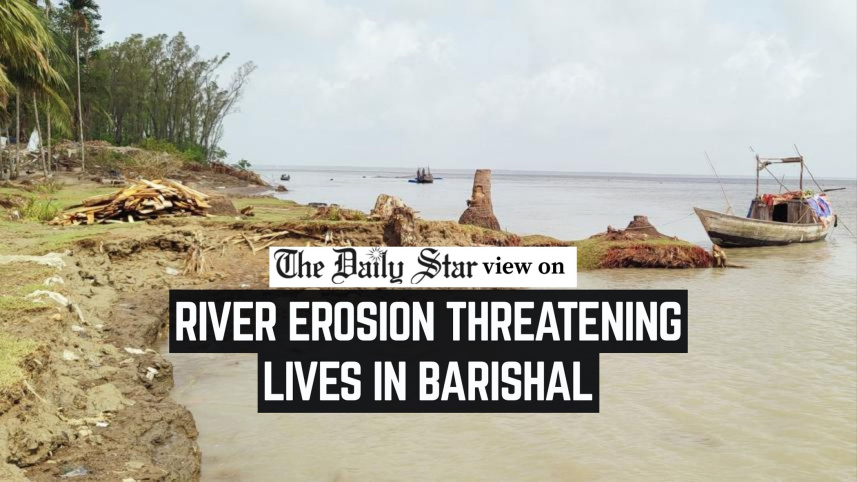
A recent report by Prothom Alo narrates how at least a hundred people, including schoolchildren, formed a human chain along the banks of a river in Barishal to draw the authorities’ attention and save their homes, schools, and belongings from devastating erosion. In the district’s Kedarpur union, the Sandhya River’s erosion is threatening the locality, with several important infrastructures, including two schools, at risk of being washed away. The erosion has also put at least 50 families at risk. Locals say this phenomenon is not new; the erosion recurs every monsoon. What strikes us as odd is the fact that despite the annual recurrence of the erosion, there has been little attempt for a permanent solution.
This is particularly alarming given the prevalence of river erosion in Bangladesh, with 20 of the 64 districts facing the crisis on a regular basis, that forces the displacement of around 200,000 people and causes the loss of at least 8,700 hectares of homestead and arable land. Such erosion has a lasting impact on the education, economy, and social life of the affected population. If we were to focus on education alone, a recent study found that 38 to 42 percent of children displaced due to river erosion experienced temporary or permanent school dropout, compared with 18 to 21 percent among non-displaced children. There must be a coordinated approach from the government to address river erosion with urgency and utilise science-based solutions to safeguard communities from the results of such calamities.

Of course, there have been erosion mitigation projects in the country before. For example, ADB’s erosion mitigation project in the Jamuna-Meghna rivers utilised geotextile bags to protect the riverbanks. In some areas, locals have used nature-based solutions, such as bandalling, to tame the rivers. The Bangladesh Water Development Board (BWDB) has various structural projects including emergency intervention drives in erosion-prone districts as well.
However, a lot of these projects begin after an emergency occurs and are followed by inaction. Hence, we urge the government to invest in a long-term erosion management strategy. This can include constant monitoring and geospatial mapping of erosion-prone areas and strengthening riverbanks through nature-based solutions. Local communities should also be involved in identifying vulnerable areas and monitoring interventions. The government’s recent plans for long-term measures to prevent erosion on the Khowai River is a welcome move. We hope such efforts will become part of a broader, preventive strategy so that no communities have to face erasure due to river erosion.
 For all latest news, follow The Daily Star's Google News channel.
Comments