


Press freedom should not be elusive
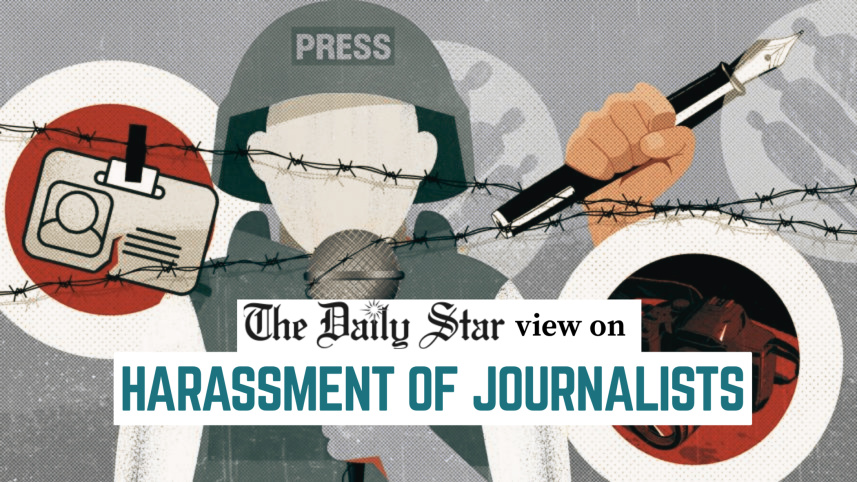
When a new government assumed power following a landslide victory in a free and fair election after the 2024 July uprising, there was a flicker of hope that journalists’ safety would finally be ensured in Bangladesh. However, a recent report by the Human Rights Support Society (HRSS), noting that at least 75 journalists were harassed across the country just last month, dashes that hope. According to the report, which aggregated information from 14 dailies, 42 journalists were injured, 17 assaulted, 10 threatened, three detained, and five were accused in four separate cases. It has been nearly three months since the BNP government took office, yet the number of harassment incidents is already higher than last year’s monthly average (HRSS recorded 318 attacks throughout 2025). This raises a vital question: can we ever expect a regime where journalists can carry out their work in this country without fear of harassment, threats or arrests?
Sadly, an analysis by this daily of Sweden-based Varieties of Democracy’s (V-Dem) press freedom data shows there has never been a period in our history when journalists did not face harassment from powerful actors, be it government or non-government. V-Dem scores range from -3.33 (journalists cannot operate without facing certain harassment) to 4.13 (journalists are never harassed). In its 55 years, and irrespective of whether it had a political or non-political government, Bangladesh never went above 0.5, indicating an environment where some journalists were suppressed while others managed to continue freely. The only period when the situation was relatively better was during the tenure of President Ziaur Rahman, father of current Prime Minister Tarique Rahman.

One might expect the BNP to follow that example to ensure a fear-free environment. Indeed, their manifesto pledges to ensure freedom of expression, and the party boasted about doing so in its “60 notable initiatives” in its first 60 days. Ironically, around the same time, a cartoonist was arrested under the Cyber Security Ordinance, 2025 for satirising a BNP politician. Although he was later granted bail, a number of journalists, who were arrested—often on flimsy and false charges—after the fall of Sheikh Hasina, remain behind bars without trial, some for over 600 days.
As we noted recently, as long as problematic clauses in laws like the Cyber Protection Ordinance remain, journalists will face harassment. We urge the government to revisit and amend laws that restrict free speech, train law enforcers on this issue, and rein in party activists. Above all, forming a media commission and a functional and independent National Human Rights Commission is urgent to ensure press freedom and journalists’ safety.
 For all latest news, follow The Daily Star's Google News channel.
Comments