


Rethinking healthcare for children in the CHT

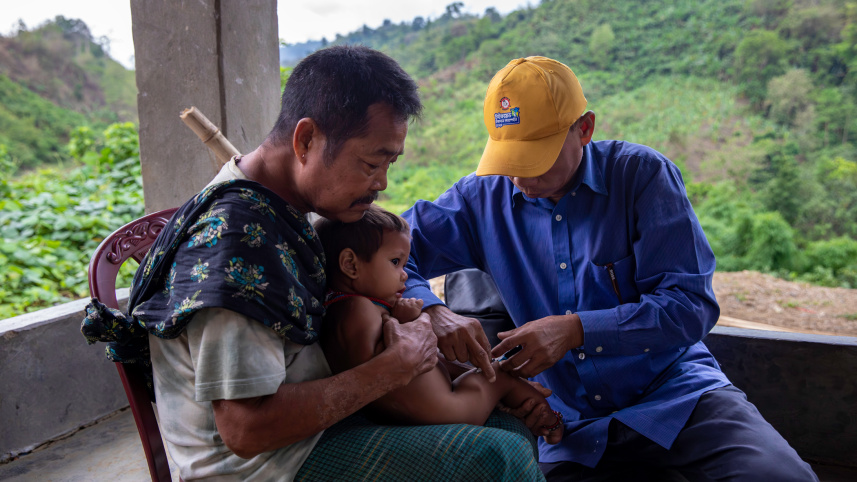
In the remote hills of Bandarban, a child’s illness is rarely just a medical event. It is a test of distance, terrain, poverty, and trust. A recent report in The Daily Star on child deaths and suspected measles-like illness in Alikadam brings this reality into sharp focus. For many families from Mro and Marma communities, accessing formal healthcare can be an excruciating ordeal. The journey to the nearest facility can take hours, sometimes even days, requiring crossing steep, unforgiving paths, with costs that far exceed a family’s monthly income. Such harsh realities often lead to the community members relying on traditional remedies, which is not always a choice on their part.
It is tempting, from a distance, to prescribe familiar solutions: build more hospitals, deploy more doctors, and expand infrastructure. But those who have lived and worked in the Chattogram Hill Tracts (CHT) know that this terrain resists one-size-fits-all solutions. The crisis is seldom only about the absence of services; it’s also about the lived realities of the hills.

The first step towards a meaningful response would be to shift how we approach the problem. Instead of expecting patients to travel for healthcare services, it must be ensured that care reaches patients regardless of geographical challenges. To bridge immediate gaps, facilities such as mobile healthcare units—equipped for immunisation, maternal and child health services, and basic diagnostics—can be introduced. These ideas are not new, but their consistent and well-resourced deployment in hard-to-reach unions remains limited. Regular outreach, on fixed schedules known to communities, can build both access and trust, ensuring that services are not sporadic but dependable.
Investing in people from these communities is equally important, especially when it comes to bridging the healthcare gap in the CHT region. Training local youth as community health workers could be an important long-term strategy. These workers would have the unique advantage of understanding the language, cultural nuances, and the topography. They can help identify early symptoms of an outbreak, provide basic care, support immunisation drives, and facilitate timely referrals. In places where an outsider’s advice may be met with hesitation, a familiar face can make the difference between delay and action.
However, referral itself remains a weak link. When a child develops complications, the window for effective treatment is narrow. For many hill families, arranging transport—be it by foot, boat, or motorcycle—is both logistically complex and financially crippling. A community-based emergency transport and referral system is, therefore, essential. This could include locally managed funds to cover urgent travel costs, transport options adapted for hilly terrain such as motorbike ambulances, and simple communication networks to alert facilities in advance. Without such mechanisms, even the best primary care cannot prevent avoidable deaths.
Another dimension that demands careful engagement is the role of traditional healers and Indigenous knowledge systems. Public health responses often treat these as obstacles to be overcome. In reality, they are deeply embedded sources of trust. A more pragmatic approach would be to engage local healers to recognise danger signs and encourage timely referrals, while respecting their role within the community. This could help bridge the gap between tradition and modern healthcare.
Communication strategies also need recalibration. Health messages crafted in the capital rarely resonate in remote CHT villages. Language barriers, differing worldviews, and limited exposure to formal education—all shape how information is received. Hence, community engagement must be participatory and localised. Campaign materials should use Indigenous languages, adopt the hill’s style of storytelling, and utilise trusted community forums. When mothers understand why a vaccine matters, not as an abstract concept but as a shield against a familiar fear, they are more likely to seek it.
At the same time, there is a need for modest but strategically placed health posts. They should not aim to replicate urban hospitals; they would serve as the first point of contact. They could be instrumental in offering essential medicines, routine services, and a base for outreach teams. Over time, such initiatives can strengthen the overall referral network, making the system more responsive and less fragmented.
All of these interventions, however, require a policy framework that recognises the unique advantages and challenges of the CHT. Uniform national strategies often fail to capture the diversity and complexity of the hills. Dedicated budget lines, flexible implementation models, and stronger collaboration between government agencies and NGOs are critical. Development partners, too, must move beyond pilot projects and support scalable, context-sensitive programmes.
The measles situation in Bandarban reminds us that even if inequity in healthcare is not always visible, it is deeply felt. A child in Alikadam should not have a lower chance of survival simply because of where they are born. Addressing this injustice demands more than infrastructure; it needs empathy translated into policy and policy translated into practice.
Those who have spent time in the hills know that communities are not passive recipients of aid. They are resilient, resourceful, and willing to engage if approached with respect and understanding. The task before us is to listen, adapt, and act. Because in the end, healthcare is more than about facilities and medicines; it is about reaching people where they are and standing with them when it matters most.
Sumit Banik is a public health professional and content writer focusing on human rights, equity, and compassionate healthcare. He can be reached at sumitbd.writer@gmail.com.
Views expressed in this article are the author's own.
Follow The Daily Star Opinion on Facebook for the latest opinions, commentaries, and analyses by experts and professionals. To contribute your article or letter to The Daily Star Opinion, see our guidelines for submission.
 For all latest news, follow The Daily Star's Google News channel.
Comments