


Teacher shortage must be addressed
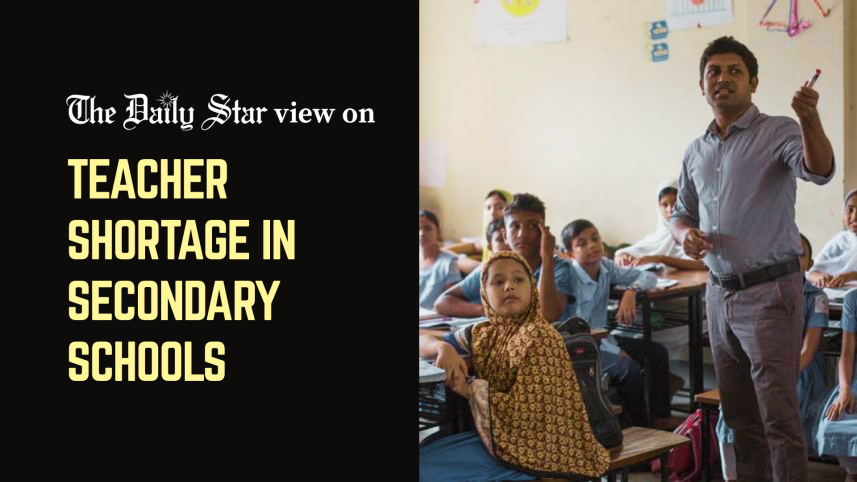
We often complain about “learning poverty” among the majority of students in public schools, but ignore the fact that, over the years, we have failed to ensure adequate staffing in many of the primary and secondary schools. Recent reports on two schools from two very different parts of the country have revealed the sorry state of the prevailing teacher shortage.
The Jessore Education Board Model School and College, established in 2007, does not lack school buildings or teachers’ quarters; what it lacks is enough subject-specific teachers to teach classes from grade 3 to 12. For the institution’s 1,411 students, there are only 26 teachers—a teacher-student ratio of 1:54, starkly contrasting the standard of 1:15 ratio in a well-performing system. However, the ratio becomes even less acceptable when one considers that this “model” school has no subject teacher for Bangla, English or science for any of its 850 school-level students. These subjects are being taught by teachers of philosophy, social science and statistics, respectively. Imagine how such substitutions affect students’ learning and preparation for the SSC examination, for example. What's worse is that, at the college level, there is no teacher for higher mathematics. There are not enough teachers for ICT, science and commerce subjects either.

The situation at Lalmonirhat Dahagram Government High School is even worse. For its 550 students, there is only one teacher, who himself is scheduled to retire in two years. The situation at this institution—the only one in the union surrounded by India—has become so dire that students have begun boycotting classes, demanding the recruitment of the required number of teachers.
Perhaps the saddest part is that these schools did have more teachers at some point. Seven teachers were appointed to the Dahagram school when it was nationalised in 2013. Since then, six teachers have retired. This raises the question: why were no new teachers appointed to fill the vacancies over the past 13 years? The acting headmaster and the only serving teacher claimed that he had sent requisitions for teachers 15 times over the last 10 years. What happened to those requisitions? The same question can be raised about the model school in Jashore. Before it was nationalised in 2018, it had 57 teachers. But during nationalisation, only 26 were listed as government teachers. What is more puzzling is that, at the time of nationalisation and over the last eight years, the authorities did not feel the need to create new posts for teachers. Consequently, students’ learning has continued to suffer.

Our children want to learn and have the capacity to grow. But the authorities responsible for ensuring a smooth learning process are failing in their duties. We urge the government to find out why these gaps exist and take appropriate measures. Introducing new curricula or ambitious policies will achieve little if we cannot ensure this basic requirement of having adequate, qualified teachers in our schools.
 For all latest news, follow The Daily Star's Google News channel.
Comments