


How tobacco companies target schoolchildren

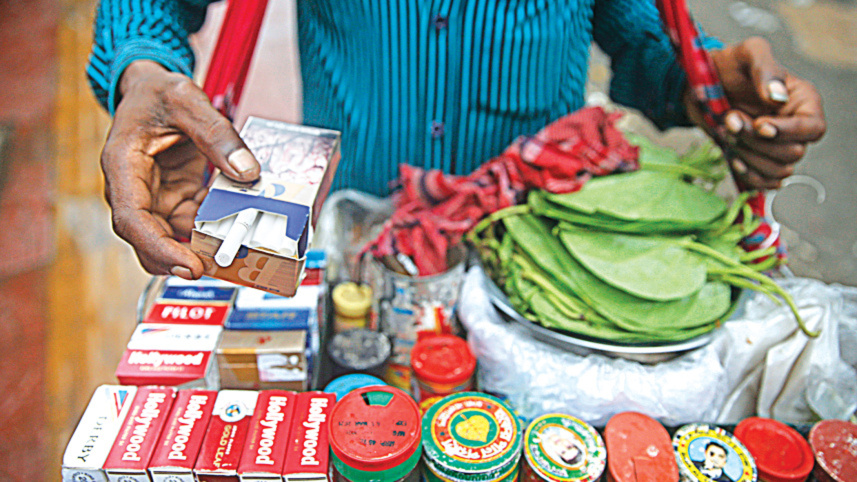
Targeting young children to gain future smokers is a longstanding tactic of tobacco producers globally. One of the most effective ways of doing this is by ensuring that cigarettes and other tobacco products are sold near schools, making it so that children are repeatedly exposed to tobacco branding and imagery, making smoking seem familiar, normal, and accessible.
Bangladesh is paying an enormous price for the tobacco epidemic. At least 1.61 lakh people die every year from tobacco-related diseases in the country, according to the National Heart Foundation of Bangladesh. A study by Economics for Health and Institute of Health Economics, University of Dhaka found that the total economic cost of tobacco use is Tk 87,544 crore, nearly double the amount the government earns in tobacco tax revenue.

However, the burden is not only reflected in deaths and economic losses; it is also present in the steady exposure of new generations to tobacco products. Among teenagers especially, smoking is often associated with adulthood, rebellion, or looking “cool.” Children and adolescents are more susceptible to visual cues, branding, and product placement. This is what makes the retail environment around schools so important.
Historically, there has been very limited public data on the actual situation around Bangladeshi schools. The evidence that does exist has long pointed to a serious problem. A 2016 study by the Bloomberg School of Public Health at Johns Hopkins found that around 90 percent of selling points within a 100-metre radius of 110 schools in Dhaka sold tobacco products. In 2018, Dhaka Ahsania Mission conducted a study across 157 schools and 23 playgrounds nationwide and found that about 90.5 percent had nearby vendors selling some form of tobacco. Most of these vendors were also advertising tobacco products and selling single cigarettes, making tobacco even more accessible.
More recently in November 2025, a study by the Power and Participation Research Centre on 121 schools and their surroundings in four divisions found 666 tobacco points of sale, averaging 5.5 outlets within 100 metres of each school. The density was slightly higher in urban areas than in rural ones. Cigarettes were found to be almost universally available, sold at 99.1 percent of all surveyed outlets. Flavoured cigarettes were available at 84.4 percent of points of sale surrounding schools, with slightly higher availability in urban areas.
The problem is not only that tobacco is being sold, but also how it is being made visible and attractive. Overall, 71 percent of outlets openly displayed tobacco products, often at a child’s eye level. Placement near candy, sweets, or toys was also widespread. Some outlets even allowed customers to reach out and take cigarette packs themselves, while others used branded display units. Dummy or empty cigarette packs were the most common advertising material, followed by stickers, posters, and branded price lists.
Bangladesh is a party to the World Health Organization Framework Convention on Tobacco Control and has taken several legislative steps to regulate tobacco use, marketing, and consumption. The country enacted the Smoking and Using of Tobacco Products (Control) Act, 2005 and later amended it in 2013 to strengthen restrictions on tobacco advertising, promotion, and sponsorship, expand smoke-free public spaces, and introduce larger pictorial health warnings. A new amendment came into effect, issued by the interim government, on December 30 last year. The amended ordinance explicitly prohibits any person from selling or causing the sale of tobacco or tobacco products within a 100-metre radius of educational institutions such as schools and colleges. It also reinforces the ban on tobacco advertising, promotion, and sponsorship while introducing broader smoke-free provisions, including bans on smoking and e-cigarettes in all public places and public transport.
On March 12, the ordinance was placed before parliament. The onus is now on the new government to ensure its passage into law and, subsequently, its effective enforcement. If we are serious about protecting our children, then we cannot allow schools to remain ringed by tobacco branding.
Mohammad Ihtesham Hassan is senior research associate at the Power and Participation Research Centre (PPRC).
Views expressed in this article are the author's own.
Follow The Daily Star Opinion on Facebook for the latest opinions, commentaries, and analyses by experts and professionals. To contribute your article or letter to The Daily Star Opinion, see our guidelines for submission.
 For all latest news, follow The Daily Star's Google News channel.
Comments