


Rethinking Rooppur in the age of solar energy

Last week, uranium fuel loading began at the Rooppur Nuclear Power Plant in Pabna, a moment Bangladesh’s scientists and engineers have awaited since plan to build a nuclear power plant was first conceived in 1961. According to Prothom Alo, this milestone makes Bangladesh the 33rd country in the world to operate nuclear power and the third in South Asia after India and Pakistan. The achievement is real and deserves acknowledgment. Yet as the nation celebrates entry into this exclusive club, a harder question demands an answer: how did Bangladesh arrive at a point where a $12.65 billion debt-financed reactor became the primary answer to its energy crisis, when solar energy could be significantly more affordable?
The Rooppur plant, built by Russia’s Rosatom, will eventually generate 2,400 megawatts across two units and is expected to meet around 10 percent of Bangladesh’s electricity demand. The Daily Star reports that initial grid supply of around 300 MW is anticipated by late July or early August this year, with full capacity reached gradually over the next two years. Considering Bangladesh’s chronic electricity deficit and high annual demand growth, this energy development is truly significant.

But the financial architecture of Rooppur should propel every Bangladeshi to pause and think for a moment. Russia extended $11.38 billion in export credit for the Rooppur project. As the taka depreciates against the dollar, Prothom Alo reports that actual expenditures have risen by Tk 260 billion above contractual amounts, with total outlays now approaching Tk 1.39 trillion. Debt service on a foreign-currency obligation of this scale, especially for a country already burdened with LNG import costs and coal procurement payments, is energy bondage with a long amortisation schedule.
Compounding the fiscal concern, Bangladesh’s Anti-Corruption Commission has initiated a formal investigation into allegations of financial irregularities in Rooppur’s procurement process. The full scope of those allegations remains under active investigation, and the public deserves a transparent accounting before the debt repayments that will burden the national budget for the next two decades are simply accepted as the cost of doing business.
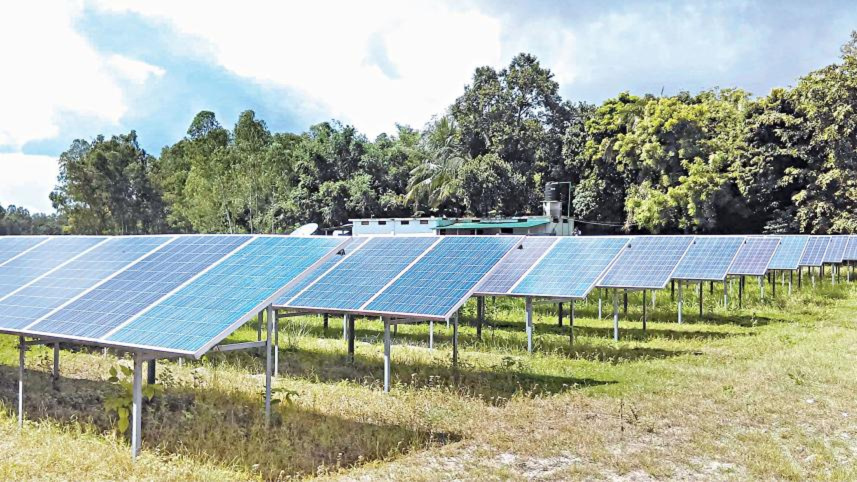
These grievances would have been more tolerable had Bangladesh simultaneously invested in domestic renewable energy. Institute for Energy Economics and Financial Analysis (IEEFA) reports that Bangladesh installed only 245 MW of rooftop solar capacity in the entire 17-year period from June 2008 to June 2025. For a tropical nation receiving 4-5 kilowatt-hours of solar irradiance per square metre daily, this figure is indefensible. The Financial Express reports that within Dhaka alone, approximately 375 MW of installed rooftop solar sits almost entirely idle because no functioning net metering system exists and no government plan integrates this capacity into the distribution grid. Bangladesh mandated solar panels on new buildings in 2012 and then never built the regulatory infrastructure to use the power those panels generate.
The argument that solar is unreliable or insufficient does not survive scrutiny. Germany, at 51 degrees north latitude, receives a fraction of Bangladesh’s sunshine but has an impressive solar capacity. Vietnam deployed more than 20 gigawatts in five years through decisive feed-in tariff policy. Morocco now exports solar electricity to Europe. However, despite strong sunlight, Bangladesh has produced only a bit over 1 GW of solar power after 20 years of policy efforts.
The reason is not entirely technical but political too. Importing LNG generates lucrative procurement contracts. Importing nuclear technology and fuel generates commissions accessible to politically connected intermediaries. Domestic solar, by contrast, is decentralised, transparent, and difficult to extract rent from. The sun does not require a middleman. This structural misalignment between the public interest and the interests of energy procurement syndicates has cost Bangladesh dearly—in foreign exchange, debt accumulation, and in the foregone clean energy that could have powered millions of homes at zero recurring fuel cost.
A $5 billion investment in distributed rooftop solar and utility-scale ground arrays, less than half the Rooppur debt, could have delivered 5,000 to 8,000 MW of domestic capacity with no fuel import cost, no foreign-currency loan, and no geopolitical dependency. According to IEEFA, Bangladesh now needs to deploy approximately 760 MW of new renewable energy annually between 2026 and 2030 just to achieve its modest goal of 20 percent renewables by that date. The FY2025-26 national budget allocates no specific incentives to the renewable energy sector. The gap between stated targets and budgetary commitment is itself an indictment.
Rooppur will generate electricity we need. But Bangladesh must understand that a single $12.65 billion nuclear plant—financed by a geopolitical creditor, repayable in foreign currency over 20 years, vulnerable to sanction disruption—is not an energy strategy. It is a monument to the failure to develop what was free, domestic, and abundant.
Dr Ahad Chowdhury is a geologist, currently teaching at Jefferson Community and Technical College in Louisville, Kentucky.
Views expressed in this article are the author's own.
Follow The Daily Star Opinion on Facebook for the latest opinions, commentaries, and analyses by experts and professionals. To contribute your article or letter to The Daily Star Opinion, see our guidelines for submission.
 For all latest news, follow The Daily Star's Google News channel.
Comments