


Time to draw up a reform roadmap for LDC graduation

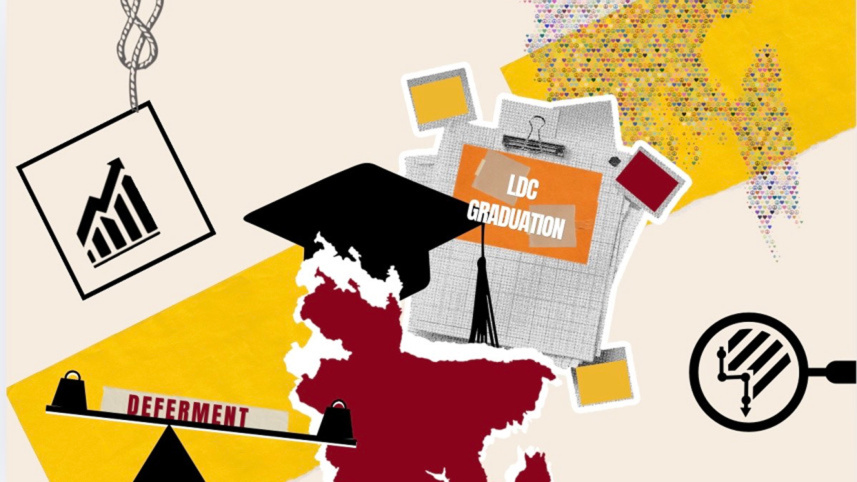
Bangladesh has entered a critical juncture by seeking deferment in formally graduating from the Least Developed Country (LDC) to Developing Country status. For a country that has proven itself to be a development puzzle to the world, it was a challenging decision to request delaying an advancement that has been touted as a symbol of national progress.
We know the country has earned international recognition for its remarkable socioeconomic achievements by meeting all three graduation criteria—Gross National Income (GNI) per capita, Human Assets Index (HAI), and Economic and Environmental Vulnerability Index (EVI). However, stakeholders as well as policymakers have agreed that challenges remain regarding structural preparedness for maintaining socioeconomic stability. At the same time, it is important that economic milestones are not confused with economic preparedness in this regard. Thus, the more pertinent question is not whether Bangladesh deserves to graduate, but whether it is sufficiently prepared to bear the consequences of graduation without undermining its long-term development prospects.

Recognising the economic headwinds facing the country, the government requested the United Nations Committee for Development Policy (CDP) in February 2026 to defer graduation by three years. The CDP subsequently endorsed this request, recommending an extension until November 2029. It stressed that the additional period must be used to implement deep structural reforms rather than postpone difficult decisions. We must be clear and confident that the recommendation is not a diplomatic embarrassment, but rather a strategic opportunity to identify the challenges and vulnerabilities that Bangladesh faces, and formulate solutions to overcome them.
The primary concern is obviously Bangladesh’s overwhelming dependence on a single export sector, namely readymade garments, which accounts for roughly four-fifths of the country’s export earnings. While the sector has been the backbone of Bangladesh’s economic transformation, such concentration creates significant vulnerability. Following LDC graduation, Bangladesh will gradually lose duty-free and quota-free access to many export markets, particularly in the European Union under the existing preferential schemes. It is anticipated that even relatively modest tariff increases would substantially reduce export competitiveness, especially as rival producers continue to enjoy competitive advantages.
The country’s pharmaceutical industry also faces a critical challenge. As an LDC, Bangladesh currently benefits from intellectual property flexibilities under the World Trade Organization’s TRIPS Agreement, which allows domestic manufacturers to produce many patented medicines without paying licensing fees. These flexibilities have helped build one of the strongest pharmaceutical industries in the developing world. Their eventual withdrawal will increase production costs, reduce competitiveness, and potentially affect affordable healthcare unless the industry rapidly upgrades its research, innovation and regulatory capacity.
Bangladesh’s limited progress in export diversification is also a matter of concern. Sectors such as information technology, agro-processing, shipbuilding, leather goods, medical equipment, and light engineering remain comparatively underdeveloped, despite repeated policy commitments over the past two decades. No modern economy can sustainably rely on a single dominant export sector, expecting resilience against evolving external shocks.
Fiscal vulnerability presents another obstacle since Bangladesh continues to have one of the lowest tax-to-GDP ratios in Asia. There is inadequate domestic revenue mobilisation to finance the large investments required in infrastructure, education, healthcare, technological upgrading, and climate adaptation. Therefore, stronger domestic resource mobilisation should make up for the gradual decline in concessional lending.
Foreign direct investment (FDI) inflow is also well below the country’s potential, as investors have time and again identified policy uncertainty, bureaucratic complexity, judicial delays, inconsistent regulation, weaknesses in contract enforcement, and governance challenges as major constraints. Unless these structural issues are addressed comprehensively, graduation alone will not improve investor confidence.
Labour productivity is another area that requires urgent attention. Bangladesh is blessed with a demographic advantage, but shortages of skilled workers persist across manufacturing, digital services, engineering, healthcare, and advanced technologies. The country risks remaining trapped in low-value production even after graduation if major investments are not made in technical education, vocational training, and innovation.
Climate vulnerability further complicates Bangladesh’s position as it is exposed to floods, cyclones, salinity intrusion, and other disasters. So, it is imperative that graduation should be accompanied by substantially greater investment in climate resilience, disaster preparedness, resilient infrastructure, and green industrial transformation. In view of the current realities, postponing graduation until 2029 should be understood as a window for strategic preparation, not any policy complacency. It is important that the additional three years are utilised by defining a clear national reform roadmap.
First, Bangladesh must diversify its exports by offering targeted incentives for high-value manufacturing, information technology, pharmaceuticals, agro-processing, and knowledge-based services. Second, negotiations for preferential market access, including securing the EU’s GSP+ arrangement, should be accelerated, while bilateral and regional free trade agreements with major trading partners should also be pursued before the existing LDC preferences expire. Third, comprehensive tax reforms should broaden the revenue base, improve compliance, and strengthen fiscal sustainability. Fourth, governance reforms, inclusive of regulatory predictability, judicial efficiency, anti-corruption measures, and improvements in ease of doing business must receive the highest political priority.
Fifth, substantial investment should be directed towards education, technical skills, digital infrastructure, research, and innovation so that Bangladesh can move steadily up global value chains. And finally, measurable annual benchmarks for graduation readiness should be established, enabling policymakers, businesses, and development partners to evaluate progress objectively rather than relying on political optimism.
History shows that successful graduation is determined not by crossing statistical thresholds but by achieving structural transformation. Several countries have successfully navigated this transition because they strengthened productivity, diversified exports, and enhanced institutional capacity before preferential treatment expired. Others struggled because graduation preceded genuine economic resilience. Bangladesh has demonstrated extraordinary resilience over the past five decades. We all need to understand clearly that the country’s next challenge is not merely graduating from the LDC category, but graduating into a competitive, diversified, and innovation-driven economy capable of sustaining prosperity without preferential treatment.
A delayed graduation should, therefore, not be interpreted as delaying success. Rather, it is an opportunity to ensure that when Bangladesh finally graduates, it does so from a position of enduring strength.
AKM Wahiduzzaman is deputy permanent representative of Bangladesh to the United Nations in New York, US.
Views expressed in this article are the author's own.
Follow The Daily Star Opinion on Facebook for the latest opinions, commentaries, and analyses by experts and professionals. To contribute your article or letter to The Daily Star Opinion, see our guidelines for submission.
 For all latest news, follow The Daily Star's Google News channel.
Comments