


Tribute to Abul Quasem Fazlul Haq: A beacon in the classroom and beyond

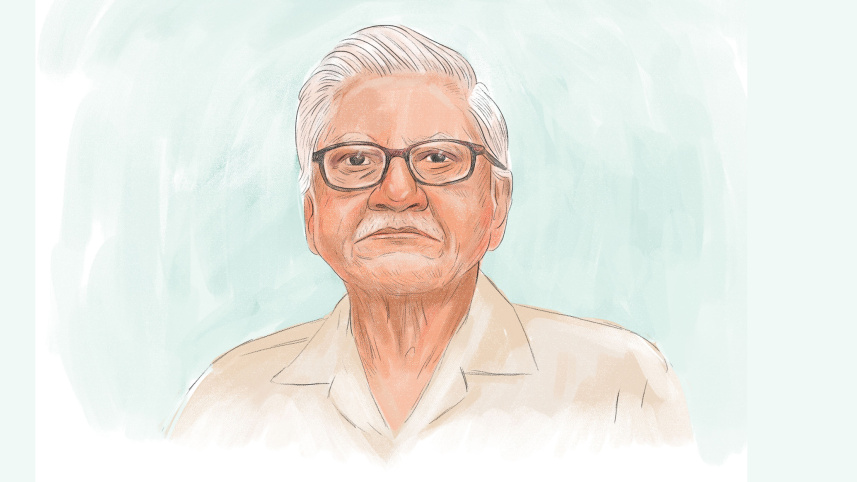
Prof Abul Quasem Fazlul Haq was one of the foremost torchbearers of Bangladeshi culture. Throughout his life, he remained committed to addressing society’s injustices and shortcomings. Learned and scholarly yet remarkably humble, he guided the people of this country while carrying the banner of the Bangalees’ emancipation. With his passing, a dream-like era has come to an end. But he will continue to live on in the consciousness of Bangalees and through the enduring value of his work.
Fazlul Haq was born in Pakundia, Kishoreganj. His father was Muhammad Abdul Hakim, his mother Jahanara Khatun, and his wife Farida Pradhan. His children are Suchita Sharmin and Faisal Arefin Dipan. His daughter is a professor of development studies at Dhaka University and was the first woman vice-chancellor of Barishal University. His son, Faisal Arefin Dipan, owner of Jagriti Prokashani, was murdered on October 31, 2015.

For four decades, Fazlul Haq taught in the Bangla Department at Dhaka University. Through his writing and public engagement, he sought to inspire honest and critical thinking among people. He wished to awaken society’s moral consciousness. He respected people and never looked down upon anyone. He also believed that, since the overwhelming majority of the country’s ordinary people are religious, directly attacking their beliefs only alienates them and ultimately hinders the broader goal of social transformation.
Fazlul Haq upheld throughout his life the belief that “teaching is not a job, it is a vocation.” Through genuine affection and compassion, he shared the light of knowledge with his students and embodied the ideals of a true teacher. Among colleagues and students alike, he was widely respected for his humility and decency. His role as a teacher extended far beyond the classroom. He also showed his students the path towards liberation from exploitation and oppression, and remained steadfast in his commitment to instilling truth in his students. Beginning with his work in the university classroom, he went on to shape the country’s intellectual sector, emerging as a thinker, teacher and guiding light for the nation and society.
He was an accomplished scholar whose intellectual breadth enriched both society and the nation’s ideas. He wrote countless essays for newspapers and magazines, and earned immense acclaim as a literary critic. Over a period spanning 60 years, he authored more than 50 books. His writings spoke of the liberation of ordinary people and carried messages of hope. As a versatile writer, he enjoyed immense popularity among readers. There is a universal religious or moral maxim that every person has three duties in life: a duty to the creator, a duty to one’s parents, and a duty to humanity. Fazlul Haq believed in this philosophy and devoted himself to awakening a sense of humanity in others. In 1981, he received the Bangla Academy Literary Award. On October 27, 2024, the interim government appointed him president of Bangla Academy.
I have many memories of Fazlul Haq—we had the opportunity to attend various events together as guests, and we also appeared on television to discuss contemporary affairs and Bangla language and literature. Whenever we met, he would ask what I was working on and what I was writing. He generously shared his thoughts on language and culture, encouraging me to work for the country’s welfare. He never gave in to despair and always sought to forge a meaningful connection between life and the world around us.
Philosophers, writers, and thinkers awaken society. TS Eliot wrote, “I can never see that poetry can ever be separated from something which I should call belief.” Poetry is born from the poet’s convictions. Poets inspire dreams, and they give voice to humanity in times of crisis. Poetry, therefore, does not remain confined to the pages of books. It lives in human consciousness and imagination. In the end, poetry is truth, and poetry is strength. When that truth and strength resonate through the poet’s voice, the world becomes more beautiful. Another name for that beauty is life itself. Indeed, life is the name of an extraordinary poem. Fazlul Haq was one of the greatest standard-bearers of this vision.
The learned safeguard society. They protect it from destruction. During the July uprising of 2024, Fazlul Haq spoke in support of the people and remained steadfast in his commitment to truth and justice. He was a political philosopher guided by principle. His writings consistently expressed hope and a vision for a better future. His practical, action-oriented thinking was closely connected with lived reality. His thoughtful and intellectually rigorous works on the state, society, politics, economics, philosophy, psychology, ethics, epistemology, and history continue to sharpen and enrich our collective consciousness and judgement. He was a trusted and dependable public intellectual who stood with the country’s labourers, farmers, and hardworking middle-class people. Throughout his life, he wrote in support of the freedom, liberty, democracy, and progress of the people of Bangladesh, always reflecting deeply on the country’s future and the advancement of society.
Throughout his life, Fazlul Haq upheld the ideals of secularism, which remain an aspiration for many people in Bangladesh today. Philosophers and thinkers don’t exist merely to pursue their own interests. Those who think only of themselves cannot endure in the memory of others. Fazlul Haq’s memory remains cherished even after his passing. He was a man of intellectual clarity and integrity. Throughout his life, he worked tirelessly to help students become responsible citizens of the country.
Even in the twilight of his life, he never stopped. He remained actively engaged in promoting the public good through his work. We will never again receive a new book from him, nor hear another of his speeches on transforming society and culture. That is why we must continue to engage with his works. Only by understanding the essence of his ideas can we further expand the influence of Abul Quasem Fazlul Haq’s thoughts in society. I believe that his illuminating words and writings will continue to inspire generations to come.
This article was translated from Bangla.
Dr Mohammad Asaduzzaman is professor at Dhaka University and director at the International Mother Language Institute.
Views expressed in this article are the author's own.
Follow The Daily Star Opinion on Facebook for the latest opinions, commentaries, and analyses by experts and professionals. To contribute your article or letter to The Daily Star Opinion, see our guidelines for submission.
 For all latest news, follow The Daily Star's Google News channel.
Comments