


Return of the King of Pop in Michael
This review contains spoilers.
I have often wondered how someone you have never met or do not know can ever have an impact on you through a television screen. More so if you are considering Michael Jackson’s level of fame, which is a case that can be a field of study in itself. Even the Yawalapiti tribe in the Amazon jungle knew who Michal Jackson was. He was that big.

This year, when Michael (2026), directed by Antoine Fuqua, perhaps the most anticipated biopic of the year, if not the decade, was released, every MJ fan knew that they would be getting the first ticket to the first screening in the theatres. The movie was met with a lot of criticism from critics from all over the world, who weren’t happy with how the movie played out, with most of them rating it as being average. However, that didn’t stop the fans, old and new, from running to the theatres multiple times, making it the most successful biopic ever made, with the current record of making USD 217 million at the box office for its global opening, securing the biggest worldwide debut ever for a musical biopic.
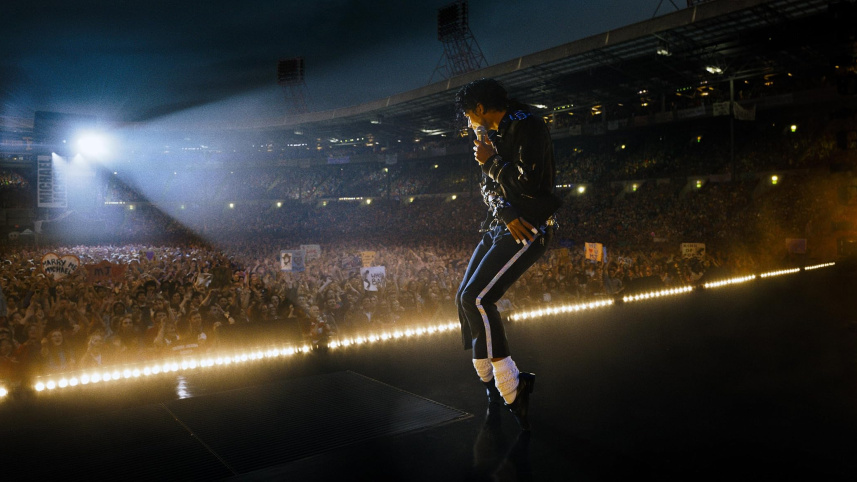
The movie begins with Michael (Jaafar Jackson), the global pop star, walking onto the stage—the scene frozen in time, as if the real-life embodiment of Michael himself graced the audience with his presence. And why wouldn’t it feel that way when Michael’s own nephew played him in his biopic? If anything was excellent about this film, it was Jaafar Jackson’s debut performance, where he perfectly imbibed his uncle’s entirety, from Michael’s soft-spoken style to how he stomped his feet on the stage.
Michael Jackson, the youngest of his brothers, began as the lead vocalist in their family band, The Jackson 5. The movie showcased how difficult it was for the siblings, especially Michael, the youngest, who, if he ever protested against his father, Joseph Jackson (Coleman Domingo), was met with corporal punishment. His relationship with his father was complicated; his father instilled fear in him, leading Michael to rarely stand up for himself.
Raised in fear at home, as The Jackson 5 rose to fame, a softer side of Michael was shown in the movie. This side of Michael used to read, a teenager obsessed with Peter Pan and Neverland, an allusion to him building the Neverland Ranch in the future. One of the sweetest bits of the film is the portrayal of Michael’s love for animals and the accumulation of his exotic pets, beginning from a snake to a giraffe, in his Neverland Ranch. The most special relationship he shared was perhaps with his pet monkey, Bubbles, whom he had saved from lab experiments. Often alone, not finding anyone to spend time with, with close to no friends around his age, Michael hung out with Bubbles, read him storybooks, and played Twister with him.
The movie took a turn when he suffered a third-degree burn and nerve damage during a PepsiCo shoot and found light to announce he was going solo after their last concert for the Victory Tour in 1984. The last scene portrays Michael Jackson’s first solo performance at Wembley Stadium in 1987, performing one of his biggest singles, “Bad”.
The film in itself has met with a lot of backlash, with Fuqua’s direction said to be all over the place and one that wasted no time in capitalising on the musical rights he acquired on the King of Pop’s music, which seemingly happens to be the director’s saving grace. However, as much as the film depicts the making of the greatest songs by Michael, it perhaps fails to show more of what made Michael who he is, limiting the complexities that surrounded Michael’s life to only overcoming parental abuse and loneliness. What the film doesn’t fail in doing is losing focus and remaining true to its title, making the movie about Michael, leaving very little space for the audience to understand the many people who shaped Michael Jackson, except for his abusive father and timid mother (Nia Long).
It is said that biopics are biased; they suffer and serve a side that fits a narrative. Hence, while the storyline may be an amalgamation of many fabricated, fragmented bits of MJ’s life, Jaafar Jackson is a living truth of Michael’s embodiment with his extraordinary portrayal of his uncle. Jaafar not only performs the moonwalk impeccably, but he also sings, dances, and levitates himself to the stature of the great Michael Jackson, making the audience swear that, in some instances, MJ possessed Jaafar’s body and shot a coy glimpse at us. It is true that Michael could have done a better job in developing the musical segments it offered, but it is also true that for fans old and new, the theatres turned into a live performance by Michael Jackson, enabling us to groove to the music, laugh with Michael, and cry every time he was hurt.
At least younger fans got to see close-to-perfect depictions of “Billie Jean”, “Thriller”, and “Human Nature” amongst Michael’s many great performances. And all of that was possible because of Jaafar’s phenomenal performance and his ability to make us reminisce, remember, and fall in love with Michael Jackson all over again.
The movie ends right after Michael’s first solo performance of “Bad” (1988), with the scene cutting to a black screen that says in bold, “His story continues.” Now, fans wait for a confirmation of a sequel, because the 127 minutes spent with Michael were clearly not enough. Perhaps it all becomes less about the movie and comes down to the people who love the King of Pop and want to catch another glimpse of Michael, or experience him for the first time, because some of us weren’t old enough to see him live. Despite its loose ends, Michael’s success is a living testament to who MJ was and still is. His story will definitely continue, because, as it was once said to Michael when receiving an award, "Immortality will cradle you gently in its arms, and you will forever be known.” The words remain true. Long live the King.
 For all latest news, follow The Daily Star's Google News channel.
Comments