


APO 433: Dhaka’s forgotten post office of World War II
9 September 2026
•
In Focus
Dadabhai Naoroji: The man who exposed the economics of British colonialism
8 September 2026
•
In Focus

Untold stories of 1971 through private letters
7 September 2026
•
In Focus
The extraordinary journey of Atish Dipankar Srigyan
6 September 2026
•
In Focus

Forgotten story of Jeanette Van Tassel, the American woman who flew over Dhaka in 1892
5 September 2026
•
In Focus
Beyond 1947 / A personal essay
4 September 2026
•
In Focus
Abul Mansur Ahmad / A global quest in search of a nation
3 September 2026
•
In Focus

Chand Bibi and the forgotten history of Muslim women’s political resistance
2 September 2026
•
In Focus
Women’s voices in Nazrul’s Dhumketu
31 August 2026
•
In Focus
How Milad-un-Nabi shaped Muslim cultural life in colonial Bengal
26 August 2026
•
In Focus

In memory of my teacher
It is, indeed, a great pleasure for me to avail myself the opportunity to say a few words on the occasion of the 100th birthday of the late Professor A. K. Nazmul Karim, who was my teacher, supervisor and colleague at the Department of Sociology,
31 July 2022
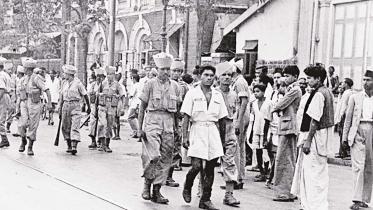
The forgotten mutiny for India’s independence
One of the most important but undervalued events of India’s independence movement was the naval revolt of 1946, about which Indian historian Sumit Sarker wrote,
24 July 2022

Dr Muhammad Shahidullah: A tribute
Dr Shahidullah is one of the greatest linguists that the South Asian region has produced. This is a universally acknowledged fact and one can easily use it as the beginning statement of an article on him.
17 July 2022
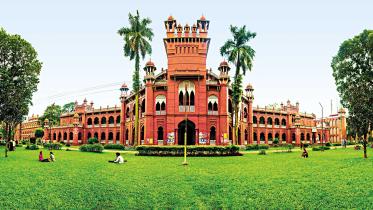
University of Dhaka: The Trillion Dollar Opportunity Cost
Unlike in Western universities, the teaching staff of DU is constituted of her own brilliant graduates, but the brilliance of result is seldom the guarantee of excellence in teaching and competence in research.
3 July 2022
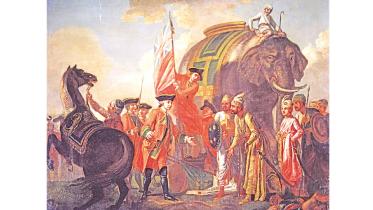
Plassey: Myths and reality
Each year on 23 June arrives an occasion of template lament for Bengalis: the defeat of Siraj-ud-daulah at Plassey at the hands of forces led by Robert Clive—and Bengal’s subsequent quick subjugation by the East India Company.
26 June 2022
A novice’s sadhusongo
In the early 2000’s, a concept restaurant was opened in my birth-town, Paris, France, named “In the Dark” (“Dans le Noir”). Clients enter a completely dark space, and are served a set menu which, obviously, they cannot see.
19 June 2022
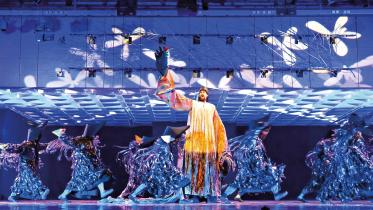
The Making of Theatre: There are no secrets
What makes theatre good, bad or even deadly? I thought I knew the answer to this tricky question. I had a valid ground for this belief because more than thirty years ago, the pre-eminent playwright of Bangladesh,
12 June 2022
Mughal painting in its sequel
It is perhaps possible to formulate the classical qualities of Mughal painting, but it is less easy to point to a given work or a group of works and to say "Here is a definite example wherein everyone of those characteristics is fully and exclusively manifested," and which, thereby, completely isolate the work from other groups or styles of painting. For, Mughal painting was highly eclectic. While three broad streams --Persian, Indian and European-- have long been recognized to have mingled in its formative course, historical research has not yet fully established the manner and the medium through which the indigenous tradition reached the imperial court.
5 June 2022
Nazrul, the eternal rebel warrior: 100 years later
One late December night in 1921, Kazi Nazrul Islam wrote what would be his most iconoclastic poem, the poem that would give rise to his soubriquet, “Bidrohi Kabi,” the Rebel Poet. Inspired by a complex of emotions, Nazrul’s ideas were flowing too fast for his pen to keep pace.
29 May 2022

Remembering Rammohun Roy
It is now commonplace to call Rammohun Roy the ‘Father of Modern India’; it is much less common to understand or appreciate the historical and ideological content and context of this modernity.
22 May 2022

Raja Rammohun Roy: An Autobiographical Sketch
In conformity with the wish, you have frequently expressed, that I should give you an outline of my life, I have now the pleasure to give you the following very brief sketch:-
21 May 2022

Floral economy of Bengal
During the Mughal period, gardens were a ubiquitous element of the city landscape. Dhaka, once capital of the Bengal Subah, was no exception, and the names of some areas of the city such as Shahbag, Lalbag,
15 May 2022
Tagore’s idea of nationalism
If you look for a definition of the word ‘nationalism’ on Google, or in an encyclopedia, you will find quite a few. However, this word, like many such words, is ‘notorious’ in its own way, as no single definition seems to define it thoroughly.
8 May 2022

A search for the Shakespearean semiotics in Bangladesh
This writing celebrates how Bangladesh has practised a ‘disturbingly relevant’ legacy of William Shakespeare through a testimonial of Aly Zaker, a phenomenal figure in the cultural arena of the country.
24 April 2022

Administrative Civil Service in Bangladesh: Its legacy and role
In his seminal publication -- The Men who ruled India (1985) -- Philip Mason, in the last paragraph of the epilogue wrote: “When all has been said, one simple point remains.
17 April 2022
Bishop Heber in Dhaka,1824
Bishop Reginald Heber (1783-1826) was an Oxford educated Anglican clergyman from England, a man of letters and a notable hymn-writer. As an intrepid traveler and a curious observer, he has left behind an interesting travelogue entitled: ‘
10 April 2022

Muzaffar Ahmad’s Unexpected Turn in Life
Muzaffar Ahmad (1889-1973), one of the earliest communists in India, became the representative figure of a socialist and communist circle in Bengal during 1921-22.
3 April 2022

America, Grassroots Activism and the Creation of Bangladesh
Henry Kissinger once wrote that “history is the memory of states”. In this vision of the past,
27 March 2022
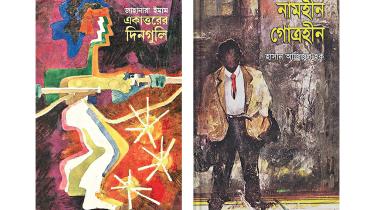
Between fiction and testimony: Revisiting the inheritances Liberation War
Literature in Bangladesh about the war is in the nature of memorials to 1971, a thread between the dead and the living, a reminder of the absent as having once been, a mark of the present, of rupture and continuity.
13 March 2022
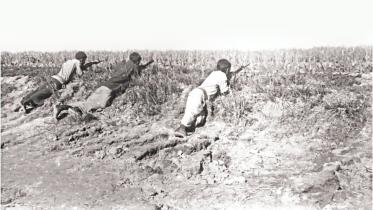
Guerrilla operations
Ak Khandker: Around June-July of 1971, those of us involved in the Liberation War were a bit frustrated. But in mid-August, our naval commandos conducted successful attacks on shipping at the Chittagong and Chalna ports.
6 March 2022