The invisible Mintis of Karwan Bazar

Every night, when most of Dhaka is winding down, Karwan Bazar comes alive. Trucks loaded with vegetables, fish and fruit crowd its narrow lanes, traders negotiate prices and buyers hurry to secure the day’s supplies.
Amid the noise and relentless movement is a group of workers without whom the market could not function. Known locally as Mintis, they carry tonnes of goods on their heads, living from one day’s earnings to the next while remaining largely invisible despite keeping one of Bangladesh’s busiest wholesale markets running.
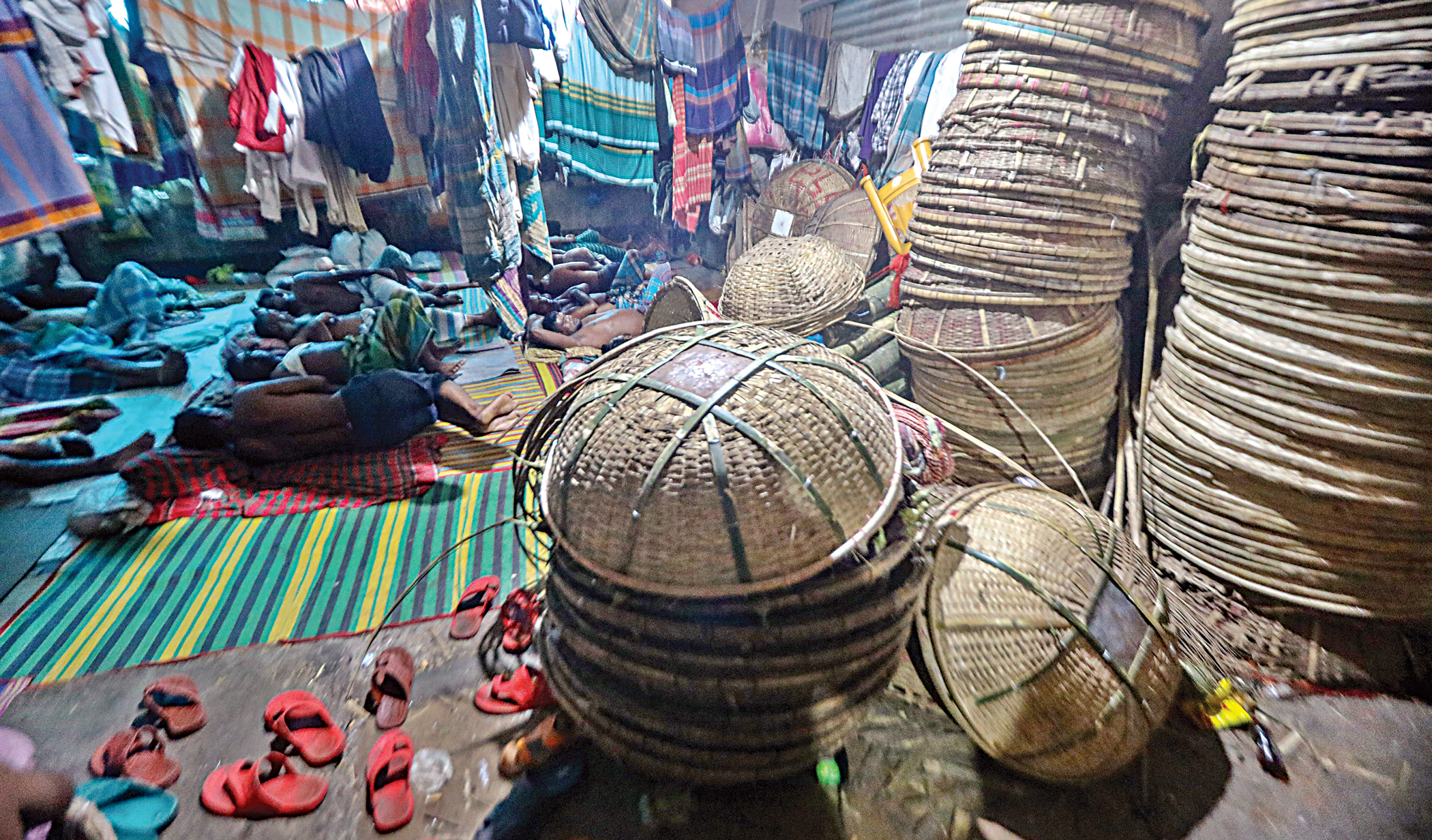
Thousands of Mintis work across the market every day. Most have no permanent accommodation in Dhaka, making the market not only their workplace but also their home. A walk through Karwan Bazar reveals many of them sleeping inside stalls and makeshift rooms between shifts.
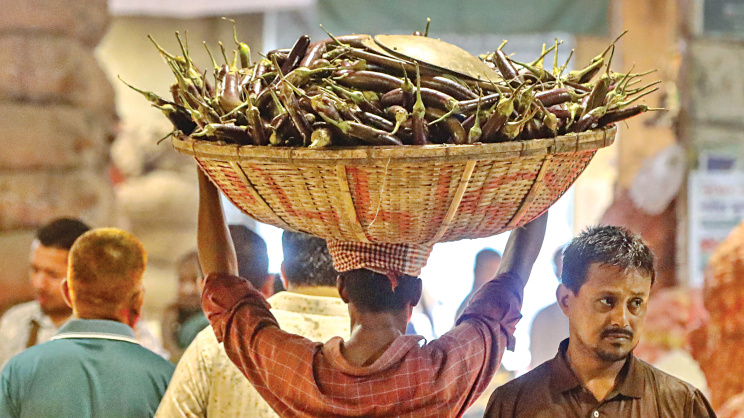
These floating labourers carry goods using large bamboo baskets called tukris, balancing them on their heads before delivering them to waiting vehicles or nearby homes. The baskets are rented each day for Tk 30 from owners who also provide basic sleeping spaces for another Tk 20 per night.
The labour force operates in two shifts. The night shift is the busiest and pays better because of the greater volume of work. Many day labourers take up night work in Karwan Bazar for the extra income. Others work during the day, waiting for customers who need help carrying their purchases.
One of them is Mohammad Nazrul Islam, a 55-year-old Minti who has spent years living and working in Karwan Bazar. For him, the market is more than a place of work; it is also home. His day usually begins around 7:00 or 8:00 in the morning. After renting a tukri, he walks through the market looking for customers, often continuing until 9:00 or 10:00 at night before calling it a day.
Rather than keeping his earnings overnight, he leaves the money at a trusted tea stall, fearing theft. His meals come from cheap hotels inside the market. On days when work is scarce, he has to make do with fewer meals.
When asked how much he earns, Nazrul replied, “It depends on luck.” Sometimes he earns Tk 1,000 to Tk 2,000 from a single heavy load, but such opportunities are rare. On many days, he returns with only a few hundred taka.
The labour ecosystem inside Karwan Bazar extends well beyond the Mintis. The market buildings are owned primarily by the Dhaka North City Corporation. Long-term leaseholders rent them from the corporation, while tukri-rental business owners lease smaller spaces. At the bottom of this chain are the Mintis.
On the second floor, rows of tiny sleeping spaces have been built with corrugated tin and hardboard partitions. The floor also contains communal bathhouses and a room with an old CRT television. Workers pay Tk 10 to bathe and another Tk 10 to use the toilets.
One of the key figures in this ecosystem is Aslam, a tukri-rental business owner and member of the Karwan Bazar Tukri Malik Samabay Samiti. According to him, there are 24 tukri-rental businesses in the market.
Each owner contributes Tk 100 daily to a welfare fund. If a labourer is injured, the cooperative provides up to Tk 5,000 for treatment. If a coolie dies while working, it arranges to transport the body back to the worker’s family.
The tukris are mainly produced in Narsingdi and Mymensingh. Today, producing one costs around Tk 1,200, and labourers rent one for Tk 30 a day after providing identification. When Aslam entered the trade, a tukri cost around Tk 200 to produce and rented for Tk 5. At that time, there were between 1,500 and 2,000 coolies in the market. Today, he estimates the number exceeds 5,000.
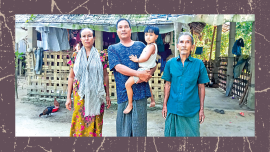
According to Aslam, the labourers come from almost every district, although a significant number are from Mymensingh, Kishoreganj, Sirajganj and Khulna. River erosion remains one of the biggest drivers of this migration, forcing many to leave their land and seek work in Dhaka.
Another labourer, Emdadul, has worked as a Minti for nearly 25 years. Originally from Mymensingh, he moved to Dhaka after the devastating floods of 1988 and has been working as a coolie since the early 1990s.
Unlike many others, he avoids the night shift. Despite the higher pay, he says he can no longer cope with its physical demands.
As migration to the capital continues, so too does the number of Mintis in the crowded lanes of Karwan Bazar. Their labour keeps one of Bangladesh’s largest wholesale markets moving every day.
Yet despite being indispensable to its operation, they remain among its least recognised workers, living within an informal ecosystem that provides just enough support to keep them working, but little security beyond that.
Ystiaque Ahmed is a journalist at The Daily Star.
Send your articles for Slow Reads to slowreads@thedailystar.net. Check out our submission guidelines for details.

Microplastics in Bangladesh’s fish: A growing threat to public health
Republic of the footpath

The dreams of girls in a Bangladesh river char
Can Bangladesh bring back the Chakaria Sundarbans?
Who protects women in Bangladesh's gig economy?
Bangladesh’s climate-displaced / From lost homes to life in Dhaka’s slums
Buried by development: The human cost of river dredging in Dumuria
Char contracts: Surviving river erosion without the state
When extreme heat becomes a death trap for Bangladesh’s workers