Becoming the teacher I never wanted to be

My father is an Indian whose fate brought him to Bangladesh around three decades ago. A brilliant scholarship student of mathematics at Calcutta University, my father arrived in this country alone, leaving his parents and six siblings behind in India, with his personal belongings consisting of only two shirts, two pairs of trousers, two legendary books written by Sankar, and a mere 100-rupee note. For days, he slept on the cold, hard floor in a narrow 8 ft x 5 ft corner of a room in his distant relative's house. I am not sure if he ever managed to get a single night of good sleep while lying in that hot, cramped space, with mosquitoes swirling around his body and no ceiling fan above his head.
When life seemed to betray him at every step, his supercomputer-like brain, extraordinary talent, profound knowledge and relentless hard work did not. He soon took up teaching at a local school and simultaneously started giving maths lessons to the children of his new neighbours. Then he met my mother, and I was born. I still feel like I was the reason he could not return to his homeland—to his ageing parents, who passed away without having their eldest son by their side during their final moments, and to his family, who perhaps still await his homecoming.
I saw my father toiling away day and night but still struggling so hard to provide for his family of four. I saw my father slowly wasting away after years of never-ending labour.
But this story is not about my father as a parent; it is about him as a teacher, and why I once vowed never to follow in his footsteps.
Witnessing the magic
Whenever I remember my early days, I am almost invariably taken back to the tiny, windowless, dark and suffocatingly hot one-bedroom house where I was born and raised until I was three. This unit had an extended, narrow veranda where my father, after his long days at school, used to teach high-school and college maths to young students. I was something of a child prodigy who started reading and writing before I was even two; I was fascinated by the way my father did not just teach maths but also showed its magic to his struggling students during those afternoon tutoring sessions.
All these lived experiences of my father's life as a teacher made me promise myself that when I grew up, I would take up any profession other than the thankless job of teaching.
I would often find myself sitting in the middle of those students and listening, awe-struck, to my father chanting the beautiful formulas of algebra. Even after so many years, I still vividly remember how carefully, passionately, honestly and lovingly my father used to teach his students, many of whom would perform exceptionally well in their board exams, thanks to my father's dedicated lessons.
A vow never to teach
But I also remember the tiny drops of sweat on my father's forehead, the visible signs of exhaustion on his face, the three shirts he would wear on repeat for years, and our tiny one-bedroom house, where sunlight and the spring breeze never had any access. In later years, even though we shifted houses, my father's struggles to put food on our table, give me a decent education and take care of his family in a country that wasn't his own continued. He would travel long distances across different parts of the city to teach his students at their homes. Not a day would pass when he managed to have a decent lunch himself. How could he? He had to reach his students' houses at the pre-scheduled time, after all. But in the evening, when he would finally return home, he would never let us see how tired, hungry or sleep-deprived he felt.
Thus, having witnessed my father's life as a teacher up close, I decided never to become one. I saw my father toiling away day and night but still struggling so hard to provide for his family of four. I saw my father slowly wasting away after years of never-ending labour. It was almost as if, one fine morning, I woke up and discovered that my father had grown old long before he was supposed to.
All these lived experiences of my father's life as a teacher made me promise myself that when I grew up, I would take up any profession other than the thankless job of teaching.
The generational inheritance
But as they say, the apple does not fall far from the tree; it was written in my fate that one day, I would follow in my father’s footsteps and enter the world of academia. I started teaching right after beginning my undergraduate studies, and the very moment I stood in the classroom, in front of my curious young students, something quite inexplicable happened to me. I felt like a completely new person whose only passion in life was teaching. Every word I uttered during my first lecture reinforced my belief that I was born to be a teacher and nothing else. I finally realised that I could by no means refuse the generational inheritance my father had unknowingly passed down to me.

I love teaching, and I love to believe that my father also loved teaching, even though I am abundantly aware of the differences between our passions. For my father, teaching did not just mean moulding young learners’ minds and shaping their futures; it also meant that without it, he, a foreigner in a strange land, had no means of providing for his wife and two little children. So, essentially, my father did not have a choice. For me, a graduate of the top business school in Bangladesh, I had myriad options, such as going into the corporate world, becoming a brand manager for an MNC, or working as a consultant at one of the Big Four firms. But I deliberately chose teaching because I loved being a teacher.
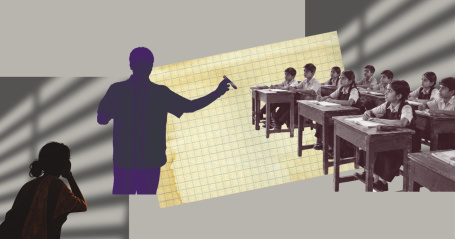
I reminisce about my father's struggle today because I want to remind myself why I am doing what I am doing with my life. As a teacher, my father ultimately never became rich. I know I will never become rich either. But on days when I feel too exhausted and frustrated to stand before my students, who wait patiently for me to begin my lecture, I think of my brilliant father, a maths genius, who, despite the exhaustion and hardships he faced every day, never stopped giving his best to his students.
Nadia Afroze Disha is a Lecturer at BRAC Business School, BRAC University.
Send your articles for Slow Reads to slowreads@thedailystar.net. Check out our submission guidelines for details.
The moral hierarchy of blood
The curious case of Bangladeshi ‘tension’
What can a teacher give that AI cannot?
What phuchka and jhalmuri can teach us about the science of taste
Remembering Yayoi Kusama: My encounters with the master of infinity
Dress and morality : The politics of what women wear
Is being single at 35 a failure?
Travelling through books / One more page please, Mama
BTV does not need a new look to have a new future