


A dream Test 23 years in the making
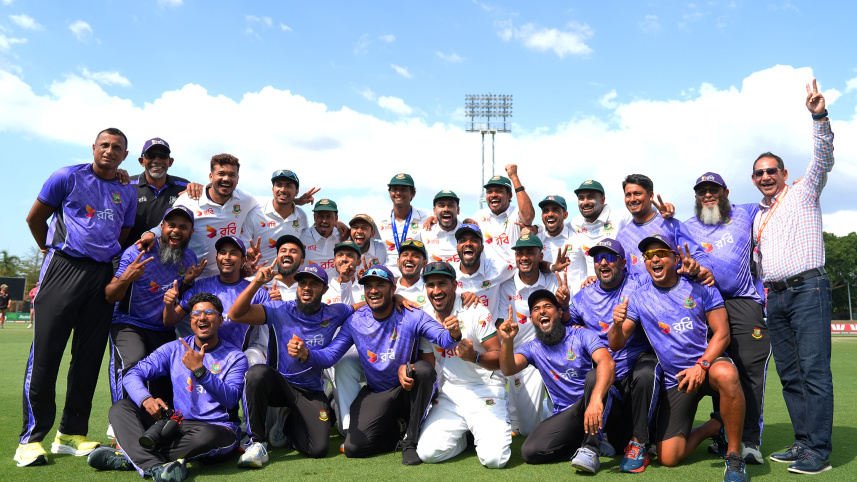
If the manner of Bangladesh’s performance in the first Test against Australia in Darwin, which culminated in a commanding nine-wicket victory on Day 4 yesterday, is anything to go by, the Tigers are a very different unit from the one that last toured Australia 23 years ago.
There was a determination to stay true to Test cricket’s ideals, and in doing so, they earned a result that had been more than two decades in the making.

Winning a Test in Australia is a barometer of how seriously a team wants to be taken in the format. Test culture has been difficult to develop, but since Bangladesh’s last Test tour to Australia in 2003, the Tigers have built a side of substance.
BCB chief selector Habibul Bashar had said before the series that Bangladesh wanted to return with respect. Twenty-three years ago, Bashar and Co. did not earn that respect, losing both Tests by an innings. What Najmul Hossain Shanto and Co. achieved in Darwin, however, will live long in cricket’s folklore.
A win alone garners attention. But the manner of Bangladesh’s domination made this one even more significant. The Tigers had beaten Australia in a Test before, in 2017 at home, but winning in Australia represented another frontier altogether.
For any Test side wanting to be considered a serious contender in the format, winning a five-day battle in Australia is a final frontier. This time, Bangladesh earned that stature and respect in emphatic fashion.
The Tigers’ determination to value the longest format was evident throughout the match. Across four days and 11 sessions, Australia were never really on top.
After being bundled out for 198 in the first innings, it was expected that a team boasting some of the finest fast bowlers and batters of this generation would find a way back, especially on home soil. But Bangladesh never relinquished control.
Individually and collectively, the Tigers overpowered everything Australia threw at them. Without premier pacers Nahid Rana and Shoriful Islam, Hasan Mahmud led the charge with a six-wicket haul on the opening day -- the first five-wicket haul by a Bangladesh bowler in Australia in any format.
Hasan’s career-best figures laid the foundation, but the Test was still going to be an immense challenge for Bangladesh’s batters against Australia’s formidable attack.
Yet Tanzid Tamim, playing only his third Test innings, did the unthinkable. He stood up to Mitchell Starc and Co., producing a maiden Test century in one of the most difficult places to tour and helping Bangladesh make the most of their advantage.
It was not just Tanzid. Every batter contributed. Veteran Mominul Haque set the tone on the opening day before Shanto and Tanzid continued the domination, with Mushfiqur Rahim providing a solid platform on Day 2.
When Australia struck three quick wickets to expose the tail, with only Mehidy Hasan Miraz among the recognised batters, they must have sensed a way back. Instead, Miraz and the tailenders responded with grit and patience, frustrating Australia with a 228-run first-innings lead on Day 3.
The mental toll on Australia was evident when they returned to bat. Bangladesh kept pegging away, executed their plans better and showed greater nuance with the ball, eventually bowling Australia out for 284 early on Day 4 before making light work of the 57-run target.
Even more remarkable, they made Australia bowl on all four days -- an unfathomable feat that was perhaps even stranger than the result itself.
The belief within the Bangladesh camp had never wavered, despite the scepticism outside it. “I saw one main thing: everyone is working really hard and their body language showed they were up for it from the beginning,” Bashar said. “Even after the practice match went poorly, I didn't see anyone having any confusion or doubt that we couldn't do it.”
The scepticism, if anything, appeared to make the Tigers more determined.
“When we came here earlier in 2003, we heard the Test would be over in a day. Coming here this time, we heard it would be over in two days. But seeing the last few days, everyone worked really hard and was determined to achieve something,” Bashar added.
Australia remain one of the strongest Test sides in the world, but Darwin offered conditions unfamiliar to both teams, and a little flat for Australia’s liking. The venue had not hosted a Test since 2004, while the pitch demanded old-school Test cricket -- patience, grit and the ability to spend long periods at the crease. Too used to playing on spicy bowling wickets that produced results within three days, Australia floundered.
Australia, having not played a Test in eight months, found the grind too alien.
 For all latest news, follow The Daily Star's Google News channel.
 In Australia, on their own turf, the Tigers showed the hosts something about Test cricket -- that there is value in the classical, old-school way.
Twenty-three years after having little to show for their first Test tour Down Under, Bangladesh have now shown they can take on Australia in their own conditions and dominate.
From feeling forlorn to proving their mettle at the final frontier, this was a dream 23 years in the making.
Comments