


‘I don’t want Bangladesh to need Tony Hemming forever’
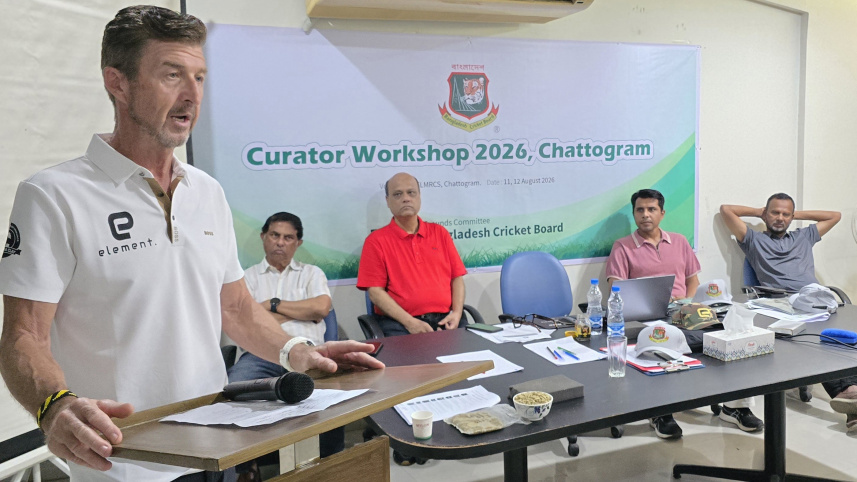
The Bangladesh Cricket Board (BCB) is holding its first-ever Curator Level 1 course with a long-term vision. Led by Head of Turf Management Tony Hemming, the initiative aims to standardise foundational knowledge among participants from Cox’s Bazar, Chattogram, Purbachal, BKSP, and Fatullah, creating a sustainable pathway for the next generation of curators. Hemming spoke to The Daily Star's Abdullah Al Mehdi after Tuesday's opening session in Chattogram about mastering local conditions and ending the reliance on foreign expertise. The excerpts are as follows:
The Daily Star (DS): What is your aim with the course and how are you communicating with the participants?

Tony Hemming (TH): What we're trying to achieve is a recognised accreditation for Level 1 groundstaff. A lot of the groundstaff across the country have worked for many years for the BCB. This is basically standardising their accreditation. It allows us to test their skills, both in theory and in practice. I know a lot of them have the practical skills down, but when it comes to the theory, I just want to make sure they have it in the methodology that we want. When it comes to Level 1, we're looking at an introduction to curation; we're talking about guys with experience, and we're talking about volunteer-type situations.
I have two interpreters with me, and we have a full module written out and completed in Bengali.
DS: Do you see Bangladesh developing their own Tony Hemming someday through such courses?
TH: Absolutely. I don’t want Bangladesh to need Tony Hemming forever. I want to help develop Bangladeshi curators who understand their own country, their own climate, soils, and cricket. What they need is knowledge, experience, mentoring, and opportunity to work on good wickets. If in five to ten years Bangladesh produces curators preparing international wickets and travelling overseas to help other countries, I’ll be proud. Hopefully, they’ll become better than me.
If in five to ten years Bangladesh produces curators preparing international wickets and travelling overseas to help other countries, I’ll be proud.
DS: Ideally, what kind of wickets are being discussed in this course?
TH: We’re really talking about good, consistent, and predictable cricket wickets. The curator’s job is to produce a surface where the players’ skills decide the game. We’re looking at things like the soil profile, clay content, grass species, root depth, moisture, rolling, preparation, and how the pitch changes throughout a match.
DS: How much have you enjoyed your time in Bangladesh so far, and what are the specific requirements for developing good wickets here?
TH: I’ve really enjoyed my time in Bangladesh. I’ve worked in many different countries, but Bangladesh has unique challenges with heat, humidity, rainfall, soil conditions, and a huge amount of cricket. Being on the ground, working with local curators, and seeing how pitches respond has given me a better understanding of what is required here. I have global experience, but the people who work here every day have tremendous local knowledge. If we bring these two things together, Bangladesh can produce some very good cricket wickets.
I’ve worked in many different countries, but Bangladesh has unique challenges with heat, humidity, rainfall, soil conditions, and a huge amount of cricket.
DS: With 30 participants in Chattogram and 40 in Dhaka, how many do you predict will build wickets in Bangladesh’s ecosystem?
TH: I hope many will. I will not put a number on it. Completing a course does not make you an experienced curator overnight. Real learning starts when you work on wickets, make decisions, and learn from mistakes. If 70 people finish these programmes and we develop 15 to 20 strong curators for grounds across Bangladesh, that is a fantastic result. My role is transferring knowledge, developing people, and creating a pathway for the next generation of Bangladeshi curators.
 For all latest news, follow The Daily Star's Google News channel.
Comments