


Brazil lack midfield to play possession football: Ancelotti
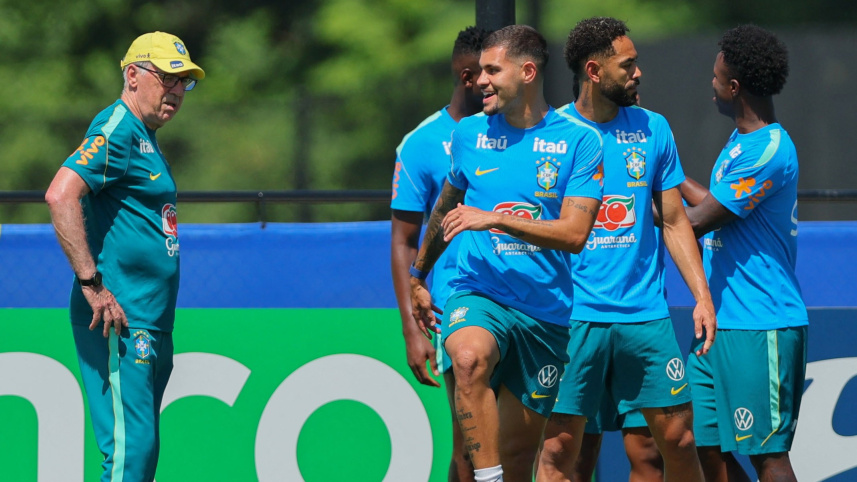
Brazil coach Carlo Ancelotti has defended his side's direct style of play following their disappointing World Cup exit, insisting the Selecao simply do not possess the midfield quality required to dominate possession in the manner of champions Spain.
Brazil were eliminated from this year's World Cup following a 2-1 defeat to Norway in the Round of 16, their earliest exit since 1990, when they were knocked out by Argentina at the same stage. It was also the first time Brazil had failed to reach at least the quarterfinals after progressing to the last eight in each of their previous eight World Cups.

Erling Haaland struck twice in New Jersey to send the five-time champions home, triggering fierce scrutiny of Ancelotti's tactics, team selection and the direction of Brazilian football.
For a country that measures football pain in four-year cycles, the finger-pointing began almost immediately.
Much of it was directed at Ancelotti, who had only a year to rebuild a national side that drifted through three interim managers while the Brazilian Football Confederation waited for him to leave Real Madrid.
His decisions also came under heavy criticism. Bruno Guimaraes was entrusted with an early penalty that he failed to convert, while veteran duo Casemiro and Danilo, both 34, remained on the pitch until the final whistle despite Brazil looking increasingly short of energy, creativity and ideas.
The statistics made for grim reading. Brazil had just 34 percent possession against Norway -- their lowest in a World Cup match since records began in 1966.
Yet Ancelotti believes possession alone is a misleading measure of performance.
"I think the team needs to have a style based on the characteristics of the players," Ancelotti told Brazilian broadcaster ge on Wednesday.
"The truth is that you might receive criticism because the team had less possession than Norway. The structure, the characteristics of the players, are not suited to playing a possession-based game."
Instead, Ancelotti argued Brazil's strengths lie in attacking quickly through the pace and movement of their forwards. For the Italian, the message is clear. Brazil should stop trying to imitate Spain's blueprint and instead embrace a style that suits the players they have – at least until another generation of elite midfielders arrives.
"When you have players like Vinicius, Endrick, Estevao and Raphinha up front, you don't have to play a possession-based game. You have to play a more vertical game.
"So the style is based on the characteristics of the players. If new players emerge, a very high-quality midfielder, obviously you can play a more possession-based game."
Despite their wealth of attacking talent, Brazil rarely looked fluid through the middle or composed in possession throughout the tournament. Their midfield lacked dynamism and mobility, struggled to dictate the tempo, and often failed to provide the control or creativity needed against top opponents -- an issue that has plagued several Brazil teams at recent World Cups.
Ancelotti pointed to Spain's World Cup-winning side as the perfect example of why possession football depends on personnel rather than philosophy.
"It's true that the team that won the World Cup, Spain, had a lot of possession," he said.
"But Spain conceded a goal. They had a lot of possession because Spain has a very strong generation of midfielders. They have seven top midfielders in the world: Fabián, Rodri, Pedri, Olmo, Zubimendi, Merino and Gavi. Seven.
"So they sought the possibility of controlling the game and winning the World Cup."
Asked whether Brazilian supporters would have to accept seeing the national team regularly surrender possession, Ancelotti again stressed that style should be dictated by the players available.
"I think there are games where having less possession isn't so decisive, because it depends on the players' characteristics," he said.
 For all latest news, follow The Daily Star's Google News channel.
 "When a team has Vinicius Junior, Endrick and Estevao up front, who attack the depth a lot, they have to play a more vertical game than others. That's not the case with Spain, which doesn't have players of that quality up front. They have one player, Lamine, who is very good in one-on-one situations. But the others are all combination players."
Comments