


Can football stay the people’s game?

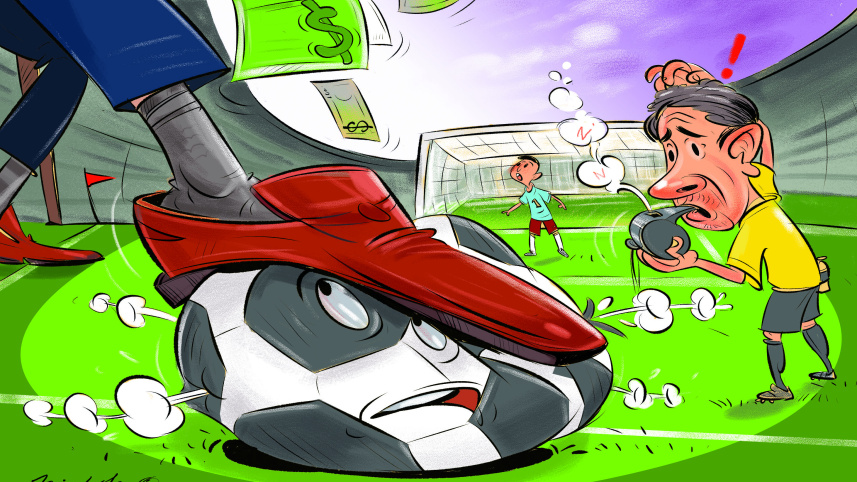
Just days after the biggest FIFA World Cup in history came to a close, FIFA unveiled a proposal that threatens to alter football's future fundamentally, with critics warning it could push the world's most popular game away from its sporting ideals and towards a model increasingly shaped by investor interests.
UEFA's member associations voted unanimously to boycott the World Cup and other FIFA competitions if FIFA goes through with its plan, with the decision taken at a virtual meeting yesterday.

FIFA on Tuesday proposed creating a private subsidiary named FIFA Forward Enterprise (FFE) to manage the commercial operations of its major tournaments, including the World Cup.
The governing body plans to sell minority, non-controlling stakes in the company to private investors, while insisting it will retain majority ownership and full authority over footballing matters such as statutes, voting rights for its 211 member associations, hosting decisions, competitions, development programmes, the international match calendar, and the overall structure of the sport.
While FIFA president Gianni Infantino insists the proposal is "a golden opportunity to turbocharge the development of the game globally", the financial windfall awaiting the global governing body is difficult to ignore. FIFA hopes to raise $4.2 billion from long-term investors, with FFE expected to be valued at around $20 billion.
Infantino has insisted the proposal is "just an offer, not an obligation". Yet the circumstances surrounding its emergence have inevitably fuelled scepticism.
The plan only became public after The Times revealed its existence last Tuesday. FIFA formally announced the proposal only after the leak, prompting widespread criticism over transparency, investor influence, potential conflicts of interest, and the accelerating commercialisation of the sport.
The concerns deepened further after The Times reported that discussions had already begun with financial advisers and potential investors. Among those named were Thrive Capital, the investment firm founded by Joshua Kushner -- brother of US President Donald Trump's son-in-law Jared Kushner -- and an arm of JP Morgan Chase, the American bank that previously attempted to finance the failed breakaway European Super League.
The report also claimed that Infantino, 56, could eventually benefit personally from the structure by becoming commissioner of FFE after his expected final presidential term ends in 2031. FIFA denied that such a possibility had ever been discussed.
The timing of FIFA's pitch to its member associations has done little to ease concerns.
Infantino told all 211 member associations that they could receive as much as $40 million during the next funding cycle between 2027 and 2030 -- including $20 million upon signing -- if they support the proposal. They have been given until September 19 to sign up, leaving them less than two months to decide.
That has inevitably raised questions over whether the financial incentives are designed simply to support football development or to secure approval for one of the most significant structural changes in FIFA's history.
According to The Times, opponents of the proposal have described the promised payments as "outright bribery". Whether or not that characterisation is justified, the offer presents a dilemma, particularly for smaller football nations such as Bangladesh, where FIFA funding remains vital for infrastructure and long-term development.
While $40 million may not significantly influence Europe's wealthy UEFA members or South America's CONMEBOL, home to footballing powerhouses such as Brazil and Argentina, the equation is vastly different for the other four continental confederations -- the AFC, CAF, CONCACAF and OFC -- where FIFA funding plays a far greater role in sustaining football's growth.
CAF's response appeared to reflect that reality.
The African confederation said it remained "committed to continue consulting" with its member associations "in support of increasing financial and other resources for the development and growth of football in Africa and worldwide" -- a stance that suggests the financial benefits alone make the proposal difficult to dismiss outright.
Others, however, have been far more critical.
AFC president Sheikh Salman bin Ebrahim Al Khalifa, whose confederation includes Bangladesh among its 47 member nations, branded FIFA's lack of consultation over the proposal "totally unacceptable", arguing that it undermines football's existing continental structure.
Meanwhile, the broader concern extends far beyond governance.
Private equity firms do not invest billions without expecting significant returns, and critics fear that commercial priorities could gradually begin shaping football itself. Pressure to maximise revenues could eventually lead to larger and more frequent tournaments, an even more congested international calendar, greater emphasis on premium broadcasting and sponsorship deals, and decisions increasingly driven by commercial value rather than sporting integrity.
 For all latest news, follow The Daily Star's Google News channel.
 The recently concluded World Cup offered a glimpse of those concerns.
Expanded to 48 teams for the first time, it was the largest World Cup ever staged. Yet even before kickoff, questions had emerged over whether the tournament was becoming too commercialised.
Ticket prices soared, with even standard seats costing around $4,000 for some matches. Fans also faced significant travel expenses across the three host nations -- the United States, Canada, and Mexico -- while visa complications, particularly in the United States, prevented many supporters, and even family members of the participants, from attending.
On the pitch, the introduction of quarter-style breaks through hydration intervals in air-conditioned and domed stadiums also attracted criticism. While officially implemented for player welfare, many supporters viewed the interruptions as additional opportunities for advertising, disrupting the rhythm of matches and the viewing experience.
Combined with the soaring costs, many observers labelled it a World Cup increasingly designed for affluent spectators rather than ordinary supporters, despite FIFA celebrating record attendances and television audiences.
Against that backdrop, Infantino's assurance that commercialising FIFA's competitions would allow "fans from everywhere in the world [to] gain immeasurably from this game-changing potential" has struggled to convince many sceptics.
Football has always evolved, whether through tactical revolutions, technological innovation or tournament expansion. But those changes have traditionally been introduced in pursuit of improving the sport itself. FIFA's latest proposal marks something fundamentally different: opening the game's commercial engine to private investment for the first time.
The question, therefore, is no longer whether football can generate more money; it already does that better than almost any other sport. The real question is who that money will ultimately serve.
If investor expectations begin influencing the direction of football's biggest competitions, the sport risks becoming less about the millions who play and follow it, and more about the billions it can generate. That would not simply change football's finances -- it could change football as the world has always known it.
Comments