


£266m, eight deals and counting: Inside Chelsea and Aston Villa's transfer ‘relationship’

“The relationship is only through the deals -- for money, for other players ... it is not a good relationship.”
Aston Villa and Chelsea may have become two of the Premier League's most frequent trading partners, but Aston Villa manager Unai Emery insists there is no friendship behind the business.

“They want to kill us. And we want to kill them.”
The timing of Emiliano Martinez's move makes that relationship difficult to ignore.
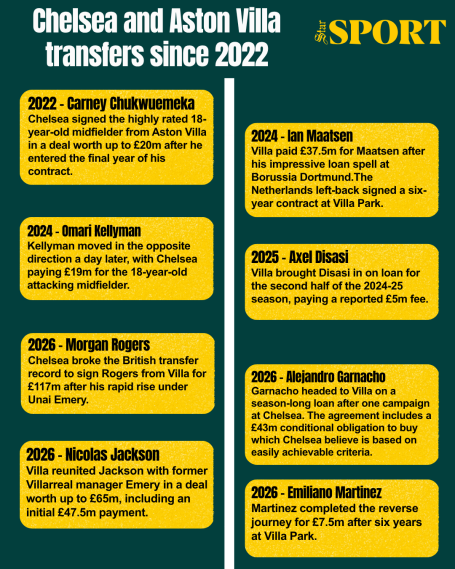
The Argentina goalkeeper joined Chelsea on Sunday for £7.5m, becoming the eighth player to move between the clubs since 2022. Four of those deals have come this summer alone, with Morgan Rogers, Nicolas Jackson and Alejandro Garnacho also crossing between Stamford Bridge and Villa Park.
They want to kill us. And we want to kill them.
In total, Chelsea have paid Villa £163.5m for players since 2022, while Villa have spent £102.5m on Chelsea players, including Axel Disasi's loan fee.
That is £266m exchanged between two clubs who, according to Emery, want to “kill” each other.
So why do they keep doing business?
A transfer corridor has emerged
The relationship accelerated after BlueCo's takeover of Chelsea in 2022 and has since developed into one of the most unusual transfer pipelines in English football.
Carney Chukwuemeka was the first major deal of the new era, moving from Villa to Chelsea for £20m.
Omari Kellyman followed for £19m in 2024, while Ian Maatsen went the other way for £37.5m. Last season, Axel Disasi joined Villa on loan for £5m.
Then came this summer's remarkable run.
Rogers moved to Chelsea for £117m, a British-record fee. Garnacho then went to Villa on loan with a conditional obligation to buy, while Jackson joined permanently in a deal worth up to £65m.
Martínez is now the latest piece of the puzzle.
There has even been movement beyond the playing squad, with Chelsea bringing in Villa's former set-piece coach Austin MacPhee this summer.
Not a unique ‘relationship’
Villa are not, however, Chelsea's only major transfer partner.
According to BBC Sport's analysis of permanent and loan deals between the 15 clubs that have remained in the Premier League since 2022, Chelsea have also completed eight deals with Brighton.
 For all latest news, follow The Daily Star's Google News channel.
 According to BBC Sport's analysis of permanent and loan deals between the 15 clubs that have remained in the Premier League since 2022, Chelsea have also completed eight deals with Brighton.
That puts Chelsea-Villa and Chelsea-Brighton joint-top.
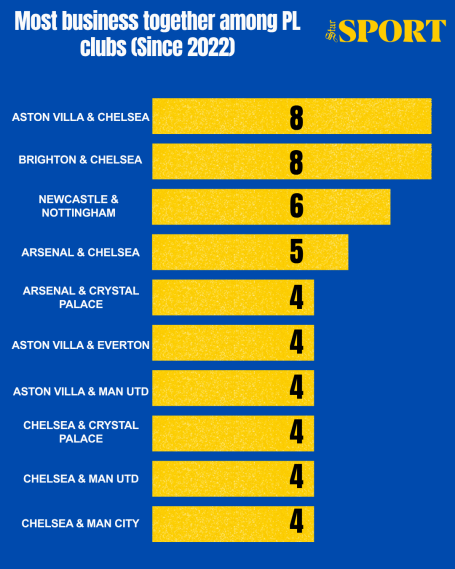
Newcastle and Nottingham Forest are next on six, while Arsenal and Chelsea have exchanged five players.
More strikingly, Chelsea feature in six of the 10 busiest club pairings.
That suggests the Villa relationship is part of something bigger: Chelsea's post-BlueCo transfer model has made domestic trading a central part of their squad-building and squad-clearing process.
Why Villa?
There is a more specific reason why Villa have become such a regular counterparty.
Chelsea co-owner Behdad Eghbali and Villa owner Nassef Sawiris have developed a close working relationship and communicated directly over transfer business, according to BBC Sport.
That does not mean every deal is part of some grand exchange.
Villa had already been interested in Jackson, who previously worked with Emery at Villarreal.
Chelsea's interest in Martínez can similarly be explained by their need for a goalkeeper after Robert Sanchez's inconsistent start to the season.

But an existing relationship between decision-makers can make negotiations easier when footballing interests happen to align. And this summer, they have aligned repeatedly.
The questions around the deals
That frequency has not gone unnoticed.
BBC Sport reported that a number of Premier League club executives have raised questions about the volume of business between the two clubs, particularly while both have had to navigate domestic and European financial regulations.
There is no suggestion that either club has broken any rules.
UEFA can scrutinise transfers between the same clubs completed within a 45-day period. Garnacho's move to Villa came two days after Rogers joined Chelsea, while Jackson's permanent transfer was completed 38 days after the Rogers deal.
But timing alone is not evidence that separate transactions are connected.
Villa can point to their long-standing interest in Jackson. Chelsea can argue that Martinez was being pursued because of their own goalkeeping requirements, independent of previous business with Villa.
Rivals on the pitch, partners in the market
Villa and Chelsea are competing for the same Premier League points, European places and players. Yet they have repeatedly found mutually beneficial deals.
Rogers is now trying to hurt Villa rather than help them. Martinez has left Emery for Chelsea. Jackson is expected to help fill the attacking void left by Ollie Watkins, while Garnacho could eventually become another major Villa investment.
And there is still the possibility of more business before the window closes.
Emery's point, ultimately, is that none of this changes the nature of the rivalry.
They may want to “kill” each other on the pitch. In the transfer market, they keep coming back for another deal.
“It is a deal for money and a deal for players,” he said.
They may want to “kill” each other on the pitch. In the transfer market, they keep coming back for another deal.
Why buy from a Premier League rival?
There is nothing inherently unusual about Premier League clubs buying from one another. Money is, obviously, a major reason.
English clubs generally have greater spending power than teams elsewhere in Europe, meaning another Premier League side can often be one of the few realistic buyers for a high-value player.
Domestic transfers can also carry less recruitment risk. Clubs already know how a player performs in the Premier League and have extensive data and scouting information on them.
For sellers, there is often a better chance of receiving a significant fee. For buyers, there is less uncertainty about adaptation.
But even in a league where domestic trading is common, the volume of business between Villa and Chelsea stands out.
Comments