


Costa Rica's spark shines in shadows of giants

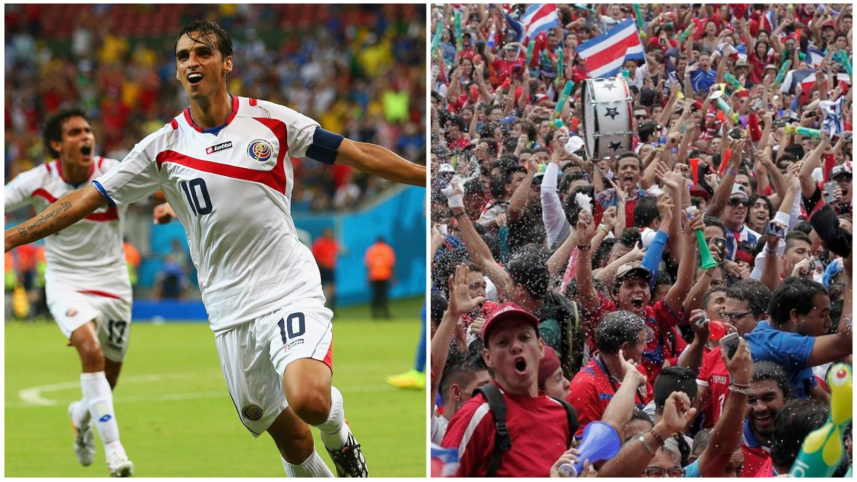
The Group D of the 2014 World Cup in Brazil had already been widely branded as the "group of death". Featuring Uruguay, Italy, and England, it was the only group in World Cup history to contain three former world champions. Amidst these footballing heavyweights, Costa Rica were dismissed by almost everyone as mere whipping boys -- a convenient source of points for the giants.
The consensus was that they would finish rock bottom and head home after the first round. Yet, the true beauty of the World Cup lies in its unpredictability, where the astonishing rise of an underdog leaves an indelible mark on the hearts of football romantics.

Twelve years ago, the Central American nation of Costa Rica authored precisely such an unforgettable fairytale. Turning all predictions on their head, they proved that on the pitch, no powerhouse is invincible when faced with self-belief and tactical precision.
Their Colombian manager, Jorge Luis Pinto, was completely driven by this mantra. He had been sacked from the Costa Rica job midway through the World Cup qualifiers in 2005, but returning for a second stint, his faith was absolute. He knew his team was far greater than just a collection of individuals. Indeed, that squad was being hailed as the most talented in Costa Rica's history; 14 of the players plied their trade overseas, with 11 featuring in various European leagues.
Costa Rica opened their campaign against Uruguay. The script seemed to follow the expected lines in the first half when Júnior Diaz fouled Diego Lugano in the penalty area, allowing Edinson Cavani to slot home from the spot and put Uruguay ahead. Diego Forlan then saw a shot brilliantly turned away by goalkeeper Keylor Navas, preventing the gap from doubling. At that moment, it appeared the predicted narrative was playing out flawlessly.
The second half, however, unveiled a completely transformed Costa Rica. Meeting a superb cross from Cristian Gamboa, Joel Campbell drilled a low, right-footed strike into the net to equalise. Just three minutes later, Oscar Duarte met a Cristian Bolanos free-kick with a brave diving header to give his side the lead. Late in the match, Campbell turned provider, slipping a pass to substitute Marco Urena, who coolly made it 3-1. In a stunning upset, Pinto’s men sent shockwaves through the footballing world by dismantling the two-time champions.
The victory was historic on multiple fronts. For the first time in World Cup history, Costa Rica scored three goals in a single match. It also marked the very first time Uruguay had ever suffered a World Cup defeat at the hands of a nation from outside Europe or South America.
Next up were the four-time world champions, Italy. A soaring Costa Rica unleashed another breathtaking performance against the Azzurri. In the first half, after Italy's Mario Balotelli squandered a clear chance, the referee waved away a blatant penalty shout for a foul on Costa Rica's Campbell. But just before the half-time whistle, Diaz whipped in a cross from the left, and Bryan Ruiz rose to head the ball home. The strike rattled the underside of the crossbar and bounced down over the line.
Reflecting on that goal, the then-captain Ruiz later recalled, "That goal will forever be a part of Costa Rica's history, and a part of me too. Strategically, we executed exactly what our manager Pinto wanted.
“The build-up to the goal was beautiful -- there were seven or eight passes before my header. The ball hit the bar and crossed the line by only about three centimetres. But that was enough to take us to the next round. It was an incredible moment!"
Holding onto their lead for the remainder of the game, the 1-0 triumph over Italy guaranteed Costa Rica a place in the World Cup knockout stages for the first time since 1990. Coincidentally, that history-making win 24 years prior had also occurred on 20 June. With this victory, Costa Rica became only the second team after Denmark (in 1986 and 2002) to defeat two former world champions in the group stage of a single World Cup.
Speaking on this unbelievable journey, Ruiz added, "We were in the 'Group of Death' and everyone thought we were just there to lose. Coming from behind to beat Uruguay 3-1 gave us a massive boost of confidence. Then we beat Italy. So, before facing an England side packed with stars like Wayne Rooney, Steven Gerrard, and Frank Lampard, we genuinely started to believe we could beat anyone. We played brilliantly in that match and could have won. But the point from the draw made us group champions -- another historic achievement."
By then, the exit papers had already been stamped for 1966 world champions England. Led by Frank Lampard and fielding nine changes in a dead-rubber final group game, England were held to a goalless draw by Costa Rica. Pinto’s side marched into the knockouts unbeaten, topping the group with 7 points. Uruguay finished as runners-up with 6 points, while Italy packed their bags alongside England.
Gathering momentum, Costa Rica’s dream run continued in the Round of 16, where they overcame Greece 5-3 in a dramatic penalty shootout, largely thanks to the heroics of Navas. The moment Michael Umana smashed his spot-kick into the back of the net, the nation erupted in celebration, scaling a mountain they had never climbed before: their first-ever World Cup quarter-final. They were now just two steps away from the final -- a goal that once seemed unimaginable but now felt entirely within reach.
Their fairytale run finally met its end in the last eight against the Netherlands, though the Costa Ricans fought with immense courage against a formidable Dutch side. The match remained a scoreless stalemate after both regulation and extra time. However, just before the penalty shootout, the footballing world witnessed a masterstroke. Netherlands manager Louis van Gaal substituted his goalkeeper, bringing on Tim Krul specifically for the shootout. It proved to be the turning point. Krul parried away the efforts of Ruiz and Umana, carrying the Dutch through to the semi-finals.
The cruelty of a penalty shootout may have halted Costa Rica's breathtaking campaign, but the beacon of light they ignited in the 2014 Group of Death will forever shine undiminished in the history of football.
 For all latest news, follow The Daily Star's Google News channel.
Comments