


Pure passion in absentia

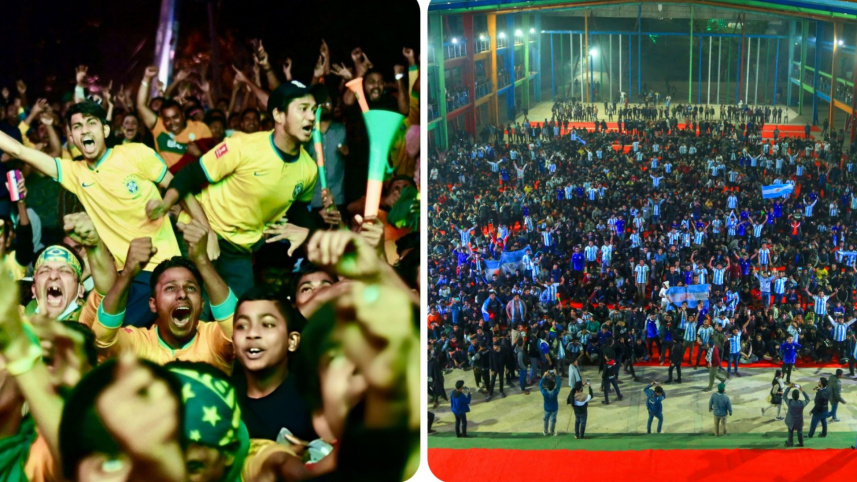
On the night Argentina defeated France in the 2022 FIFA World Cup final, parts of Dhaka barely slept. Blue-and-white flags hung like tapestries from rooftops and balconies. Fireworks shattered the midnight, and dense crowds erupted in celebrations that perfectly mirrored the euphoric scenes at the Plaza de la Republica in Buenos Aires.
For a few hours, two cities on opposite sides of the planet shared a single heartbeat. For a few hours, it felt as though the trophy belonged to a nation who has never played in a FIFA World Cup; not even coming remotely close.

Yet every four years, this South Asian nation converts the tournament into a carnival. From roadside tea stalls to high-rise corporate corridors, football dominates daily conversation. Lacking a local horse in the race, millions of fans go to extraordinary lengths to display their adopted tribalism.
Their deep bond with Argentina dates back to 1986, when Diego Maradona single-handedly conquered the world. His rise coincided with the precise moment color television was popping up across Bangladeshi households, beamed into packed living rooms via the single, state-owned TV channel. While Bangladesh’s own national team were only just beginning their first-ever qualification journey that same decade, Maradona provided a hypnotic introduction to anchor a lifelong obsession with the global spectacle.
Brazil represents the other emotional superpower -- a five-time champion whose historical joga bonito-powered success found deep resonance across generations, cultivated well before the widespread arrival of satellite television. Over time, European heavyweights like Germany, Italy, the Netherlands, and Spain have also carved out fierce followings. So deep is this proxy loyalty that when Italy failed to qualify for recent tournaments, pockets of die-hard Bangladeshi Azzurri supporters chose to boycott the broadcasts entirely.
Beyond the traditional South American and European giants, allegiance is also driven by continental solidarity and shared faith. Every four years, fans passionately rally behind Asian powerhouses like Japan and South Korea, while a religious affinity anchors widespread devotion to fellow Muslim-majority nations such as Saudi Arabia, Senegal, and Morocco.
This vibrant global outlook exists independently of Bangladesh’s own reality on the pitch. Over the forty-one years since that initial foray into qualifiers, the men in red and green have stalled out across 11 failed campaigns, sinking to their current position as the 181st-ranked side. A nadir for the local game arrived during the 2018 cycle, when a shocking defeat to Bhutan exiled the national team into a bleak, 17-month international football wilderness from October 2016.
But while domestic administrative failures might have breed apathy, the distance has only served to intensify the romance with the World Cup.
During the 2022 tournament in Qatar, this vicarious passion finally commanded the global spotlight. The sheer scale of the fandom caught the attention of the Argentina camp itself. Ahead of their Round of 16 clash against Australia, head coach Lionel Scaloni paused to acknowledge the support from thousands of miles away.
"For years the national team shirt has transmitted a madness throughout the world, because we had Diego [Maradona], and now we have Leo [Messi]. It makes us happy that there are people in Bangladesh standing up for us," said Scaloni. "Thanks to the people of Bangladesh."
The sentiment was more than just polite press-room diplomacy; it carried genuine geopolitical consequence. In 2023, Argentina officially reopened its embassy in Dhaka after a 45-year closure, reportedly influenced by the overwhelming support shown by Bangladeshi fans. Brazil, too, had recognized this obsession. Back in 2018, its former ambassador made a formal visit to Narayanganj to see up close a six-storey building painted entirely in Selecao's iconic canary yellow.
But the geography of the 2026 World Cup threatens to sever this connection. If Qatar 2022 felt like an accessible crossroads, the upcoming tournament across North America presents a formidable fortress of visa restrictions and skyrocketing ticket prices.
The obstacles are already keeping out dedicated fans, with numerous Bangladeshi supporters facing rejections right and left due to the ever-so-strict visa processing for the US. Among them is Mustafizur Rahman, a businessman from Habiganj who watched the "greatest show on earth" from the stands in 2022. "I faced the embassy in October last year. I was planning to buy the match tickets only after getting the visa, but I was refused," he explained.
Worryingly, this cold bureaucratic wall does not discriminate; even sports journalists from Bangladesh, formally accredited by FIFA to cover the extravaganza, are facing the same ominous music at the consulate gates.
The financial barrier is equally steep. Even the wealthy and privileged are feeling the pinch of inflation and exclusive ticketing systems. When Shakib Al Hasan -- Bangladesh’s premier cricket icon, a multi-millionaire, and current US resident -- publicly muses about needing assistance from the football federation just to secure match tickets, the scale of exclusion for the ordinary fan becomes starkly clear.
Compounding the anxiety had been an unprecedented domestic broadcasting deadlock, with TV rights hanging in limbo till it was solved only a week before the tournament got underway.
But irrespective of whether fans in Bangladesh continue their quadrennial bond-renewal tradition with television, history suggests that on the rooftops of Dhaka and elsewhere, the blue, white, and yellow flags will inevitably rise. The nation, despite being the World Cup’s ultimate ghost participants, will remain indispensable to the magic of the spectacle.
 For all latest news, follow The Daily Star's Google News channel.
Comments