


Crisis in a Cylinder

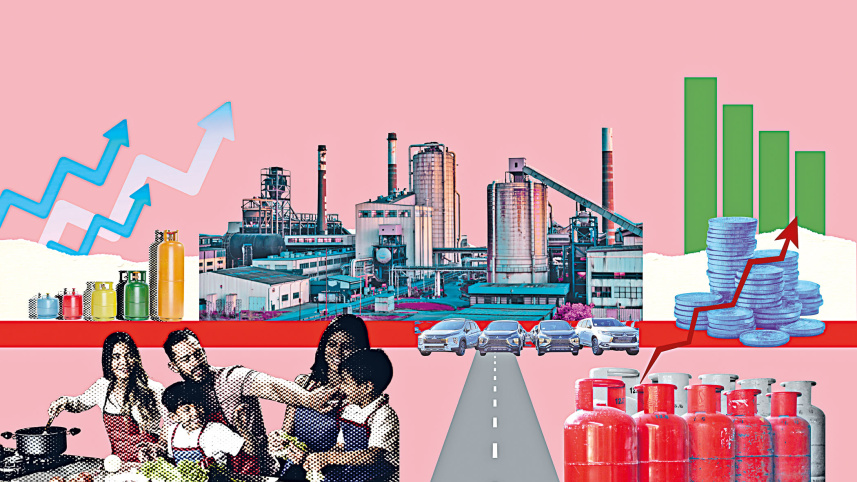
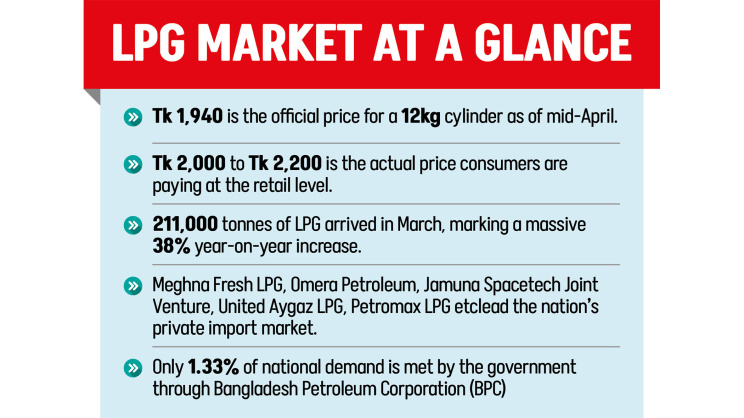
Gas cylinder prices have surged recently, hitting Tk 1,940 for a 12 kg LPG (Liquefied Petroleum Gas) cylinder by mid-April 2026. Distributors often charge far above the official rate which is up to Tk 2,300 per cylinder in Dhaka. Industry insiders blame private syndicates and global supply strains. As March 2026 saw 211,000 tonnes of LPG (up 38% year-on-year) handled by about 10 major private. The government, which directly supplies only about 1.33% of demand via by‑product propane, plans to intervene by bulk‑importing LPG to stabilize the market. In the short term, analysts say much depends on global factors as Middle East conflicts are disrupting tankers for which back‑to‑back price hikes are straining household budgets. This persistent gap between policy and the marketplace is a symptom of a much larger crisis involving global warfare, a domestic currency crunch, and a supply chain that is struggling to find its footing under immense pressure.
The Geopolitical Grip

The primary driver of the current energy crisis in Bangladesh is not found within its borders but in the volatile shipping lanes of the Middle East and the shifting benchmarks of global commodities. As a nation that imports nearly 90 per cent of its LPG requirement, Bangladesh is uniquely vulnerable to the price of propane and butane as set by the Saudi Aramco contract price. When regional conflicts escalate, as seen in recent months, the cost of securing fuel does not just rise at the source; it balloons through the entire logistics chain. Tankers that once navigated direct routes are now forced into long, costly detours to avoid conflict zones, causing freight insurance and shipping rates to skyrocket. This “international premium” is a cost that local importers must bear even before the gas reaches the ports of Mongla or Chattogram.
Adding to this global pressure is the domestic challenge of the dollar crisis. Importers have voiced consistent concerns over the difficulty of opening Letters of Credit (LCs) at the speed required to maintain a steady supply. When the international market fluctuates rapidly, any delay in financial processing can mean the difference between a profitable shipment and a massive loss. While the central bank has occasionally eased credit rules to allow larger importers more flexibility, the underlying shortage of foreign currency means that the flow of fuel remains precarious. This creates a ripple effect where even a slight dip in the volume of imports in a single month can lead to localized shortages, which in turn fuels panic buying and price manipulation at the retail level.
The Divide Between Regulation and reality
One of the most significant points of friction in the current market is the disconnect between the price fixed by the regulator and the price paid by the average citizen. Industry reports and consumer investigations show that while the official price may be set at 1900 taka, the “street price” often hits 2300 taka or more. This discrepancy is not merely the result of greed; it is the outcome of a pricing formula that many dealers and retailers claim is fundamentally broken. According to market analysts and industry insiders, the current commission structure does not account for the rising costs of labor, electricity, and local transportation that retailers must cover. When a dealer buys a cylinder at a cheap rate that is already close to the government’s cap, they have no choice but to pass the extra costs onto the consumer to remain viable.
This environment has allowed syndicates or private cartels to exert significant influence over the market. The government has deployed mobile courts and inspection teams to Chattogram and Dhaka to crack down on hoarding and overcharging. However, as noted by the Daily Star, these raids are often temporary fixes for a systemic problem. Without a more realistic pricing model that acknowledges the actual overhead of a retail shop in a rural area, the official price remains, in the words of one frustrated trader, a piece of fiction. The result is a market where transparency is sacrificed for survival, leaving the consumer to bear the weight of a system that is regulated on paper but unregulated in practice.
The Private Sector Dominance
The landscape of energy in Bangladesh has undergone a radical transformation over the last decade, shifting from state-led distribution to a market where private companies now control over 90 per cent of the supply. While this has led to a massive expansion of infrastructure , with over 20 licensed importers and a network of bottling plants spanning the country. It has also concentrated market power in the hands of a few major players. Companies like Omera Petroleum, United Aygaz, Jamuna, and Meghna Fresh LPG lead the charge in sourcing fuel from international markets like China and Malaysia. While their investment has ensured that LPG reaches almost every corner of the nation, the heavy reliance on a handful of firms means that any disruption in their operations are felt instantly across the national grid.
“Setting distributor commission at least Tk 100 per 12kg cylinder and retailer commission at Tk 120 would create a more balanced, sustainable supply chain.”
To counter this concentration of power and stabilise prices, the government has recently proposed a plan for the state-owned Bangladesh Petroleum Corporation to enter the bulk import market. The intention is to use the government’s purchasing power to bypass private premiums and sell gas directly to distributors at a fixed, lower rate. However, this transition is fraught with challenges. Previous attempts at bulk tenders have failed because the price quotes from international suppliers were higher than what the government was willing to pay. As long as the state-owned Eastern Refinery can only meet a tiny fraction of the national demand, the private sector remains the backbone of the industry. Leaders within the LPG Operators Association of Bangladesh have argued that instead of competing with the private sector, the government should focus on creating a more “investment-friendly” environment by reducing the heavy tax burden that currently inflates the cost of every cylinder.
Reframing Energy as a Priority
As the nation looks toward the national budget and future energy policies, there is an increasing call to view LPG not just as a commodity, but as a vital tool for nation-building and public health. For the millions of mothers in rural Bangladesh who have transitioned from traditional biomass to LPG, this fuel is a shield against respiratory diseases and a way to reclaim hours of their day previously spent gathering wood. Abu Sayed Raza, the CMO of MGI Fresh LP gas, has noted in industry discussions that the health of women and children is directly tied to the affordability of this fuel. When prices become too high, families are often forced to “fuel stack,” returning to hazardous traditional stoves for part of their cooking, which undoes years of progress in indoor air quality and environmental conservation.
To safeguard this progress, a holistic reform of the tax and duty structure is essential. Currently, the cumulative taxes on LPG components are a significant portion of the retail price. Industry experts suggest that a sharp reduction in import duties, coupled with the removal of Advance Tax and VAT at the port level, could immediately lower the cost of a cylinder by several hundred taka. Such a move would be a powerful statement that the government prioritizes the health and economic stability of its citizens over short-term revenue collection. By combining tax relief with a more dynamic pricing model, one that accurately reflects the costs of both the importer and the small-scale retailer—Bangladesh can move toward a market that is both stable and fair. The goal is a future where the blue flame is not a source of financial dread, but a reliable partner in the nation’s journey toward health, prosperity, and sustainable growth.
 For all latest news, follow The Daily Star's Google News channel.
Comments