


LPG beyond the kitchen United Aygaz LPG Ltd.
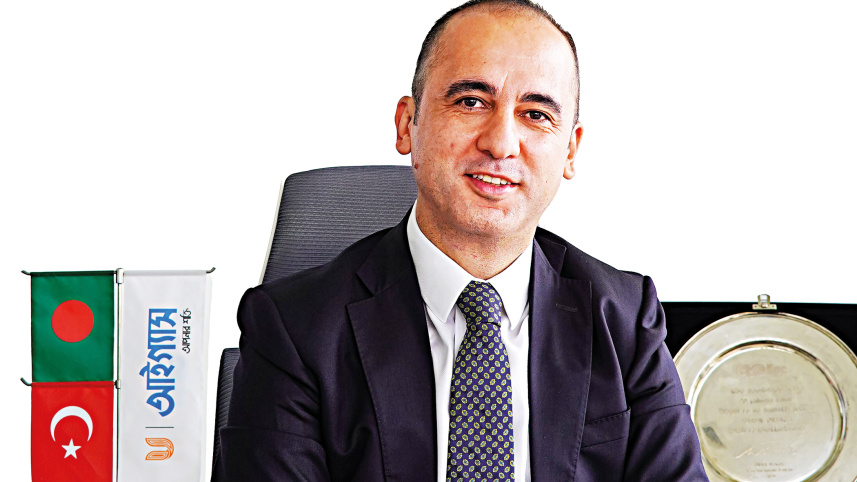
Harun Ortaç,
Chief Executive Officer, United Aygaz LPG Ltd.

We project the market to grow to 2.5–3 million tonnes, driven by urbanisation, industrial expansion, and natural gas shortages. Consolidation is also expected, with stronger players leading infrastructure investment — making the industry not just larger, but more efficient and structured.
In an era where energy security is critical to national growth, the Liquefied Petroleum Gas (LPG) sector is emerging as a key pillar of Bangladesh’s economy. In an interview with Harun Ortaç, CEO of United Aygaz LPG Ltd., the discussion explores the company’s journey, industry challenges, and the future of LPG in a rapidly evolving energy landscape.
Before addressing these, Mr. Ortaç outlines the company’s presence in Bangladesh. “United Aygaz entered the market as a greenfield investment—we built our operations from the ground up, focusing first on strong infrastructure to ensure reliable supply,” he says.
Backed by Aygaz, a 65-year-old LPG leader under Türkiye’s Koç Group, in partnership with one of Bangladesh’s leading conglomerates, United Group, the company brings global expertise and a long-term commitment to the country’s growing energy needs.
The Daily Star (TDS): What are the biggest challenges in Bangladesh’s LPG industry today, and how does competition in the market affect them?
Harun Ortaç (HO): Bangladesh offers strong growth potential, driven by its young population and strategic location near the Bay of Bengal, which is why we entered the market in 2021. Since then, we have established major infrastructure, including our primary plant in Chattogram’s Anwara, which has the largest onshore LPG storage capacity in the country. We have developed our Rupganj Plant, near Dhaka, which will have the largest LPG cylinder filling capacity in Bangladesh, with three carousels of 36 posts each.
The biggest challenge is ensuring stable and cost-efficient LPG procurement. As Bangladesh is heavily dependent on imports, global price fluctuations—particularly in the Saudi Gulf region due to geopolitical tensions—directly impact costs. Ensuring a smooth and sustainable supply at an efficient price remains the industry’s primary concern.
Additionally, foreign currency pressures and import financing constraints add complexity. Regional competition, particularly from LPG-dependent markets such as India and Pakistan, further intensifies the challenge, as Bangladesh must secure its share of global supply in an increasingly competitive environment.
TDS: What is the current market split between households, commercial users, and industrial users? Which segment is growing the fastest and why?
HO: LPG serves as a convenient and transportable energy source. The largest share of around 85% - 90% comes from cylinder gas used in households as well as commercial kitchens. Industrial usage is also growing, accounting for approximately 5%- 7% of the market. Due to natural gas shortages, many industries are increasingly relying on LPG either as a primary or backup energy source. Autogas represents another 5%- 7% and is expanding steadily.
TDS: With fuel supply under pressure, how is the industry addressing rising demand from car users?
HO: The autogas segment is gradually expanding because consumers are looking for more cost-efficient and cleaner alternatives compared to petrol and octane. However, growth is still limited due to infrastructure gaps, including limited refueling stations and the need for regulatory standardization. In markets like Türkiye, where 5.2 million out of 17.4 million cars run on LPG, we see how scale can be achieved. We expect similar growth in Bangladesh over time, driven by infrastructure development, awareness, and policy alignment.
At United Aygaz, we are investing in autogas infrastructure, including stations, equipment, and consumer awareness initiatives. We believe Bangladesh has strong potential in this segment.
TDS: What role does LPG play beyond household cooking in Bangladesh?
HO: LPG today plays a significant role beyond household cooking. It is increasingly used in commercial kitchens, agriculture, and transportation. LPG is also serving as a substitute for natural gas, diesel, and furnace oil, particularly in areas where piped gas is unavailable or unreliable. Its transportability allows for decentralised energy access, making it highly relevant for Bangladesh’s growing economy. LPG is evolving from a simple kitchen fuel into a critical economic fuel.
TDS: What role can better regulation play in supporting sustainable LPG growth?
HO: The government of Bangladesh is highly aware of the importance of LPG and is actively engaging with industry stakeholders. We are happy with the support and guidance we receive from government institutions and regulatory bodies. Considering the size and growth potential of LPG market, stronger regulation is necessary to ensure safety, standardisation, and sustainable growth. This includes enforcing cylinder standards, ensuring dealer compliance, maintaining pricing transparency, and promoting safe transportation practices. A balanced regulatory framework along with easement in regulatory environment will encourage investment while protecting consumers.
TDS: How important is technology in improving LPG distribution and safety?
HO: Technology is transforming the LPG industry by enhancing safety, efficiency, and supply chain visibility. From leak detection systems and automated bottling plants to digital distributor tracking and inventory management, technological advancements are enabling safer operations and improved service delivery. We are investing in infrastructure and collaborating with leading global suppliers to ensure the highest standards in equipment and operations.
 For all latest news, follow The Daily Star's Google News channel.
 TDS: What makes a customer choose one LPG brand over another? How can trust be built?
HO: Customers typically choose LPG brands based on availability, safety, quality, and trust. Among these, uninterrupted supply is the most critical factor. At United Aygaz, we have maintained consistent availability since the start of our operations and have never faced shortages. In fact, our strong supply network has also enabled us to support other LPG operators when needed.
But, building trust goes beyond supply. We take a 360-degree approach to brand communication, engaging consumers through nationwide TV and radio campaigns, sponsorship of local and international TV programmes, digital media, influencer collaborations, and on-ground activations. At the same time, we consistently communicate our supply assurance and product quality, while also focusing on consumer education—raising awareness about the safe and efficient use of LPG.
From supply assurance to product quality and safety awareness, our objective is to strengthen trust at every touchpoint and deliver a reliable energy experience to our customers.
TDS: How equipped is United Aygaz in terms of supply, storage, and distribution?
HO: We have significantly strengthened our capabilities across the entire LPG value chain—from global sourcing to nationwide distribution. We have diversified our sourcing beyond traditional markets, importing LPG from regions including the Arabian Gulf, Argentina, the US, Australia, and Tanzania, which allows us to ensure uninterrupted supply despite global disruptions. Our infrastructure includes the largest onshore LPG storage facility in Anwara, complemented by a major satellite terminal in Rupganj, near Dhaka with substantial filling capacity. In addition, our distribution network spans over 250 distributors and more than 22,000 retail points nationwide, ensuring strong last-mile connectivity. Together, this end-to-end capability enables us to maintain consistent availability and deliver reliable service to customers across the country.
TDS: How do you see Bangladesh’s LPG market evolving in the coming years?
HO: Our decision to invest in Bangladesh was based on long-term market research and projections extending over the next two decades. We expect the LPG market to grow to 2.5–3 million tonnes in the coming years, driven by urbanisation, industrial expansion, and natural gas shortages. The market will likely become more consolidated, with stronger players leading investments in infrastructure and supply chains. The LPG market will grow bigger, but also smarter and more structured.
TDS: Is LPG a cleaner alternative compared to other fuels used in Bangladesh?
HO: Yes, LPG is significantly cleaner than fuels like coal, diesel, and furnace oil. It produces lower carbon emissions, fewer particulates, and minimal residue. This makes LPG both environmentally friendly and operationally efficient, supporting Bangladesh’s transition towards cleaner energy.
TDS: What is United Aygaz’s vision for contributing to Bangladesh’s energy future?
HO: Our goal is to become Bangladesh’s leading LPG operator by providing reliable, safe, and forward-looking energy solutions. With over 65 years of global expertise, we aim to combine international best practices with local market understanding. Our focus is on uninterrupted supply, world-class safety standards, and continuous investment in infrastructure and technology.
We respect all LPG operators in Bangladesh and believe in cooperation alongside competition. By sharing infrastructure and supporting the supply chain, we aim to contribute to a more efficient and sustainable LPG industry.
Interview conducted by Marzia Bhuiya Tabenda
Comments