


Hasina knew the scale of the killings

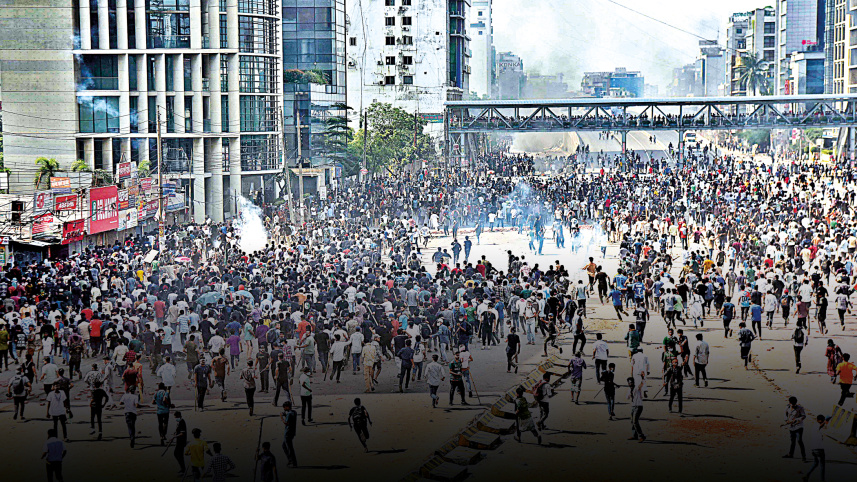
By late July 2024, deposed prime minister Sheikh Hasina was aware that scores of protesters were dying on the streets across the country, yet her government doubled down on its heavy-handed response to suppress the movement.
A batch of documents recovered from the ruins of Gonobhaban before its cleanup and conversion into the July Mass Uprising Memorial Museum reveals that she was receiving clear, direct reports from the field.

Multiple organisations and individuals collected these documents and other items. The Daily Star obtained these documents from one of these sources, who sought anonymity.
Among the papers recovered from her former residence was a detailed list of victims who died in the first week of violence. The report is titled “Report regarding nationwide casualties in violence until July 16–22, 2024”.
Although the document is unsigned, its methodology indicates the data was gathered from police stations.
The report listed 136 fatalities across the country by that time. By comparison, The Daily Star’s reported death toll for the same period stood at 146 -- strikingly close to the count on the report found on her residential compound.
The report was granular down to the smallest detail, documenting not only the political affiliations of the victims but also those of their families, noting specifically whether a victim was a mere supporter or an active party member. It recorded the corresponding police case numbers and pinpointed the exact locations where each individual was shot down.
Yet, the day after receiving this staggering casualty list, the government responded not with restraint, but with threats and escalation.
“The government will not spare the “BNP-Jamaat clique” this time so easily like in the past. They are trying to carry out terrorist activities during the curfew. Who are these people? They are not unknown faces,” Hasina declared during a meeting with leading businesspeople at her office.
Eventually, the death toll would jump every day. According to the UN fact-finding report, at least 1,400 people were killed in violence from July 1 to August 15.
Sitting in Gonobhaban, Hasina was also using surveillance reports on protesters to track the uprising.
She received live data on cellphone density around key Dhaka installations targeted during the unrest, using location analytics to trace the movement of protesters on the ground.
One report was titled “Number of mobile phone users in nearby areas during acts of sabotage on government installations during the Anti-Discrimination Movement”.
It calculated how many people gathered around the BTV station in Rampura, the Banani elevated expressway toll plaza, the Mirpur-14 BRTA complex, Narsingdi district jail, the Mirpur-10 metro rail station and the Bridges Division building in Banani between July 18 and July 19, 2024.
Yet another document uncovered from the premises shows how the state actively monitored the flow of information abroad as the violence intensified.
It recommended transferring the Cyber Threat Detection and Response system -- then based within the Department of Telecommunications -- to the National Telecommunications Monitoring Centre (NTMC) to enable content blocking at both the international internet gateway and ISP levels.
The NTMC’s content blocking and filtering system is working accurately, it noted.
The report also outlined other steps to take to block information, even as an internet shutdown raged on.
“Due to strong Indian mobile networks along the Bangladesh-India border, miscreants (BNP, Jamaat) are using Indian networks to transmit sensitive information abroad. Therefore, BTRC should take appropriate measures to reduce the transmission power of border-area Indian mobile towers,” it recommended.
It continued, “Widespread use of satellite phones has been observed. Notably, evidence shows that satellite phones are being used to transmit various information regarding the current situation abroad. It appears that most of these satellite phones are unauthorised. Under these emerging circumstances, the use of satellite phones may be suspended.”
 For all latest news, follow The Daily Star's Google News channel.
 “Due to the lack of mobile network coverage, BNP and Jamaat activists are using international passengers on various airlines to smuggle information about the current situation (photos, video footage, and written reports) abroad via portable devices such as flash drives and memory cards,” the report noted.
It zeroed in on a student leader Ariful Islam Adeeb -- currently senior joint convener of National Citizen Party -- as being the key person coordinating information with BBC, AFP, Al Jazeera and “controversial media outlet Netra News”.
The report noted how the Bangladeshis have been sentenced to prison time in the United Arab Emirates for “protesting against the Bangladeshi government” and recommended, “provisions for immediate punishment could also be introduced in Bangladesh in such cases”.
It also recommended increasing surveillance on residents of different areas by maintaining an up-to-date tenant database.
“In every instance, a large number of outsiders were observed taking shelter in residential houses within the aforementioned areas immediately before the incidents. It is possible to foresee such occurrences by maintaining records on both permanent and temporary residents living in those areas, alongside enhanced surveillance by intelligence agencies,” said a report.
Comments