


Modern banking simplifying your zakat


Zakat is far more than a simple act of voluntary charity; it is a fundamental pillar of Islam and a mandatory spiritual obligation for every eligible Muslim. At its core, Zakat serves as a divine mechanism for wealth redistribution, designed to bridge the gap between the affluent and the underprivileged. By donating a fixed portion of one’s surplus wealth, a believer not only purifies their earnings but also fosters a system of socio-economic justice. In the context of a developing nation like Bangladesh, Zakat acts as a vital social safety net, providing the right of the poor over the wealth of the rich.
While Zakat is traditionally associated with the holy month of Ramadan, the season of Qurbani (Eid-ul-Adha) has emerged as a crucial period for many to reconcile their financial dues. As families prepare for the sacrifice of animals, they often engage in a deep reflection of their total annual assets. This makes the Qurbani season an essential time for people to clear their Zakat dues, ensuring that the spirit of sacrifice extends beyond the meat of the animal to the sustainable financial empowerment of the needy.

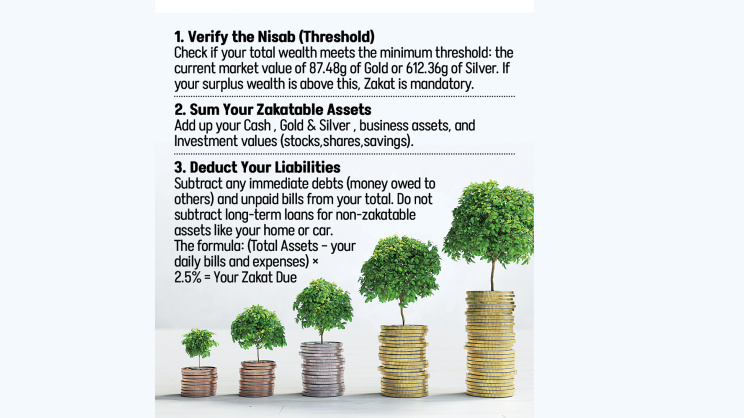
Traditional Calculation vs. the Digital Ease
The fundamental principle of Zakat is the donation of 2.5% of one’s surplus wealth held for a full lunar year (Hawl). This applies only if the wealth meets the Nisab—the minimum threshold equivalent to the value of 87.48 grams of gold or 612.36 grams of silver. Traditionally, this required complex manual bookkeeping, where individuals had to track gold prices, cash savings, and business inventory while deducting immediate debts.
Today, the digital revolution has simplified this process through authentic Zakat Calculators. Platforms provided by organisations like Islamic Relief Worldwide, National Zakat Foundation (NZF), Centre for Zakat Management Bangladesh (CZM) and even local Shariah-compliant banking apps allow users to determine their dues with precision. By simply inputting current market rates and asset values, these tools eliminate the margin of error, ensuring that every penny of the religious obligation is accurately accounted for and distributed.
The Role of MFS and Banking Institutions
The landscape of Zakat in Bangladesh has been transformed by the integration of financial technology. Previously, donating Zakat often required physical travel to remote madrasas or the homes of the poor. Now, the inclusion of "Donation" modules in Mobile Financial Services (MFS) apps like bKash, Nagad, and Rocket has made the process instantaneous and transparent.
Mainstream banking has also taken a proactive role in institutionalising Zakat. Islami Bank Bangladesh PLC (IBBL), Dutch-Bangla Bank, and Prime Bank are among the top commercial banks that facilitate Zakat collection through corporate funds and dedicated Shariah-compliant accounts. These institutions allow account holders to automate their annual payments or donate directly to reputable NGOs. This inclusion ensures that funds are handled with professional transparency, reaching verified organisations like Bidyanondo Foundation or the Centre for Zakat Management (CZM), where the money can be used for long-term poverty alleviation projects.
How to calculate your zakat?
For first-time donors, Zakat begins with confirming the Nisab. You are only eligible to pay if your surplus wealth exceeds the market value of 52.5 tolas (roughly 612g) of silver. Once confirmed, calculate your total assets, including cash in banks or mobile wallets (bKash/Nagad), the current value of gold and silver jewelry, business merchandise, and the tradable value of stocks or insurance policies.
Next, deduct your liabilities. This means subtracting money you currently owe to others, such as short-term loans or overdue household bills, from your total wealth. This ensures you only pay 2.5% on your net surplus.
Crucially, verify the recipient. Your donation must reach those within the eight Shariah-mandated categories (Asnaf), primarily the poor and the destitute. Finally, consider your timing. While Zakat is due once a lunar year has passed on your wealth, many donors utilise the Qurbani season to reconcile their dues. This allows you to pair your financial purification with the spirit of sacrifice, doubling your socio-economic impact by providing both essential cash assistance and meat to those in need during the festive period.
By leveraging modern banking and digital tools, we can move from simple charity to a structured system of economic empowerment, ensuring that our Zakat truly reaches those who need it most.
 For all latest news, follow The Daily Star's Google News channel.
Comments