


Kerry seeks to narrow divisions with Russia
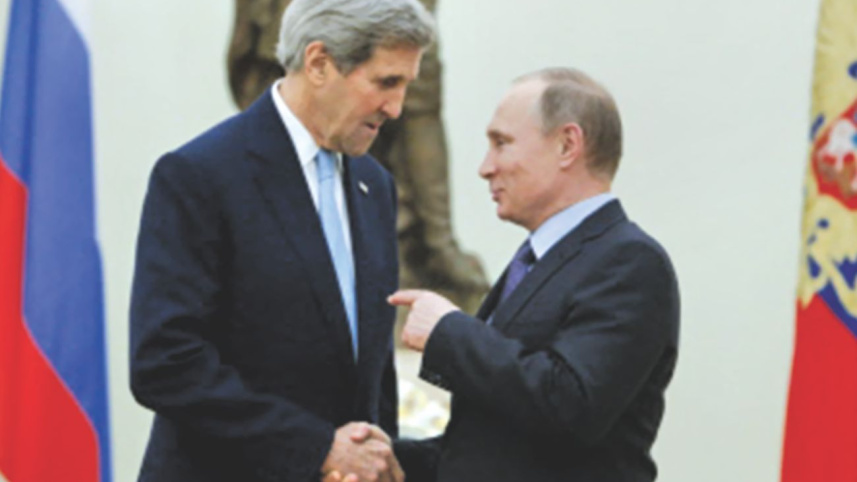
US Secretary of State John Kerry yesterday held talks in the Russian capital Moscow on ways to bridge gaps over ways to end the Syrian conflict.
He told President Vladimir Putin that the two countries had "the ability to make a significant difference".

Kerry, who also met his Russian counterpart Sergei Lavrov, said he hoped to find "common ground".
The US and Russia disagree on what role Syrian President Bashar al-Assad should play in any transition.
The US wants him to stand down, but Russia says only the Syrian people should decide his fate.
"Together, we are looking for ways out of the most urgent crises,'' Putin said ahead of the meeting.
Beyond the cordial words, there was no sign that any progress had been made in narrowing the gaps that continue to divide Russia and the US, says the BBC's Barbara Plett-Usher, who is travelling with Kerry.
Russia launched an air campaign to bolster Assad's government in September. It says it has targeted only "terrorists", above all jihadist militants from Islamic State (IS), but activists say its strikes have mainly hit Western-backed rebel groups.
A US-led coalition has been targeting IS positions in Syria since September 2014 and does not co-ordinate its raids with the authorities in Damascus.
There has been some confusion (to put it mildly) about whether Russia is or isn't supplying weapons and ammunition to the Free Syrian Army (FSA).
Last week, President Putin said it was - then, a few hours later, his spokesman Dmitry Peskov denied it.
On Monday, the chief of the Russian general staff said Russia was supporting the FSA with arms, ammunition and material help (copying Putin almost word for word). But a few hours later a Kremlin aide denied that Moscow was supplying anything.
This is what Peskov said: "I have nothing to add to what's already been said. I have nothing to add and I don't want to explore this subject."
"Even when there have been differences between us, we have been able to work effectively on specific issues," Kerry said before the start of his talks with Lavrov.
"The world benefits when powerful nations can find common ground," he added.
Kerry has been comparing notes with the Russians on a meeting in Riyadh last week that united elements of the Syrian political and armed opposition.
Russia took issue with the outcome - a statement of principles to guide peace talks that says President Assad and his aides can play no part in any transitional period.
Russia also sees some of those who participated as terrorists, and it wants all parties to agree on a terrorist blacklist before proceeding further, BBC correspondent says.
Kerry is hoping to discuss moves to convene talks between a unified Syrian opposition delegation and the government next month at a meeting of the International Syrian Support Group - which includes the Arab League, the EU, the UN and 17 countries - in New York on Friday.
There are some doubts whether the meeting will go ahead, but the US state department denied claims from Russia that "preconditions" would have to be met for it to take place.
 For all latest news, follow The Daily Star's Google News channel.
Comments