


Agri share falls amid rising costs, climate shocks

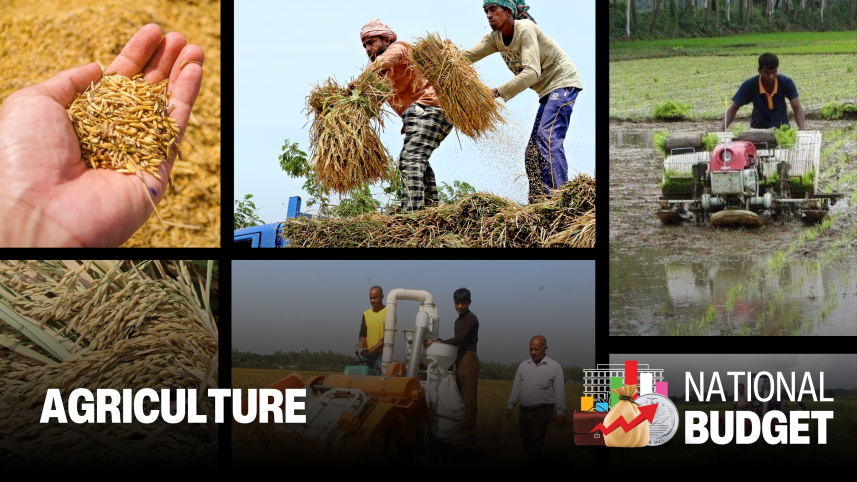
The allocation for agriculture in the proposed FY2026-27 budget has increased marginally in nominal terms.
However, the sector’s share of total spending has dropped to its lowest level in at least a decade, raising concerns at a time of rising production costs, climate shocks, persistent food inflation, and slowing agricultural growth.

Economists and experts say the modest increase in allocation, coupled with unchanged subsidy and incentive support, could make it harder for the BNP government to contain production costs, boost output, and ease food inflation.
The proposed budget allocates Tk 46,821 crore for agriculture and food security, including livestock, environment, climate change, land, and water -- up 2.3 percent from the revised FY2025-26 allocation of Tk 45,789 crore.
But as the overall national budget expands 19 percent to Tk 9.38 lakh crore, agriculture’s share has fallen to 5.0 percent from 8.7 percent in FY2023–24, continuing a sharp decline since FY2024-25.
The reduced share comes as the sector continues to lose momentum.
According to the latest Bangladesh Bureau of Statistics data, agriculture grew by only 2.42 percent in FY2024-25 -- the slowest rate in more than a decade. Provisional estimates suggest a slight recovery to 2.78 percent in FY2025-26.
Agriculture’s contribution to GDP has also steadily narrowed, falling from more than 38 percent in the early 1970s to around a provisional 10.93 percent in the outgoing fiscal year.
In his budget speech, Finance Minister Amir Khosru Mahmud Chowdhury said the government aims to build a self-reliant, climate-resilient and technology-driven agriculture sector.
To support that goal, the budget prioritises affordable inputs -- including fertilisers, seeds and irrigation -- to lower production costs, expand mechanisation, introduce agricultural insurance against natural disasters, diversify agricultural products, and expand cold storage and cold-chain facilities.
Under its blue economy agenda, the government also plans to deploy commercial vessels to harvest tuna and pelagic fish in deep seas, expand seaweed cultivation, and increase fisheries export earnings to $1 billion by 2030.
The budget further proposes a series of tax and tariff measures to reduce costs and support domestic production. These include full exemption of VAT and advance tax at the import stage for fertilisers and pesticides, removal of the existing 7.5 percent VAT at the business stage on fertilisers and 7.5 percent advance tax on pesticide imports, and zero VAT on 36 raw materials used in domestic pesticide manufacturing.
Other measures include reducing import duty on zinc ash -- used in local zinc sulphate fertiliser production -- to 5 percent; extending zero-duty concessional treatment for veterinary medicine imports under generic categories; imposing import duties of 5 percent and 25 percent respectively on unprocessed and processed cashew nuts; levying a 20 percent supplementary duty on imported pangasius fillets; and adding three raw materials for poultry, dairy and fish feed production, along with selected machinery inputs, to the zero-duty concessional list.
MOUNTING PRESSURE
Abu Saleh Md Shamim Alam Shibly, senior research associate at the Centre for Policy Dialogue, said the shrinking budget share comes as agriculture faces higher fertiliser and diesel costs, haor flash floods, and volatility in essential commodity prices.
He noted that urea prices, which ranged between $417 and $480 per tonne before the US-Israel war on Iran, had surged to $906 and now stand at $555. At current import prices, urea costs about Tk 56 per kg, but is sold to farmers at Tk 27, creating a subsidy gap of around Tk 29 per kg.
With annual imports of roughly 20 lakh tonnes, total subsidy needs could reach Tk 58,000 crore against the current allocation of Tk 17,000 crore, he said, adding that the government is also facing difficulties importing urea due to the war.
Abu Saleh also criticised the absence of any dedicated rehabilitation or support package for flood-affected haor farmers and pointed out that the water resources ministry’s ADP allocation has been reduced by 26 percent, with no projects for haor embankment repair or river dredging included despite recurring flash-flood risks.
He further expressed concern that the fisheries and livestock development budget has been cut by 53 percent from last year despite rising food prices and increasing dependence on fish, eggs and poultry as alternative nutrition sources.
Agricultural economist Jahangir Alam Khan said Bangladesh has recorded some of Asia’s highest food inflation over the past four years. He warned that current allocations and subsidy support may not be enough to generate the agricultural growth needed to curb inflation and reduce import dependence.
 For all latest news, follow The Daily Star's Google News channel.
 Still, he welcomed several budget measures, including reducing source tax on rice, paddy, wheat, potatoes, onions and edible oil from 1 percent to 0.5 percent, alongside other tax relief and incentives.
Economist Abdul Bayes, former vice-chancellor of Jahangirnagar University, said greater investment in research and development were needed to tackle recurring natural disasters.
He warned that climate impacts are becoming more severe while adaptation and mitigation efforts remain inadequate. With gains from existing high-yield crop technologies, future productivity growth will depend on more advanced technologies, he said.
Bayes also raised concern over the conversion of agricultural land for large projects, including factories. He added that fisheries, forestry and livestock require a new policy direction.
FH Ansary, managing director of ACI Agribusiness, called for targeted support for technologies such as paddy and potato harvesters, rice transplanters and dryers, and milking machines.
Citing mounting environmental pressures on agriculture, Ansary also proposed low- or zero-interest secured loans with long repayment periods for private companies alongside public-sector support to encourage innovation.
Comments