


Apart from NCT, race on for two other Ctg port terminals

Highlights
- Foreign and local firms eye Chattogram port terminals
- DP World and RSGT submit terminal operation bids
- Local MGH and BOSTOA offer competitive proposals
Amid negotiations over leasing Chattogram port’s New Mooring Container Terminal (NCT), attention has now turned to two other key facilities of the seaport as an increasing number of foreign and local operators are showing interest in making investments and running those terminals.
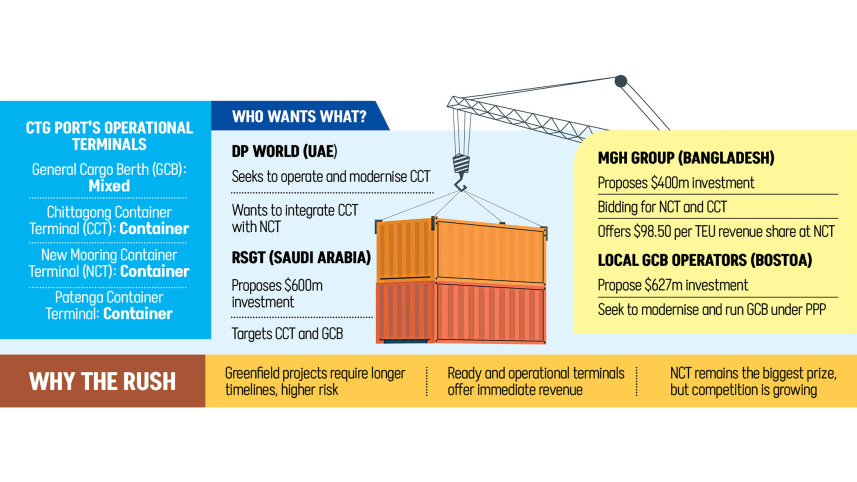
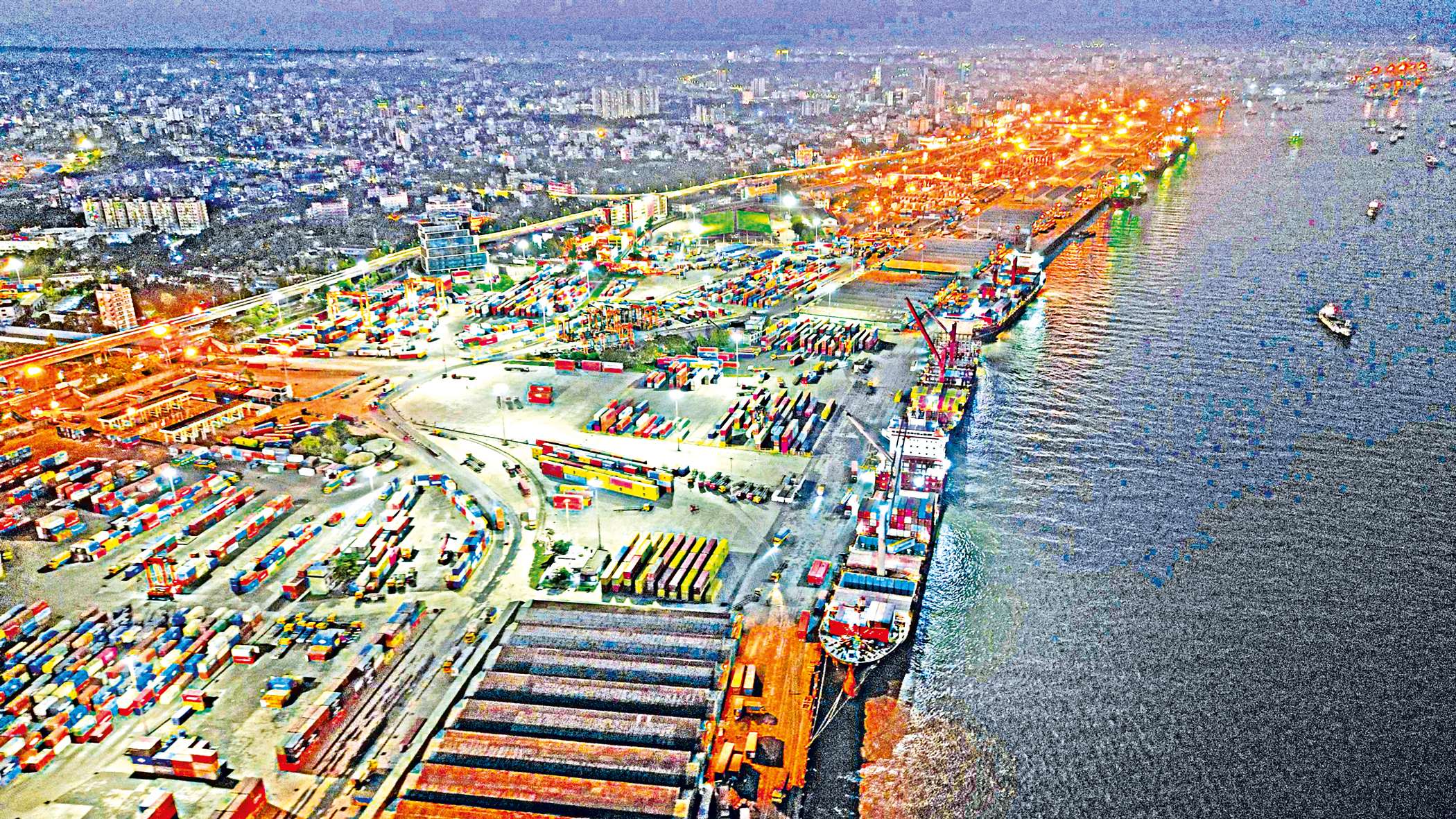
The port has four main container and cargo terminals. These are General Cargo Berth (GCB), Chittagong Container Terminal (CCT), NCT, and Patenga Container Terminal (PCT).

All of those are now operational and run by local operators, except for the PCT. Saudi Arabia’s Red Sea Gateway Terminal (RSGT) is now running the Patenga terminal.
At the fourth Dubai-Bangladesh Joint Platform meeting held in Dubai on April 8, UAE-based global operator DP World expressed interest in operating CCT. Talks have been ongoing for years to lease out NCT, the largest and busiest container terminal of the seaport, to DP World.
DP World says it wants to develop the two terminals as a single integrated facility, according to meeting minutes obtained by The Daily Star.
Within weeks of DP World’s latest approach, Saudi RSGT expressed interest in modernising and operating CCT and GCB.
Apart from the foreign firms, Bangladeshi conglomerate MGH Group, which earlier proposed operating CCT, has recently submitted a fresh proposal to operate both CCT and NCT.
Meanwhile, a group of 12 berth operators who are currently running the GCB has jointly proposed to modernise and operate the general cargo terminal.
A senior official of the Chittagong Port Authority (CPA) confirmed that several proposals have been received from local and foreign firms for investment and operation of different terminals.
Of the total four terminals at the seaport, three are dedicated to container handling. Only the GCB is used for both container vessels and bulk and break-bulk cargo.
The port handled 34.09 lakh TEUs (Twenty-foot Equivalent Unit) of containers in 2025. Of this, NCT handled 13.21 lakh TEUs, GCB 10.83 lakh, CCT 4.83 lakh, and PCT 1.53 lakh, according to CPA data.
Officials and port users say foreign firms have for several years shown interest in greenfield expansion projects such as the Bay Terminal. However, such projects require large investments and long construction timelines.
In contrast, operational terminals offer immediate revenue, which is why both local and foreign operators are focusing on existing facilities.
During the previous Awami League government, negotiations began with DP World for the operation of NCT.
The process continued under the interim government, which came close to finalising a deal before it was postponed following a strike by port workers ahead of the February parliamentary election.
The current government is still discussing DP World’s proposal for NCT.
Shipping ministry officials said CCT has also been placed under the Bangladesh-Dubai Joint Platform for discussion and may be taken up as a separate project in future meetings.
On April 22, RSGT expressed interest in modernising and operating GCB and CCT, proposing an investment of over $600 million.
 For all latest news, follow The Daily Star's Google News channel.
 Speaking on condition of anonymity, a senior RSGT official in Chattogram said the proposal was still at an early stage. “If the government allows, we are interested in modernising and efficiently operating the GCB and CCT,” he said.
In March last year, local MGH Group first proposed to upgrade and operate CCT with an investment plan of $300 million. On April 28 this year, it submitted a fresh proposal to manage and operate NCT under a public-private partnership (PPP) model.
MGH has offered the CPA $98.50 per TEU in revenue share at NCT, compared with projected earnings of $161.80 per container.
DP World earlier proposed a revenue share of $93.50 to $97.50 per container.
The group says its 15-year concession model could generate about $1.68 billion in total payments to the port authority.
Anis Ahmed, CEO of MGH Group, told The Daily Star that the company’s offer provides higher revenue to CPA than competitors.
He added that MGH’s lower financing and overhead costs, compared with foreign operators, help maintain margins despite the higher revenue share.
On November 27 last year, Berth Operators, Ship Handling Operators and Terminal Operators’ Owners’ Association (BOSTOA), a platform of 12 berth operators currently running the GCB, submitted an unsolicited proposal to finance, reconstruct, equip, operate and transfer the GCB under a PPP model.
It proposed an investment of $627 million, to be raised through a consortium of local and foreign partners, according to BOSTOA President Fazley Ekram Chowdhury.
“Since we have been operating the GCB terminal efficiently for over two decades, we have ground-level experience and have proposed a plan to reconstruct the jetties and expand yards, sheds and warehouses,” he said.
Comments