


Govts pledged renewables, but spent 90% of funds on fossil fuels
Highlights
- Renewables get under 5 percent budget allocation
- CPD study urges strategic clean energy investment
- Adviser blames fossil fuel reliance for crisis
For over a decade, governments have been allocating a disproportionately low share of the budget to renewable energy despite ambitious pledges, with nearly all power and energy allocations going to fossil fuel projects, a Centre for Policy Dialogue (CPD) study has found.
The study, unveiled at an event jointly organised by CPD and Dhaka Stream at Pan Pacific Sonargaon Dhaka yesterday, comes just weeks before the BNP-led government, which has signalled a push toward clean energy, is set to unveil its first full budget. The study was co-authored by Khondaker Golam Moazzem, research director of CPD.

Presenting the findings, Khalid Mahmud, programme associate at CPD, said the allocation trend from fiscal year 2015-16 (FY16) to FY26 shows fossil fuel projects consistently capturing over 90 percent of power and energy development spending.
The budget for the ongoing FY26 showed marginal improvement, with renewable energy receiving 4.6 percent, yet fossil fuel-based projects still dominated at over 95 percent, reflecting what he called limited structural rebalancing, he said.
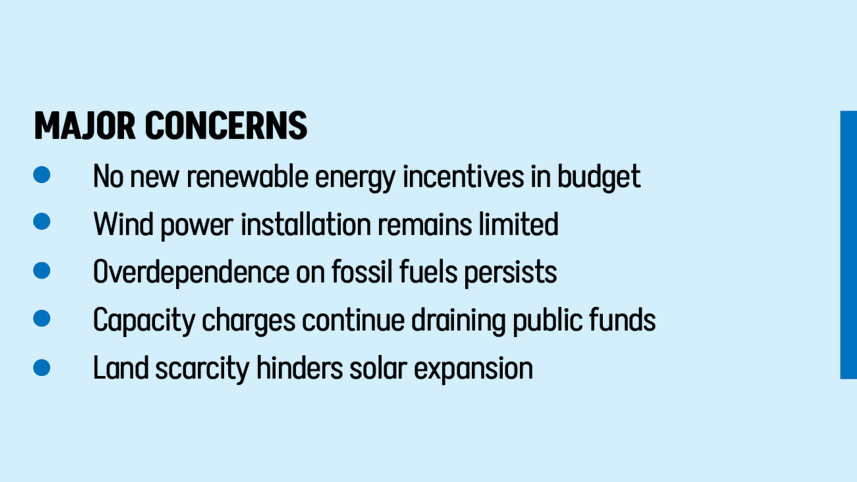
Mahmud added that the FY26 budget also dropped a Tk 100 crore allocation for renewable energy that had been included the previous year, and introduced no new incentives for solar or other clean technologies.
Bangladesh’s total installed renewable energy capacity stands at approximately 1,745 MW as of May 11, with solar unit accounting for over 83 percent of that. In total, renewables represent just 5.4 percent of total installed capacity, well short of a target set years ago to reach 10 percent by 2021.
The compound annual growth rate of renewables from 2016 to May 2026 is 15.78 percent. Of 42 active development projects, only three focus on renewable energy.
Despite the wind energy potential in the coastal region, wind power installation remains very low, accounting for only about 62 MW, said Mahmud, noting that renewables in Bangladesh continue to remain constrained within the national budget framework.
“The national budget must treat renewable energy not as a sub-line within the Power Division, but as a strategic national investment priority deserving its own fiscal instrument,” said Mahmud.
The government should restore and progressively scale up ADP allocations for renewables from FY27 onward, pegged to annual MW deployment targets, he added.
Also speaking at the event, Rashed Al Mahmud Titumir, finance and planning adviser to the prime minister, said the energy sector is caught in a vicious cycle that is difficult to escape.
He also pointed out that the wide gap between installed generation capacity and actual utilisation has led to significant waste through capacity charges.
“This mismatch is leading to a significant waste of public resources, most notably through capacity charges. While capacity is built to meet expected future demand, much of it remains underutilised in practice, an issue clearly reflected in Bangladesh’s experience,” he said.
“Many of the contracts in this sector were not concluded in full compliance with established rules and procedures, yet they have been given legal protection. This raises serious concerns from the perspective of transparency and fairness,” he added.
The PM’s adviser went on to point out that instead of transitioning toward a sustainable system, the country has largely continued to rely on a fossil fuel–dependent structure. “Together, these three issues form the core structural challenges of the sector.”
Without addressing these deep-rooted problems, it will not be possible to break free from the current cycle, he said, adding that resolving the crisis will require collective and coordinated action.
Rehan Asad, the PM’s adviser on telecom and ICT, said land scarcity is a major constraint on large-scale renewable deployment, citing risks to crop production from ground-mounted solar.
Hence, he said the government is prioritising rooftop solar solutions. “The government is taking a broader approach, planning renewable energy development in line with the overall energy ecosystem.”
Iftekhar Mahmud, editor-in-chief at Dhaka Stream, raised concerns about the sector’s integrity, saying large-scale renewable projects are increasingly being dominated by groups linked to the fossil fuel industry, including individuals accused of land grabbing and money laundering.
Local innovators and specialist institutions are being sidelined, while genuine entrepreneurs must navigate approvals from as many as 32 government departments, he added.
 For all latest news, follow The Daily Star's Google News channel.
 He said this difficult process discourages real investors and creates opportunities for influential groups more interested in land acquisition and bank loans than energy production.
Comments