


Burimari reels as Indian stone import halt drags on

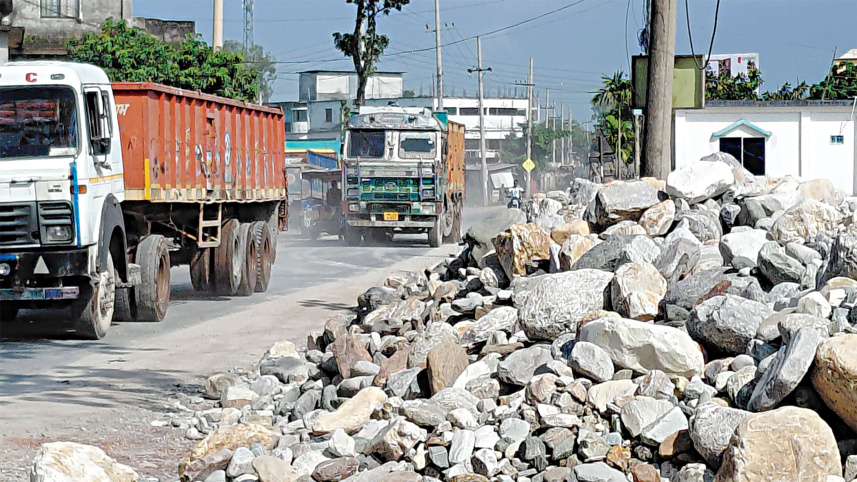
A halt in stone imports from India, now in its third month, has disrupted trade at Burimari Land Port, pushing up prices and hitting traders, contractors and thousands of workers who depend on the business for their livelihoods.
The disruption began on May 24, after Indian authorities introduced a measure allowing trucks to carry a maximum of around 25 tonnes of stone, down from 60-70 tonnes, traders said.

“The quantity that was previously transported in one truck now has to be sent in three trucks. The increased transportation cost has made stone exports unprofitable,” said Chandan Das, an exporter at Changrabandha land port in India.
He said the measure followed the formation of a new government in West Bengal, and that talks with the relevant authorities were continuing.
The disruption began on May 24, after Indian authorities introduced a measure allowing trucks to carry a maximum of around 25 tonnes of stone, down from 60-70 tonnes
“We have therefore temporarily stopped exporting Indian stones,” Chandan said, adding that continuing business through the land port would be difficult without a workable arrangement.
Meanwhile, the disruption has pushed up the price of stone in Bangladesh by as much as Tk 15 per cubic foot, to Tk 125-130 from Tk 110-115 previously, said Pavel Rahman, a contractor from Rangpur.
“This has significantly increased the cost of our projects,” he said, adding that this has led to rising costs on fixed-price government contracts, risking losses if projects are to be completed on time.
“Neither Bangladeshi nor Indian traders are benefiting from the business under the current circumstances,” said Mahmudunnabi Munna, a stone importer at Burimari land port.
Imports from Bhutan, another major stone supplier to Bangladesh, are continuing even though transport costs have also risen from there.
“Since Bhutanese stones are duty-free, we can still make a small profit,” Munna said.
Traders note that the imports from Bhutan are not enough to make up for the shortage. “Indian stones are cheaper, and buyers prefer them. But our stocks are running low. We are now crushing and selling stones that were imported several months ago,” said Manzur Ali, a stone trader at Burimari.
The slowdown has hit workers hardest.
Around 25,000 people work at the land port across loading, unloading and stone-breaking, said Fazlul Haque, president of the Burimari Land Port Loading-Unloading Workers’ Union. “About 7,000 are now idle, and the rest are earning far less.”
Worker Sirajul Islam said he now finds work only about three days a week. “I used to earn around Tk 700 a day on average. Now I cannot even earn Tk 300.”
The disruption has sharply curtailed activity at the port as stones account for around 95 percent of goods imported through it, according to Farooq Hossain, president of the Burimari land port C&F Agents Association.
“Stone is the lifeblood of Burimari Land Port. As stone imports decline, the port is gradually losing its vibrancy,” he said. “We are regularly communicating with Indian traders regarding the situation at Changrabandha.”
Mahmudul Hasan, assistant director of Bangladesh Land Port Authority at Burimari, said monthly imports, mainly stones, had averaged around 226,000 tonnes in previous fiscal years but fell to about 144,000 tonnes in July 2026.
Monthly revenue, which averaged around Tk 4.5 crore in previous fiscal years, has now fallen below Tk 3 crore, he said.
The number of trucks in the yard has fallen from 500-550 to 200-250 over the past two and a half months, he added.
 For all latest news, follow The Daily Star's Google News channel.
 “Matlabur Rahman, assistant commissioner of customs at Burimari, said customs revenue, which is based on duties, fell from an average of around Tk 7.5 crore a month to below Tk 2 crore in July.”
As most of the custom’s revenue from the port traditionally comes from Indian stones, he said, “If Indian stone imports remain suspended for another two or three months, revenue could fall to an extremely low level.”
He added that poor road connectivity and import restrictions on other goods have already discouraged traders from using the port, and warned it could become inactive without better facilities and connectivity.
The port faced a similar disruption in February last year, when Bangladeshi importers halted stone imports for 23 days over pricing disputes, also slowing trade and cutting government revenue.
Comments