


Energy crisis forces businesses to cut output, seek alternatives

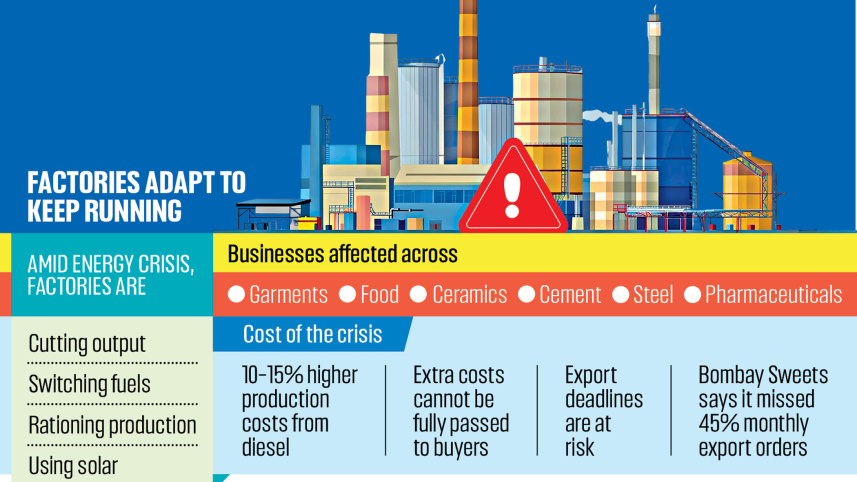
Factories producing garments, food, ceramics and pharmaceuticals are cutting production, changing work schedules and turning to alternative energy sources as the ongoing gas and power shortages make it harder and more expensive to keep plants running.
Manufacturers say switching to alternatives raises production costs, hurts margins and puts export deadlines at risk. In most cases, they also cannot pass the extra costs on to foreign buyers or local customers.

Asif Ibrahim, vice chairman of Newage Group, which makes knitwear and woven garments for international brands, said the company has been changing its production schedule according to electricity availability.
“We adjust our production schedule according to the power situation. We also try to cut unnecessary use of electricity and get more out of the machines when they are running,” he said.
The crisis has been dragging on for around one and a half months since a floating LNG terminal went offline on July 21, leaving industrial areas with lower gas pressure. Reduced gas supplies to gas-fired power plants have also triggered widespread power outages.
To offset the fallout, Newage says it has expanded its rooftop solar capacity, which now supplies about 25 percent of its electricity needs.
The company is also investing in energy-efficient machinery and power-management systems to reduce its dependence on the grid.
But these measures cannot fully absorb the cost of an unreliable energy supply.
“When there is no grid power or gas, we have to run diesel generators. That adds a lot to our cost,” said Asif.
For exporters, recovering those extra costs from buyers is difficult because they generally do not agree to higher prices when production costs rise in sourcing destinations.
“So, we have to bear a large part of the extra cost ourselves,” said the Newage Group vice chairman.
Like the garment manufacturer, PRAN-RFL Group, which makes food, beverages, plastics, household goods, furniture, and electrical and electronic products for local and foreign buyers, is also adjusting its operations.
The food maker says some of its production lines are now running below capacity.
Kamruzzaman Kamal, director of marketing at PRAN-RFL Group, said its gas-dependent factories in Narsingdi, Habiganj, Gazipur and parts of Narayanganj have been hit particularly hard.
“We are using LPG where we can. And when the gas pressure is low, we cannot run all the lines at the same time. So, we run some and keep others closed,” said Kamruzzaman.
The group currently generates around 35-38 megawatts of renewable energy for its own use, against total electricity demand of more than 200MW.
“We are working to increase our renewable power capacity to around 100MW within this fiscal year,” said Kamruzzaman. He said PRAN-RFL plans to eventually meet all of its electricity needs from solar power.
The energy crunch is also hitting the cement market, where manufacturers are paying more for electricity and other inputs but have little room to raise prices.
Mohammad Iqbal Chowdhury, CEO of LafargeHolcim Bangladesh, said the 18 percent increase in electricity prices in June, along with higher raw material and freight costs, has pushed up their production costs.
“Costs have gone up, but we cannot pass all of it on to customers,” he said.
 For all latest news, follow The Daily Star's Google News channel.
 Local cement markets already have far more production capacity than demand. The industry has an annual capacity of about 90 lakh tonnes against demand of around 35 lakh tonnes. Demand fell by 2-5 percent up to August, making it even harder for manufacturers to raise prices without losing sales.
Iqbal said several smaller producers have already shut down, while larger companies were relying on their stronger financial position to weather the downturn.
Meanwhile, ceramic manufacturers say they are struggling to keep their kilns running amid the gas crisis.
Moynul Islam, president of the Bangladesh Ceramic Manufacturers and Exporters Association, said manufacturers had initially passed some of the higher energy costs on to customers. But that was no longer possible.
“The problem is no longer just the higher cost. In some cases, we cannot produce at all,” he said.
Gas pressure in some industrial areas has fallen from around 15 PSI to simply 5 PSI, forcing some factories to shut down or sharply cut production. Manufacturers have tried adjusting machinery to operate at lower pressure, but there is a limit to how far they can go.
Ceramic kilns must maintain a specific temperature to produce goods of the required quality. When gas pressure falls too low, manufacturers often choose not to fire the kilns rather than risk damaging an entire batch.
Similar to PRAN, other food manufacturers and exporters are also taking a hit.
Khurshid Ahmad Farhad, general manager (export) of Bombay Sweets & Company Ltd, said the company could not execute 45.47 percent of its export orders in August because of the gas shortage. Around $113,000 worth of orders remained undelivered despite advance payments from importers.
Khurshid said freight costs for shipments to the Middle East have also risen to $8,500-$12,000 per container. “If a container of chips is worth around $6,000 but the freight is $12,000, how can we continue?” he said.
The company has used diesel to keep production going, but the additional fuel cost is causing losses. Raising prices is also difficult when demand is weak.
“If this continues much longer, we cannot continue like this,” said Khurshid.
Steel mills are meanwhile adjusting their production processes to use less gas.
Sumon Chowdhury, secretary general of the Bangladesh Steel Mill Association, said mills with facilities that can turn molten steel directly into billets and then hot-roll them can maintain around 50-60 percent of normal output during the crisis.
“If a factory can produce billets directly from molten steel and then hot-roll them, it can keep producing to some extent without running a reheating furnace,” he said.
Some mills are also changing when they run equipment, depending on gas and electricity availability.
Md Quamrul Hassan, executive director and COO of ACI Consumer Brands, which supplies a wide range of household, personal care, hygiene, and food products, said factories that need to operate round the clock face a bigger problem, as running on diesel generators raises production costs by at least 10 to 15 percent.
Overall production has risen, but higher energy costs have reduced profit margins, he said.
Abdul Muktadir, chairman and managing director of Incepta Pharmaceuticals, which produces life-saving medicines, said the company is accelerating its move towards renewable energy, particularly solar power, as gas and electricity shortages push up costs.
“We have to move to renewable energy, solar panels, and we have to move very quickly,” Muktadir said. “These are our only options.”
Muktadir said Incepta currently uses four energy sources to keep its factories running -- natural gas, LPG, diesel and grid electricity.
The company initially used gas-fired generators as a backup to grid power, but later installed dual-fuel generators that can switch to diesel when gas is unavailable. It also uses LPG to run its boilers.
“We cannot simply stop. There is no opportunity to stop,” Muktadir added.
Comments