


Marine fish catch slumps amid overfishing, habitat loss



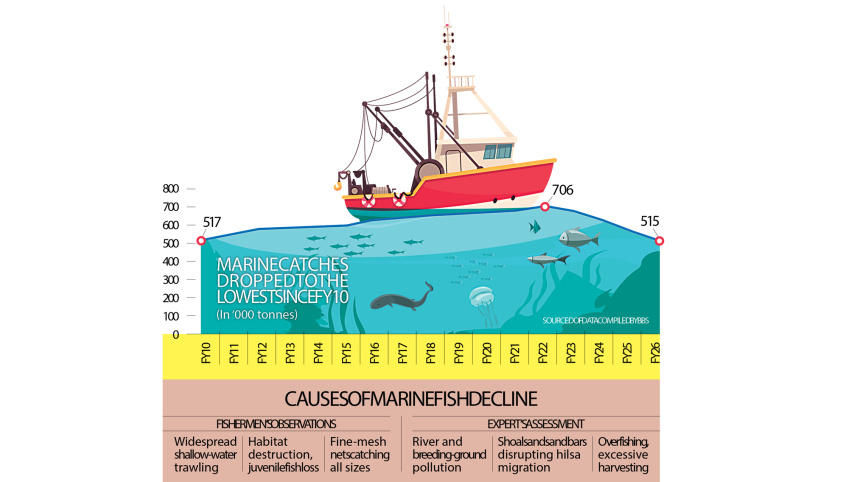
Years of overfishing, destructive fishing practices and damage to marine habitats are depleting Bangladesh’s fish stocks, with catches of hilsa and other marine species falling sharply.
The decline is increasingly hitting fishermen’s livelihoods, as poorer catches leave them struggling to cover fuel, food and other costs of each trip.

During a recent visit to the Alipur fish landing centres, Mizan Hossain, owner of the trawler FB Nurjahan, said its catch this year was at least 40 percent lower than last year.
He blamed widespread trawling in the sea.
“Trawling nets catch fish of all sizes and species. The smaller fish die as soon as they are caught in the nets,” he said.
Fazlu Gazi, former president of the Mahipur Fishermen’s Association near Kuakata, said hilsa catches this year were the lowest he had seen in four to five years.
“We give fishers advance payments every year. With catches falling so sharply, we are struggling even to recover that money,” he said.
Patuakhali District Fisheries Officer Bijoy Nandi also acknowledged a sharp decline in catches, saying it was not limited to hilsa.
“Hilsa catches have fallen significantly, and catches of other marine fish have also declined,” he said. “By our estimate, overall fishing is down by about one-third from last year.”
The situation is similar in Cox’s Bazar. Ismail Hossain, owner of Shah Jabbaria Fish Enterprise, said trawlers once brought 1.5 to 2 tonnes of hilsa from a single trip. Now, several trawlers are needed to collect the same quantity.
Each trip costs around Tk 4 lakh, including fuel and other expenses. Although trawlers catch other species, the overall haul is often so low that many operate at a loss, he said.
Mohammad Ramiz, known as Ledu Majhi, a Kutubdia resident who operates a trawler owned by Mahiuddin Company, said fishermen are spending long hours at sea for little return.
“There are hardly any fish in the sea. We cast our nets and wait for hours, but often catch very little,” he said.
Since the 65-day fishing ban ended on July 23 this year, his trawler has made 10 trips, spending about Tk 40 lakh and earning roughly Tk 42 lakh from fish sales. In the past, a trawler could land fish worth Tk 10 lakh to Tk 40 lakh on a single trip, he said.
Ledu blamed the decline partly on the growing use of trawling in shallow waters.
Once largely confined to large vessels operating in the deep sea, trawling is now also being used by wooden trawlers in shallower areas, causing damage to marine habitats and killing juvenile fish and even fish fry.
The fishermen’s experience is reflected in official data. According to Department of Fisheries (DoF) figures, Bangladesh’s marine fish catch rose steadily from 5.17 lakh tonnes in FY2009-10 to a record 7.06 lakh tonnes in FY2021-22.
The figure has since declined for four consecutive years. The provisional FY2025-26 figure of 5.15 lakh tonnes would be the lowest in 16 years, down 27 percent from the peak.
Mohammed Shariful Azam, senior assistant director of the blue economy section at the DoF, said the decline was closely linked to falling hilsa catches, which account for nearly 40 percent of the marine catch.
Talking to The Daily Star, Shariful identified pollution, changes in river and marine habitats, and overfishing as major factors behind the decline in hilsa.
 For all latest news, follow The Daily Star's Google News channel.
 Pollution is degrading rivers and breeding grounds, reducing the hatching and survival of hilsa juveniles, he said. Underwater shoals and sandbars, locally known as dubchar, have also formed in several areas, making migration routes shallower and obstructing hilsa movement between the sea and rivers.
Overfishing is adding to the pressure. More than 85 percent of the country’s roughly 30,000 artisanal fishing boats target hilsa, while years of excessive harvesting have depleted the stock.
The problem extends beyond hilsa. Shariful said the widespread use of behundi jal, or estuarine set bag nets, indiscriminately catches marine fish, particularly fry and juveniles. Despite repeated enforcement drives, controlling their use remains difficult.
Monofilament gillnets and illegal trawl doors and nets used in areas such as Barguna, Patuakhali and Kalapara are also contributing to the depletion of fish stocks, he added.
Shariful said marine fish stocks could gradually recover if fisheries management is strengthened, sea patrols intensified and fishing bans enforced more effectively. However, rebuilding depleted stocks would take several years.
He identified vessel tracking as a potential tool for strengthening monitoring. The Fisheries Monitoring Centre in Chittagong could play a key role if fishing boats are brought under a tracking system.
Discussions are underway with Bangladesh Satellite Company on the initiative, which Shariful described as a potentially major step. He also stressed the need to raise awareness among fishermen and boat owners.
Comments