


Medicine pricing needs a rethink
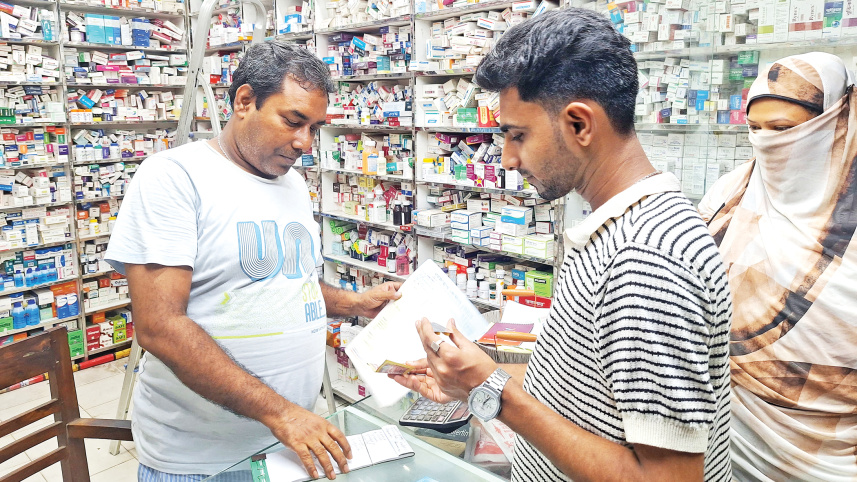
Bangladesh needs a medicine pricing system that keeps essential drugs affordable for patients while allowing local manufacturers to produce them profitably, experts and industry representatives said at a webinar yesterday.
They said the existing system has failed to keep pace with rising production costs, making some essential medicines commercially unviable and contributing to shortages. At the same time, patients are bearing most healthcare costs themselves.

The comments came at a webinar titled “Medicine Price: Arguments and Way Forward”, organised by the Power and Participation Research Centre (PPRC).
The discussion followed the government’s decision on August 3 to cancel the Essential Medicines List 2026 and Medicine Pricing Method 2026 prepared by the interim government. Until a new list is prepared, the government will follow the 1994 essential medicines list and pricing system.
The interim government had added 135 medicines to the essential list in January, taking the total to 295, following a taskforce recommendation. It also decided to fix prices for all essential medicines to make them more affordable.
After coming to power following the February polls, the BNP government formed a National Drug Advisory Council in June. The council was tasked with advising on the National Drug Policy, preparing a new essential drug list and updating it every two years, and developing the pharmaceutical sector to ensure the availability of essential medicines.
OUTDATED PRICES HURTING SUPPLY
Sayed Abdul Hamid, a professor at the Institute of Health Economics at the University of Dhaka, said the problem with Bangladesh’s essential medicine pricing system dates back decades.
In 1994, prices of 117 essential medicines were fixed using a cost-plus-markup formula covering raw materials, packaging, production, taxes, utilities and profit. But the prices were not regularly reviewed as production costs increased.
Some companies have since stopped producing certain essential medicines, while others continue to make them by using profits from other products to cover losses, he said.
Sayed called for an independent, data-driven authority to review prices regularly using reliable cost information.
Rumana Huque, a professor of economics at the University of Dhaka, said the stakes are high because Bangladeshis spend more than Tk 37,000 crore on medicines each year. Patients pay around Tk 35,000 crore of that amount directly, according to National Health Accounts data.
Government hospitals often run out of medicines within the first 10 to 20 days of a month, forcing patients to buy them from private pharmacies, she said. The problem is more serious in urban areas, where access to free medicines is limited.
Rumana also pointed to widespread self-medication and a lack of reliable data on import costs, manufacturing, distribution, wholesale and retail margins, and promotional expenses. Without such information, it is difficult to identify where costs and profits build up along the supply chain and regulate prices fairly, she said.
Kaiser Kabir, chief executive officer of Renata Limited, said strong competition and a relatively short supply chain have made Bangladesh’s medicine prices among the lowest in the world.
But that does not mean costly medicines are affordable for patients with chronic or serious illnesses.
A locally produced cancer medicine, for example, may cost around Tk 500 per tablet, compared with about Tk 30,000 for an imported version. Even the local price can be unaffordable for patients who need the medicine regularly, he said.
Instead of imposing blanket price controls, Kaiser suggested that the government directly procure expensive essential medicines and provide them free or at subsidised prices.
CALLS FOR TRANSPARENCY AND REFORM
Supreme Court advocate Jyotirmoy Barua questioned the transparency of the pricing system.
 For all latest news, follow The Daily Star's Google News channel.
 He said the government’s much-discussed pricing policy was never formally published, while the list of 117 medicines under the current framework has also not been gazetted.
The 1982 Drug Control Ordinance gave the government authority to set maximum medicine prices through gazette notifications. However, Jyotirmoy said the 2023 Drugs and Cosmetics Act appears to have limited that authority to medicines included in a government-published list.
He cited an example of a 50-tablet pack, without naming the medicine. A pack produced in August 2024 had a maximum retail price of Tk 600, while the same medicine produced a month later was priced at Tk 1,000.
“The issue is not about keeping prices frozen, but ensuring that every increase has a clear and accountable basis,” he said.
Mujshtuo Husain, an adviser at the Institute of Epidemiology, Disease Control and Research, said cancelling the February gazette on essential medicine pricing was a step in the wrong direction.
He said the revised system was better than the 1994 framework because it allowed the essential medicine list to be expanded and prices to be adjusted gradually to market conditions over four years.
Any concerns about the formula could have been addressed through consultations with manufacturers, consumers and other stakeholders, he said.
M Mosaddek Hossain, senior vice-president of the Bangladesh Association of Pharmaceuticals Industries, said local manufacturers now meet around 98 percent of the country’s medicine demand, including medicines for cancer, tuberculosis, malaria and HIV/AIDS.
However, stagnant prices have made some essential products commercially unviable, he said, citing shortages of Monocard 10mg.
He called for a joint review of the pricing formula based on affordability, quality, availability and the long-term sustainability of the pharmaceutical industry.
Moderating the webinar, PPRC Executive Director Hossain Zillur Rahman said the lack of comprehensive health insurance means most healthcare costs are paid directly by patients.
He said policymakers need to address four issues together: reducing patients’ financial burden, keeping the domestic pharmaceutical industry viable, developing an appropriate pricing formula, and ensuring the government fulfils its responsibility to make healthcare affordable, particularly for poorer people.
Comments