


Parliament scraps controversial bank ownership provision
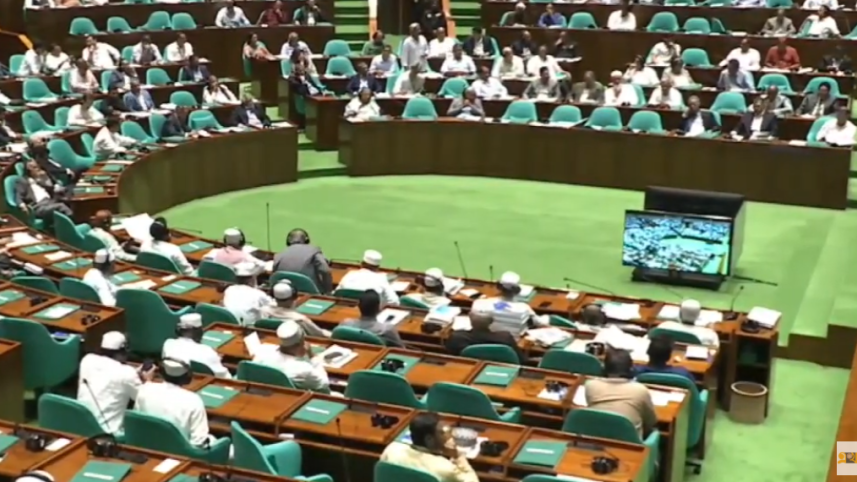
The parliament yesterday passed the Bank Resolution (Amendment) Bill 2026, removing a controversial provision that allowed former bank owners to regain control after they had been merged.
Finance Minister Amir Khosru Mahmud Chowdhury moved the bill, which was passed amid uproar in parliament after independent MP Rumeen Farhana criticised corruption and energy crises during BNP rule.

The bill removes Section 18(A) of the Bank Resolution Act 2026, passed in April.
The section allowed former directors or owners of merged banks to regain control by paying upfront 7.5 percent of the funds injected by the government or the Bangladesh Bank. They could repay the remaining 92.5 percent within two years, with 10 percent simple interest.
The provision faced strong criticism. The Bangladesh Association of Banks (BAB), which represents bank sponsors, called for it to be reconsidered, saying that allowing former owners to regain control of troubled lenders through a limited upfront payment could raise concerns about accountability, governance and moral hazard.
The earlier Bank Resolution Ordinance 2025, introduced by the interim government, aimed to address capital shortfalls, liquidity crises, insolvency and other risks facing scheduled banks.
Under the ordinance, five troubled Islamic lenders were merged into the country’s largest state-owned shariah bank, Sammilito Islami Bank.
In the bill’s statement of objectives and reasons, Finance Minister Khosru said the provision should be abolished because no individual or institution had applied under its full conditions since the law took effect.
During the debate on the bill, ruling party MPs protested loudly after independent lawmaker Rumeen criticised the BNP in her speech.
The MP said every government has a certain character.
“BNP comes to power, and there will be no gas or electricity crisis -- that cannot happen,” said the MP from Brahmanbaria-2. “BNP comes to power, and there will be no fertiliser crisis; poor farmers won’t loot fertiliser factories, that cannot happen.”
“BNP comes to power, and Bangladesh won’t become champion in corruption; that is impossible. BNP comes to power, and Bangladesh won’t top the list of loan defaults; that cannot happen. BNP in power means loan defaults reaching Tk 6.6 trillion, and so on,” Rumeen added.
Her remarks triggered chaos, with BNP MPs shouting in protest.
Amid the uproar, Rumeen said, “Such intolerance in parliament makes it feel like we are back in the Awami League era. Back then, when we criticised them, they too created uproar. Now BNP is behaving even worse.”
She further claimed that most MPs are known loan defaulters, recalling how candidates rushed to court before elections to clear their names.
When her allotted time ended, her microphone was cut off, but she continued speaking without it. Opposition MPs alleged that ruling party members hurled “objectionable words” at her.
Deputy Speaker Kayser Kamal repeatedly tried to calm the House, reminding members that every MP has the liberty to speak and that obstructing speeches violates democratic norms.
He urged the chief whip to maintain discipline, saying members should rebut speeches during their own turn rather than shout others down.
At one point, National Citizens Party (NCP) MP Abdul Hannan Masud was seen protesting. Masud insisted that no MP should be insulted with abusive language and called on opposition members to resist.
Opposition Leader Md Shafiqur Rahman asked whether Rumeen’s rights as an MP had been upheld, noting, “We couldn’t even understand what was said. Was it abuse or blessing? How will this be recorded?”
 For all latest news, follow The Daily Star's Google News channel.
 Chief Whip Nurul Islam Moni responded that parliament should solve problems, not create them, and urged healthy debate.
The deputy speaker reminded the chief whip that his duty was to keep order, not allow disruption.
Finance Minister Amir Khosru Mahmud Chowdhury lamented that the discussion had gone off-topic. “I don’t even understand what was said. This is unfortunate -- completely irrelevant debate.”
When the bill was finally put to a vote, ruling party MPs supported it with “yes” votes. The opposition remained silent, neither supporting nor opposing it.
Rumeen left the chamber during the passage of the bill.
Comments