


Predictable policies key to attracting FDI


Despite its large market and young workforce, Bangladesh trails regional peers in attracting foreign direct investment due to policy uncertainty, weak logistics and unreliable energy, according to Rupali Chowdhury, president of the Foreign Investors’ Chamber of Commerce and Industry (FICCI).
Foreign investors increasingly compare Bangladesh with competitors such as Vietnam, Indonesia, India, and Pakistan, where projects move faster, and government services are more predictable, she said in an interview with The Daily Star.

“Investors do not compare Bangladesh with its own past. They compare us with competing destinations,” Rupali said.
Her remarks came as FICCI launched its report, FDI for a New Bangladesh: Roadmap for a $15 Billion Vision, which argues that Bangladesh continues to lag behind its regional peers in attracting investment despite decades of economic growth.
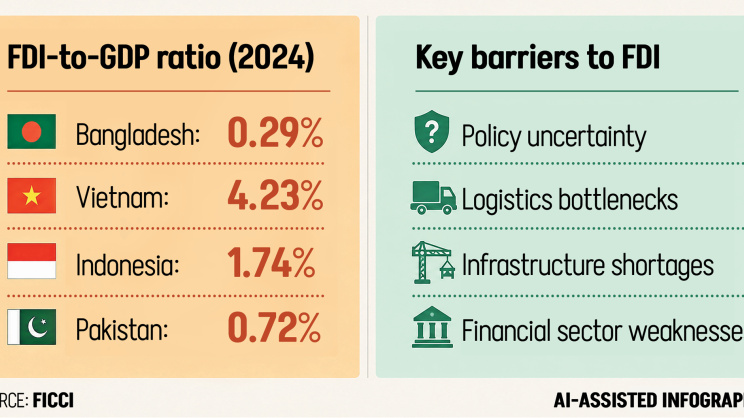
The report shows Bangladesh’s FDI-to-GDP ratio stood at just 0.29 percent in 2024, compared with 4.23 percent in Vietnam, 1.74 percent in Indonesia and 0.72 percent in Pakistan. It identifies policy uncertainty, logistics bottlenecks, infrastructure shortages, financial sector weaknesses, tax complexity and weak investor protection as the main barriers to investment.
Rupali said logistics remains one of Bangladesh’s biggest competitive disadvantages.
“It is not only about roads. It is the entire supply chain,” she said, referring to port congestion, traffic bottlenecks and delays in moving goods between Chattogram and Dhaka.
She said these bottlenecks raise transport costs and delay deliveries, undermining Bangladesh’s competitiveness. Addressing them requires better coordination among government agencies and sustained investment in transport infrastructure.
Another major challenge is the slow automation of public services.
Rupali said customs, regulatory approvals and other government services still rely heavily on manual processes.
“We need seamless automation,” she said. “If manual processes remain, businesses will continue to face delays.”
Automation must go beyond online systems by eliminating unnecessary physical interactions, she said. The FICCI report echoes this, citing lengthy approval procedures, overlapping regulations and poor inter-agency coordination as factors that increase costs and uncertainty.
Rupali suggested such reforms be designed and implemented in consultation with businesses.
“We have identified the problems. The government now needs to address them, while involving the private sector because businesses are the end users of these systems,” she said.
As an example, Rupali cited the Bangladesh Economic Zones Authority’s (Beza) limited authority to ensure supporting infrastructure and utility services in the industrial zones it allocates. “If one agency has to depend on several others to deliver services, investors continue to face delays,” she said.
She added that this lack of coordination increases uncertainty for investors planning large manufacturing projects that depend on timely access to utilities and transport infrastructure.
Rupali said reliable energy supply has become one of the first issues raised by prospective investors considering Bangladesh.
“If we cannot assure investors of reliable energy, it becomes difficult to convince them to establish new industries here,” she said.
The financial sector is another concern. The FICCI chief said high lending rates have significantly increased the cost of new investments.
“When borrowing costs rise to 14 or 16 percent, businesses naturally become more cautious about making fresh investments,” she said.
 For all latest news, follow The Daily Star's Google News channel.
 She also cited exchange-rate volatility as another factor making investment decisions harder, particularly for companies that depend heavily on imported machinery and raw materials.
According to the report, weaknesses in the banking sector, including high levels of non-performing loans and limited access to long-term financing, have further undermined investor confidence.
Despite these challenges, Rupali said Bangladesh retains significant strengths, including a large consumer market, an expanding manufacturing base and a young labour force.
She said global manufacturers are increasingly diversifying production under the “China Plus One” strategy, creating opportunities for Bangladesh to attract new investment.
However, those opportunities will not last indefinitely if competing countries continue to move ahead with reforms, she said.
The FICCI report notes that multinational companies now place greater emphasis on policy predictability, efficient logistics, legal protection and institutional quality than on low labour costs alone. It says countries such as Vietnam and India have strengthened industrial policies and logistics networks to capture a growing share of global investment flows.
Rupali said implementation is more important than announcing new policies.
“Bangladesh has many strengths. What investors want now is timely implementation, predictable policies and reliable institutions,” she said.
FICCI estimates that, if these reforms are implemented consistently, Bangladesh could increase annual FDI inflows from about $1.7 billion to $15 billion by 2030, raising the FDI-to-GDP ratio from around 0.36 percent to 2.5 percent.
The report says achieving that target will require sustained policy consistency, stronger institutions and closer collaboration between the government and the private sector.
Comments